Category Archives: Art

Threads That Weave Lives Together

Our lives are comprised of a series of patterns, interactions, and influences that combine in the most unpredictable ways as they come full circle.

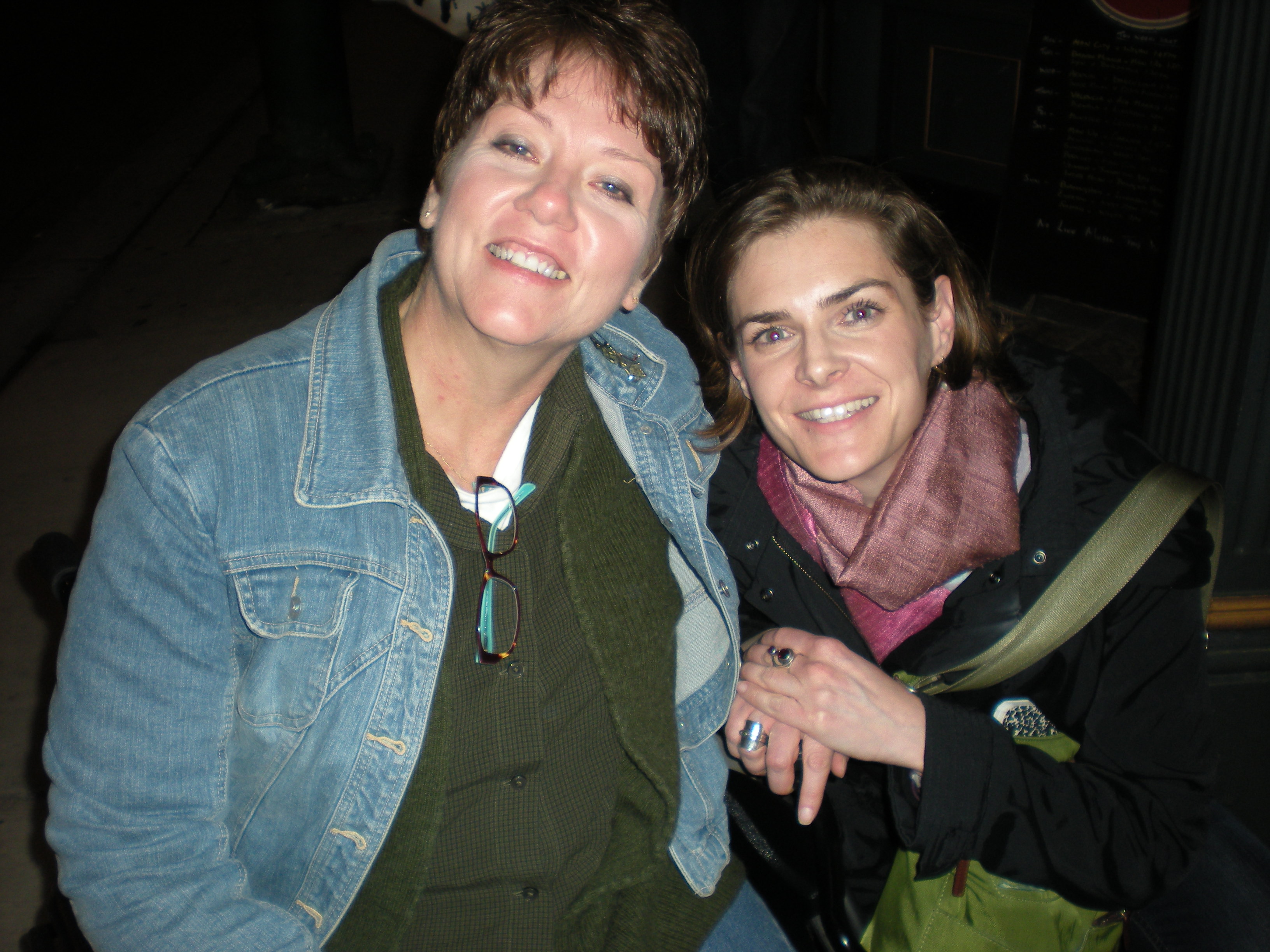
As a theatre practitioner, much of who I have become started through the relationship with my high school drama teacher and dear friend, Tina Croghan.

Tina & I in Chicago after a night out. When I lived up there, she and Tim visited regularly.

Tina & I in Chicago after a night out. When I lived up there, she and Tim visited regularly.

Tina was diagnosed with Spastic Paraplegia several years ago, and began working with the Spastic Paraplegia Foundation (SPF) soon afterwards. Since joining, she has taken on hosting conferences in St. Louis and has devoted tremendous time and effort in support of SPF. This week, Tina and her husband, Tim, are in Seattle, WA for the SPF conference. 

Right now, all of the proceeds of items sold in my Etsy shop will be donated to SPF.  Here is a direct link to the shop: https://www.etsy.com/shop/ZenUrbanCoyote

Theatre has been a part of my life even before meeting Tina, but it was because of theatre that I began working with textiles. While directing a theatre production of The Seagull a few years ago that had a spare budget, I began piecing together tablecloths, curtains and other items for the play by hand. After the play closed, I turned them into quilts — including the purple one that has become part of the “ZenUrbanCoyote” identity. The process of repurposing and transforming something so simple– and that somehow carried so much meaning — was the start of a new investigation into what it means to create.

A year later, at the rehearsal for Tina’s retirement party, I found myself stitching on one of the Seagull quilts, contemplating the irony that we had done the musical Quilters together while I was in high school. Tina and Tim ran our drama club like a family, and those of us who were a part of it continue to think of one another that way to this day. 

For more information on Spastic Paraplegia and the extraordinary research that is taking place on this rare and debilitating disease, please visit: www.sp-foundation.org.

Cloth, Stitches, and Simplicity = Breath and Space

Since winter has finally decided to settle in, and doing any building in this weather is no longer possible until it lets up, it’s a perfect time to share something else that is very near and dear to my heart:  stitching cloth by hand.

While the tiny house building takes a break, it’s a perfect time to share some of the stitch work that has been taking shape over the winter. It isn’t that I had given it up while working on the house — far from it. 

When I started this blog up originally, it was to write about and share textile projects, theatre and movement projects, writing, subversive ideas, and anything Zen or Buddhist-related. The tiny house started becoming the primary focus of the blog somewhere along the way, and everything else — despite its continuation as part of normal, everyday life — has taken a back seat on the blog.  

In all honesty — it’s a relief to have a break from the building work and to settle into greater space, quiet, and other aspects of life. During the winter, few things can beat sitting in the warmth and stitching on something in the evening. It quiets the mind and creates space to breathe and contemplate; not just the piece being worked on, but with anything that arises. When the urge to stitch arose a few years ago, seemingly out of nowhere, it began with simplicity and organic process. After taking a few years to play and explore in a wide variety of directions, the simplicity of cloth, a needle, and thread continues to be a tremendous source of joy, creativity, and provides a space for contemplative insight.  

The instant that an outcome or result enters the picture, the joy, space, and creativity dissolve, and I may as well be designing a spreadsheet in Excel. This is the one place in my life where things can be 100% organic, fluid, relaxed, and entirely free from expectation. A sanctuary.

During the tech process for A Christmas Carol last November, I knew that it would be wise to keep my nervous system grounded and slowed down with a piece of stitching at hand. Recognizing that it would need to be something that I could drop at a moment’s notice and play with in poorly lit conditions, I started with assembling scraps into tiny collages.

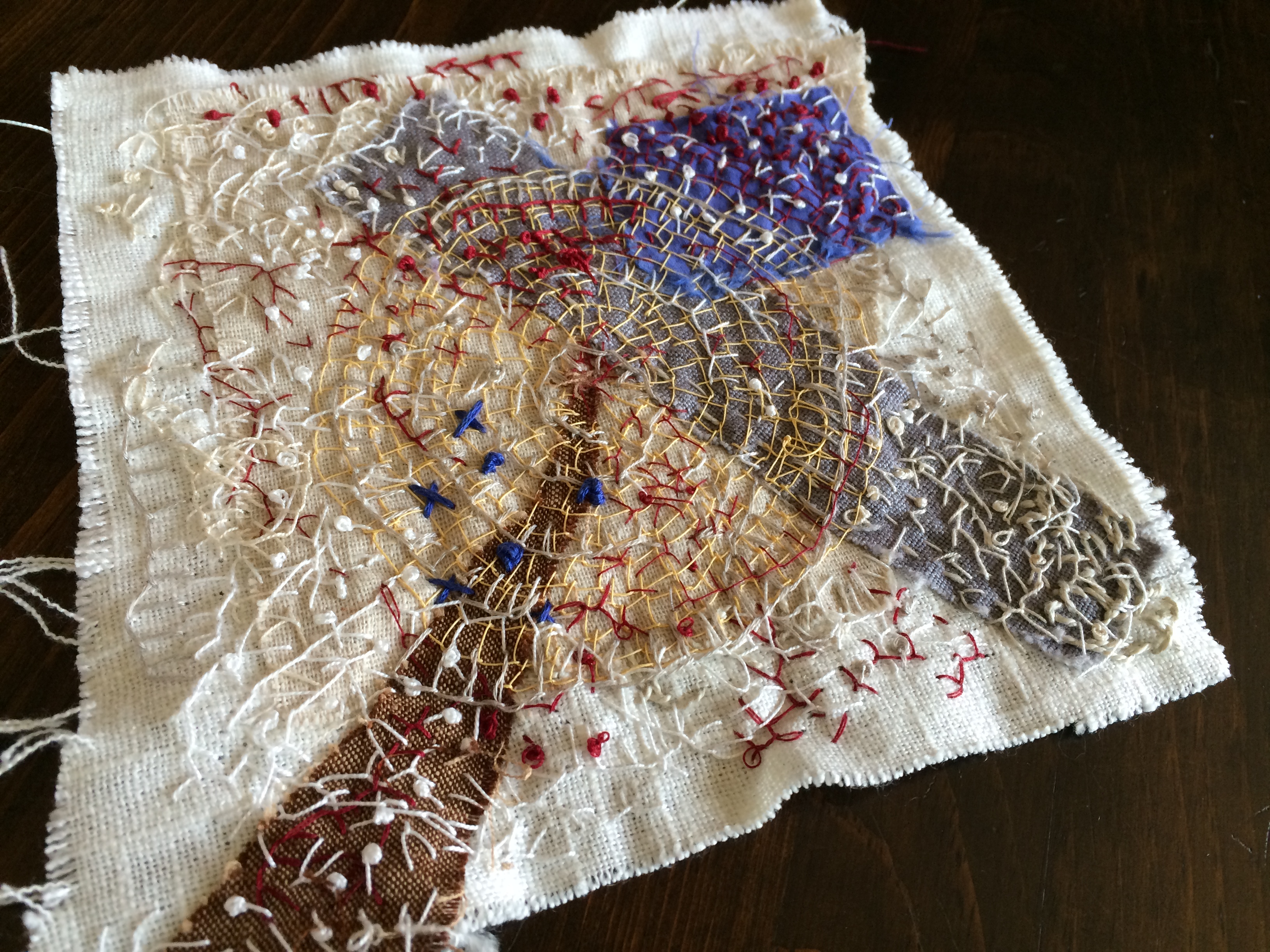
This was the piece I started with first:

"The Missing Piece"

“The Missing Piece”

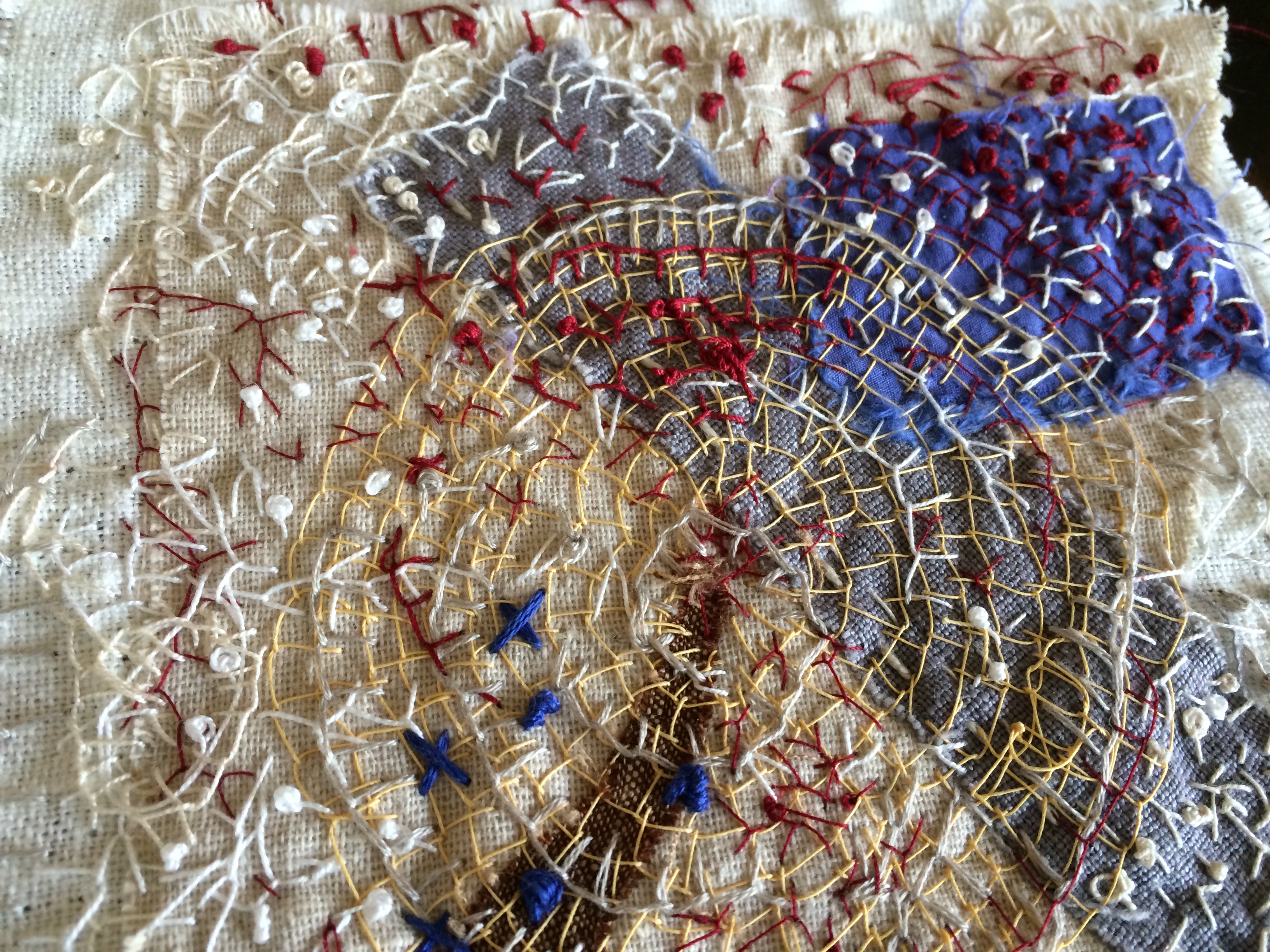
"The Missing Piece" Detail close-up

“The Missing Piece” Detail close-up

I call it “The Missing Piece” because it reminds me of the shapes from the story book by Shel Silverstein. It’s also because as soon as I started working on it, I realized how much I had missed the tactile simplicity of stitching something. The impact of it is instantly beneficial and calming.  Working in a circular fashion is also very soothing, as is the pleasure of changing the stitch at a moment’s notice, breaking every known rule imaginable, and just playing until that particular thread runs out. The inspiration to work that way comes from the fiber artist Junko Oki, and her trademark technique, “Woky Shoten”, which means “unbroken stitch”. It’s incredibly fun and freeing. (There are several more to come in another post!)

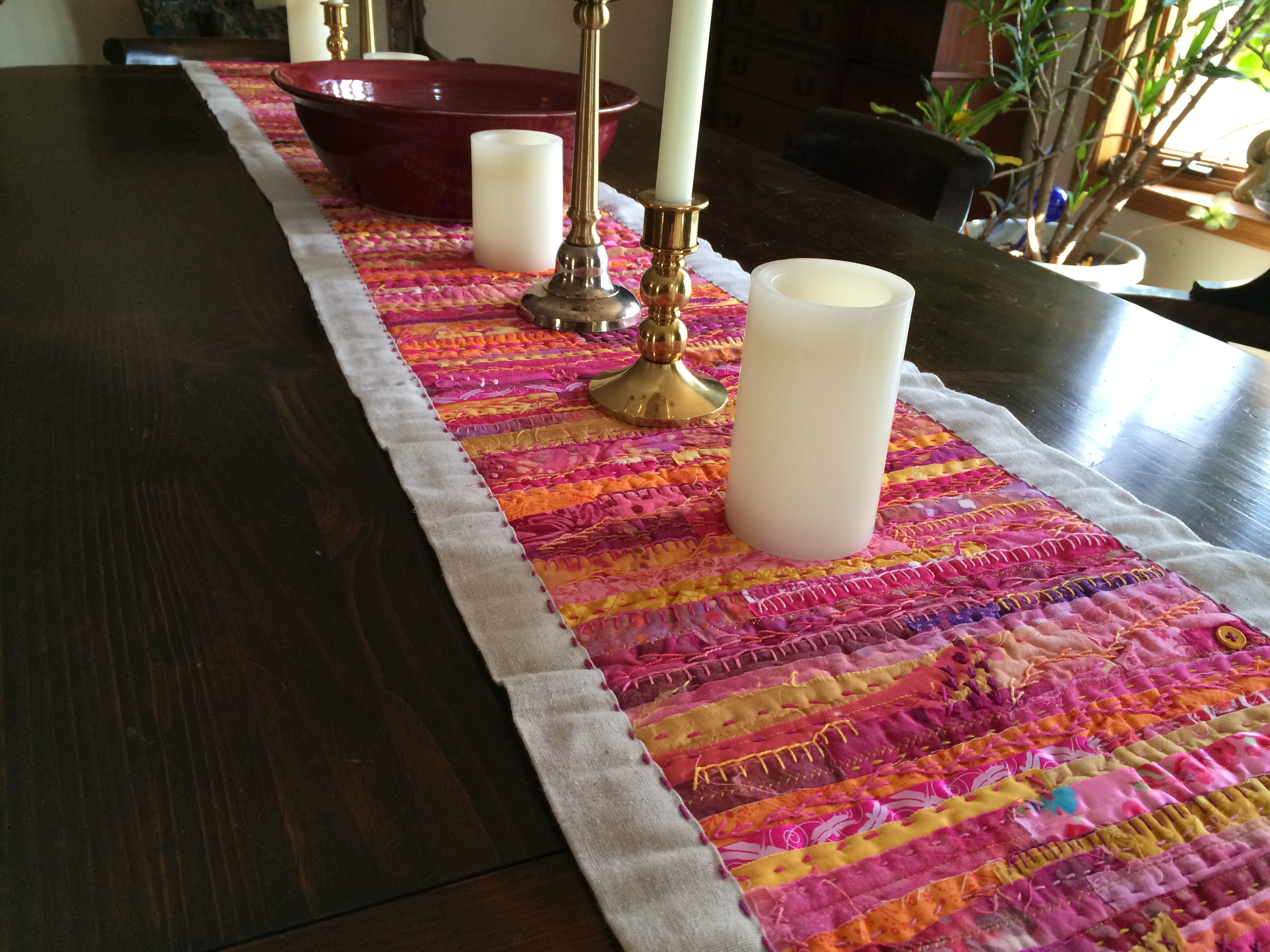
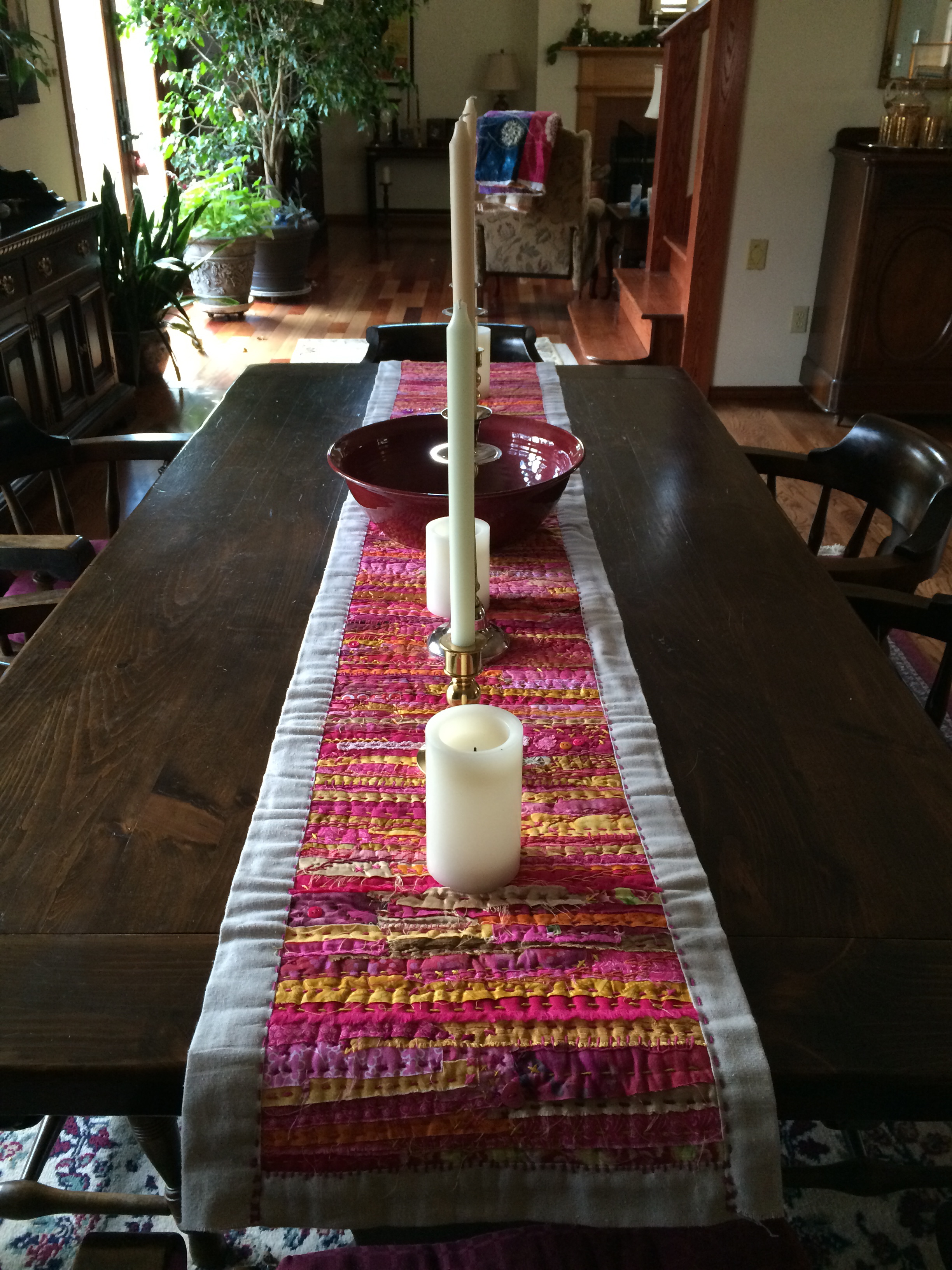
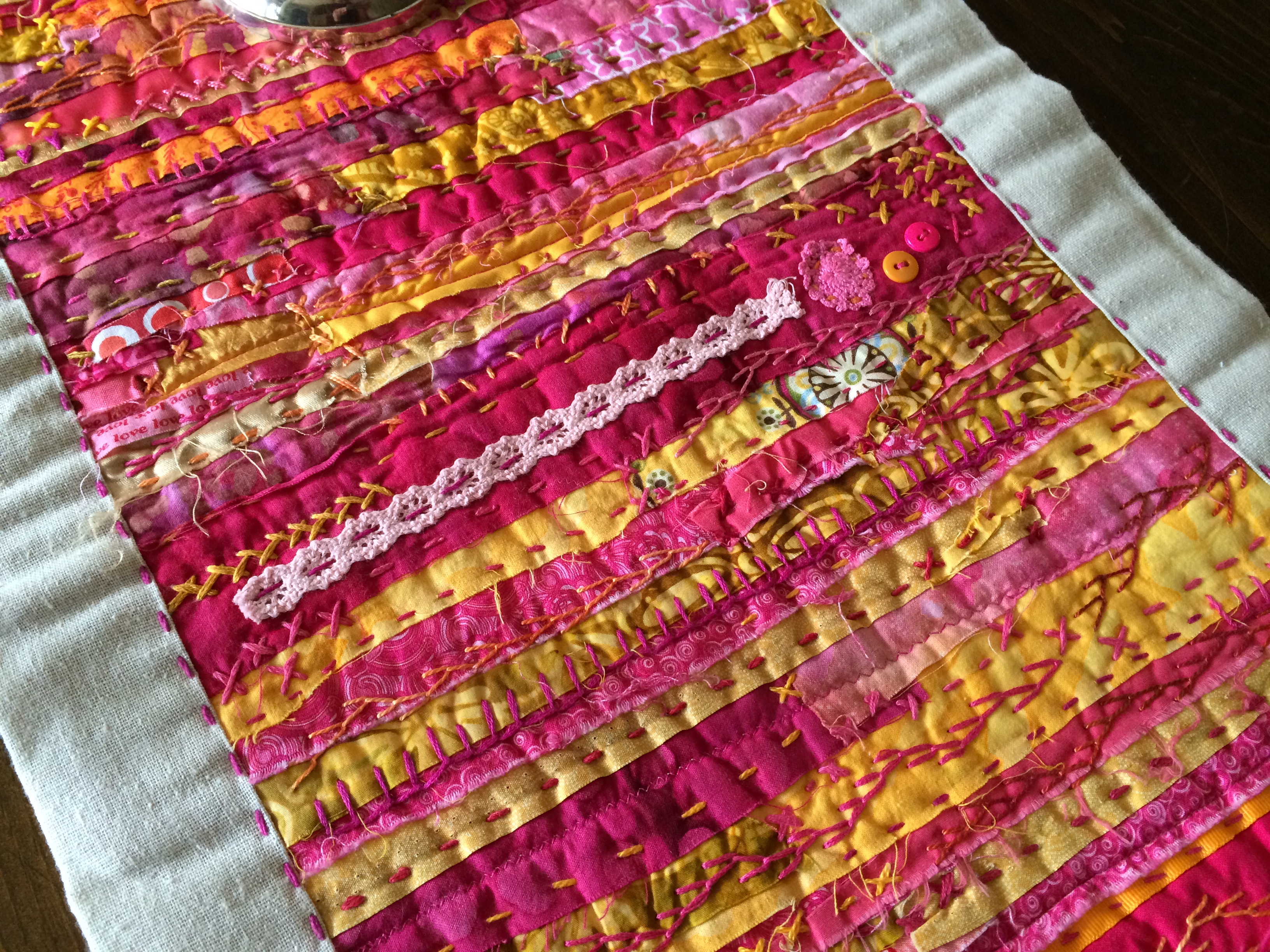
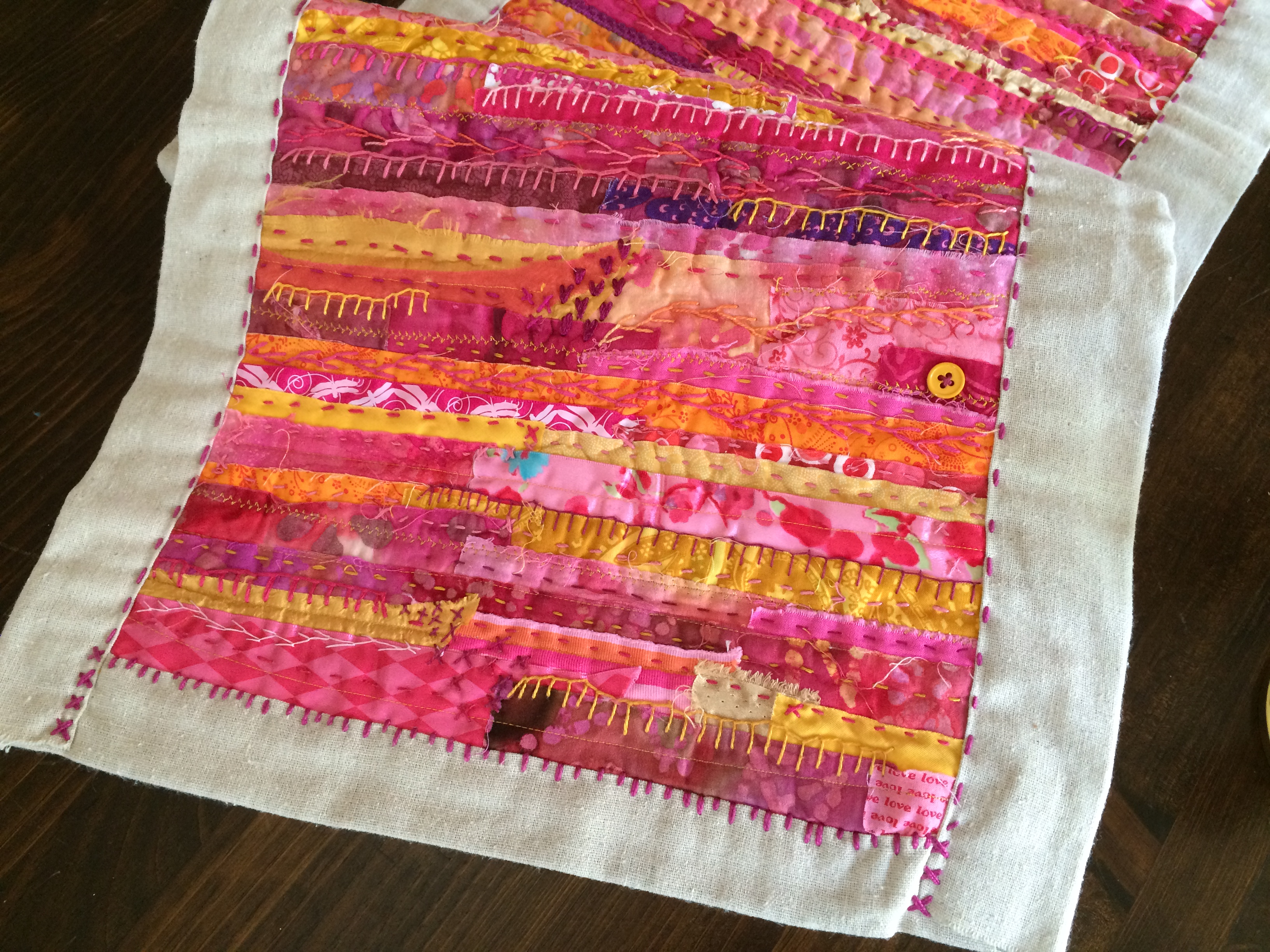
As Christmas began approaching very quickly, however, I remembered a table runner I’d started for my mother back in 2012, but had never finished. At the time, it felt like too much stitching (you’ll see why in a minute!), so I put it away for a while. It was another perfect piece to work on during tech rehearsals, and turned out beautifully. I love it; and I’ll probably never make one like this again:

Sunset Table RunnerIMG_4951 IMG_4924 IMG_4939

The table runner matches some of her hand-thrown ceramic bowls, so she was thrilled. It’s covered in kantha stitching, blanket stitches, feather stitches, french knots, and heart stitches (which I made up). The strips of ribbon, selvages, and other scraps are fused to the batting. . .making for very stiff stitching and sticky needles. Now that I have a greater familiarity with different ways to fuse fabrics for collaging and stitching, doing something similar in future could be a much more pleasurable experience.

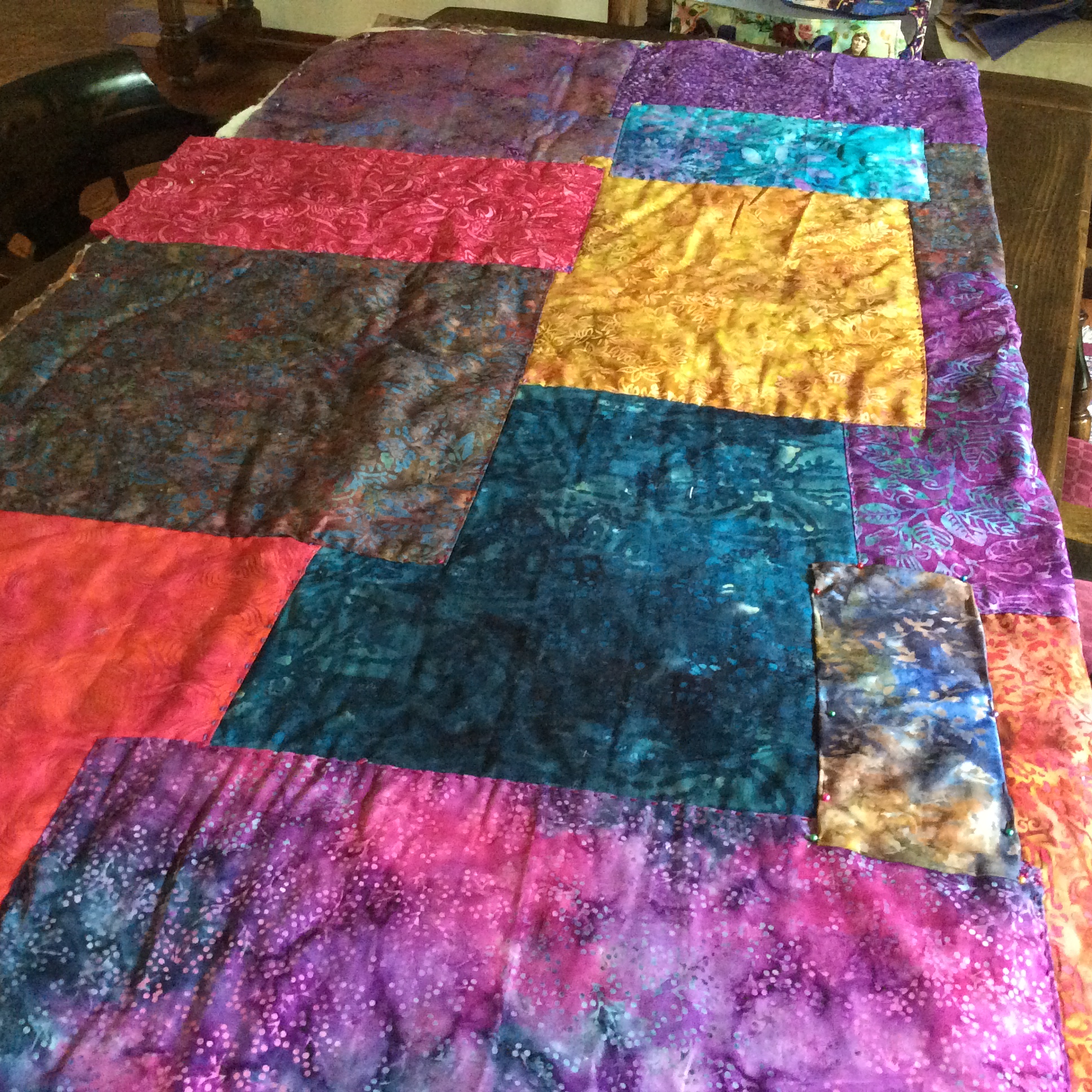
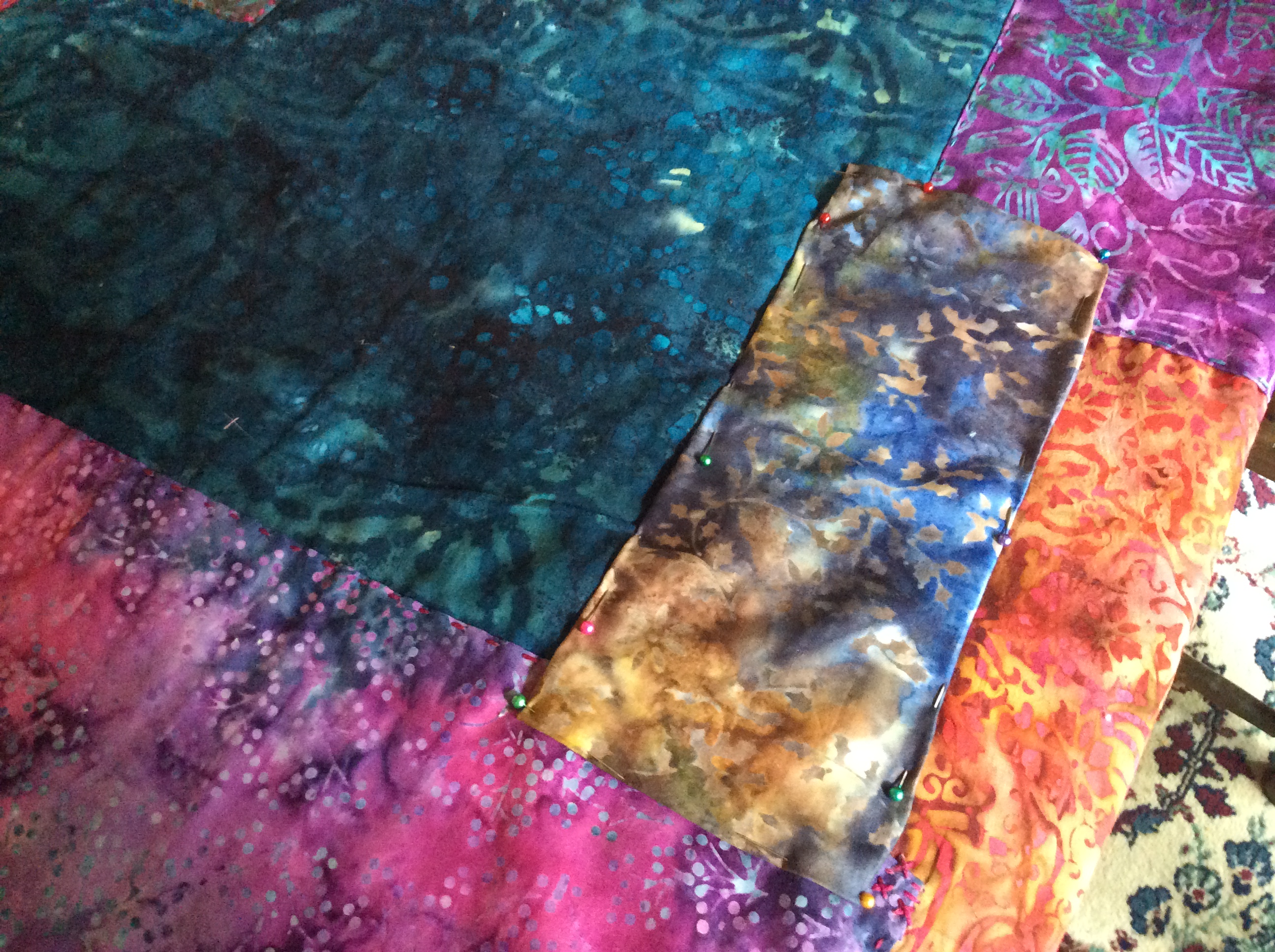
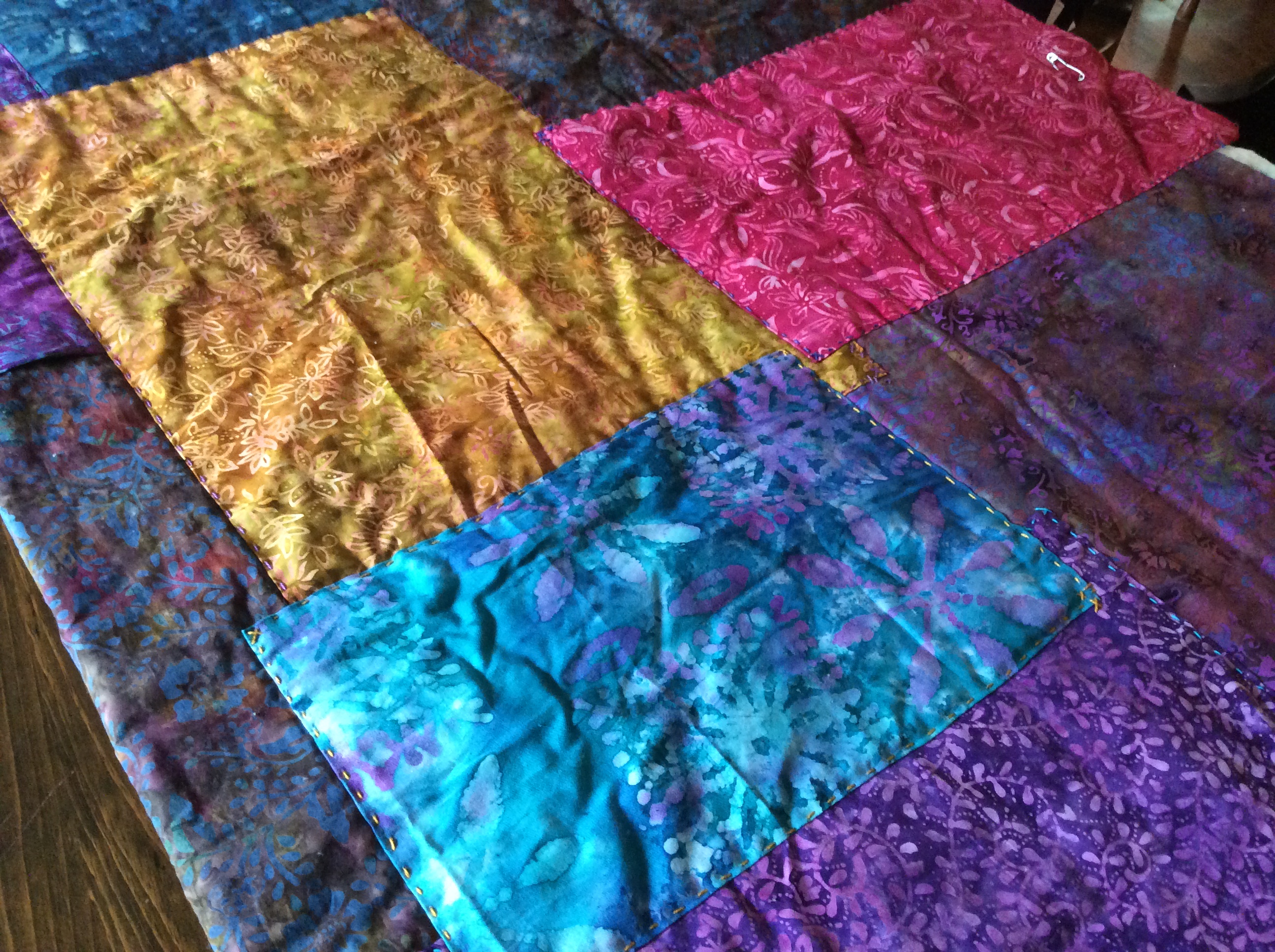
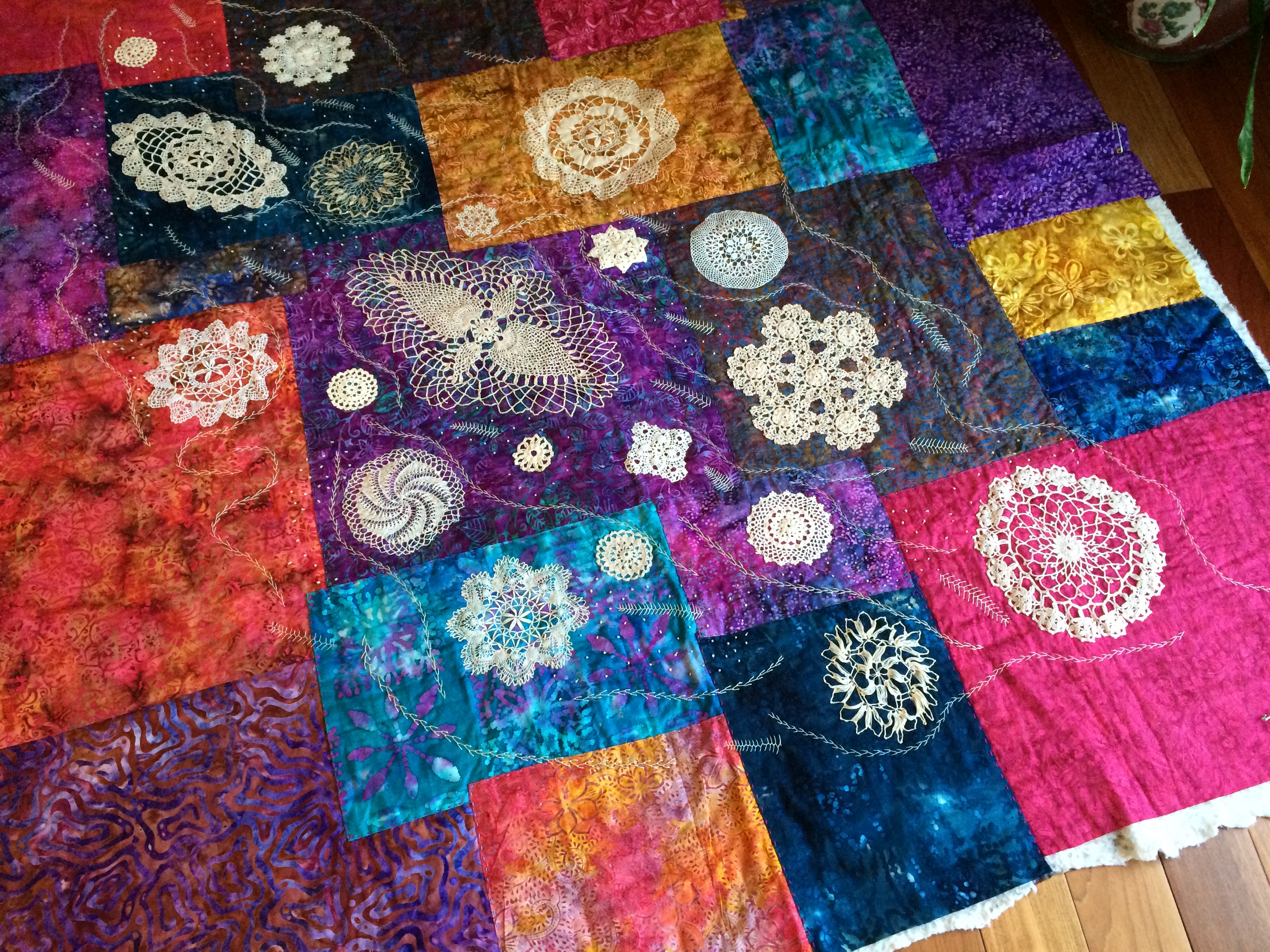
And finally, there is indeed a quilt that is taking shape slowly over the winter months. I have no idea what it will be called. Right now, there is joy in the color and playing with the stitches.

IMG_0385 IMG_0386 IMG_0388


This is another of what I refer to as a “boro-style” quilt. “Boro” means “rag” in Japanese, and traditionally they are stitched together to make quilted blankets. They’re very simple and often breath-takingly beautiful. This particular one is not making use of indigo-dyed, upcycled fabric scraps, it’s made from store-bought commercial batik fabrics. (I’m uncomfortably aware of the cultural appropriation taking place here, and its dissonance when contrasted with white, western privilege, so it’s transparently “boro-style” in this case.)  The process itself is pretty straight-forward: I choose the fabric for the backing, do any measuring and stitching, and then trim the batting and secure it to the back with basting spray, which creates a blank slate. Once the batting is secured to the back of the quilt, it’s possible to begin laying out patches of fabric and stitching them directly to the back of the quilt until it’s all covered.

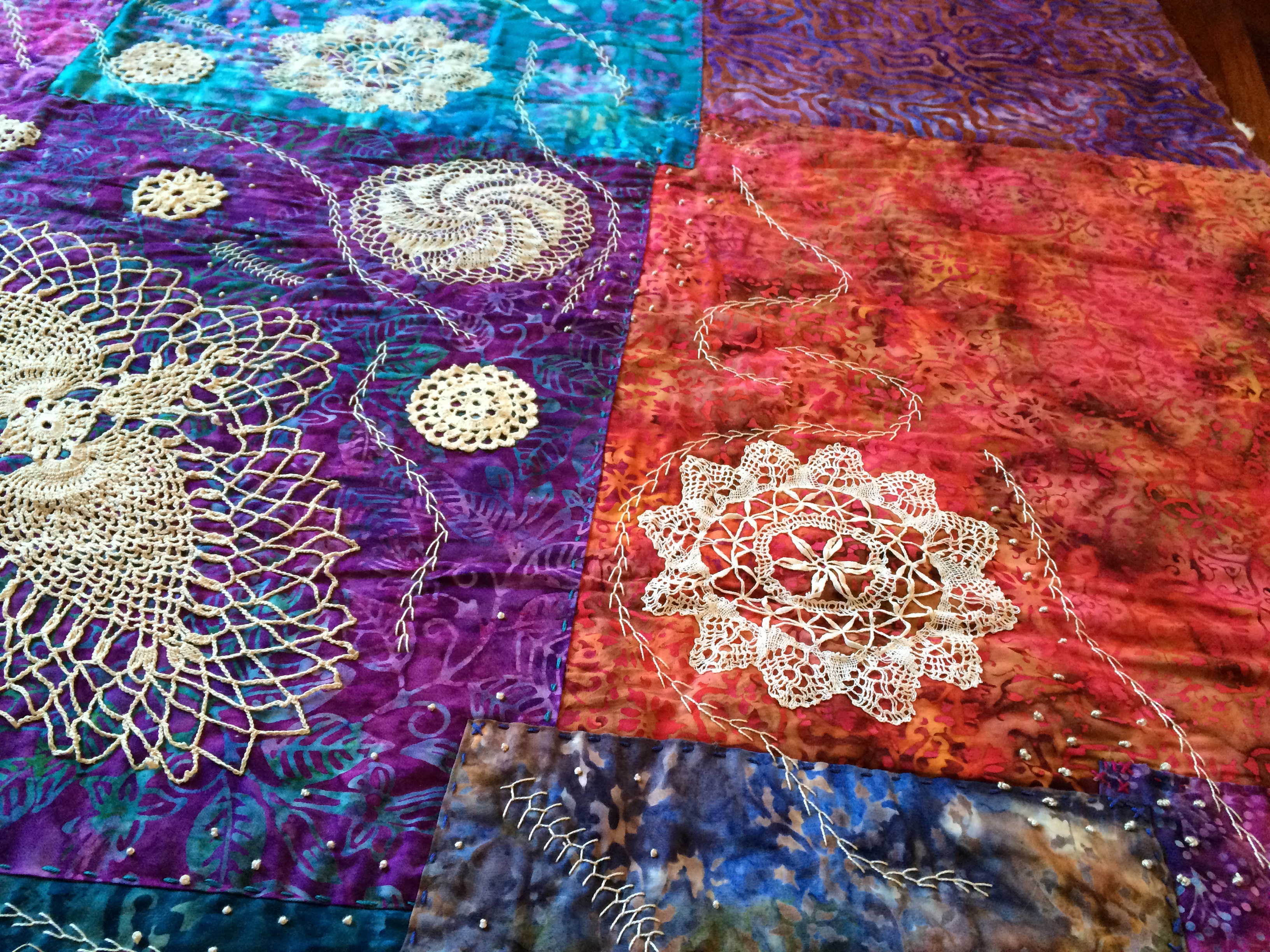
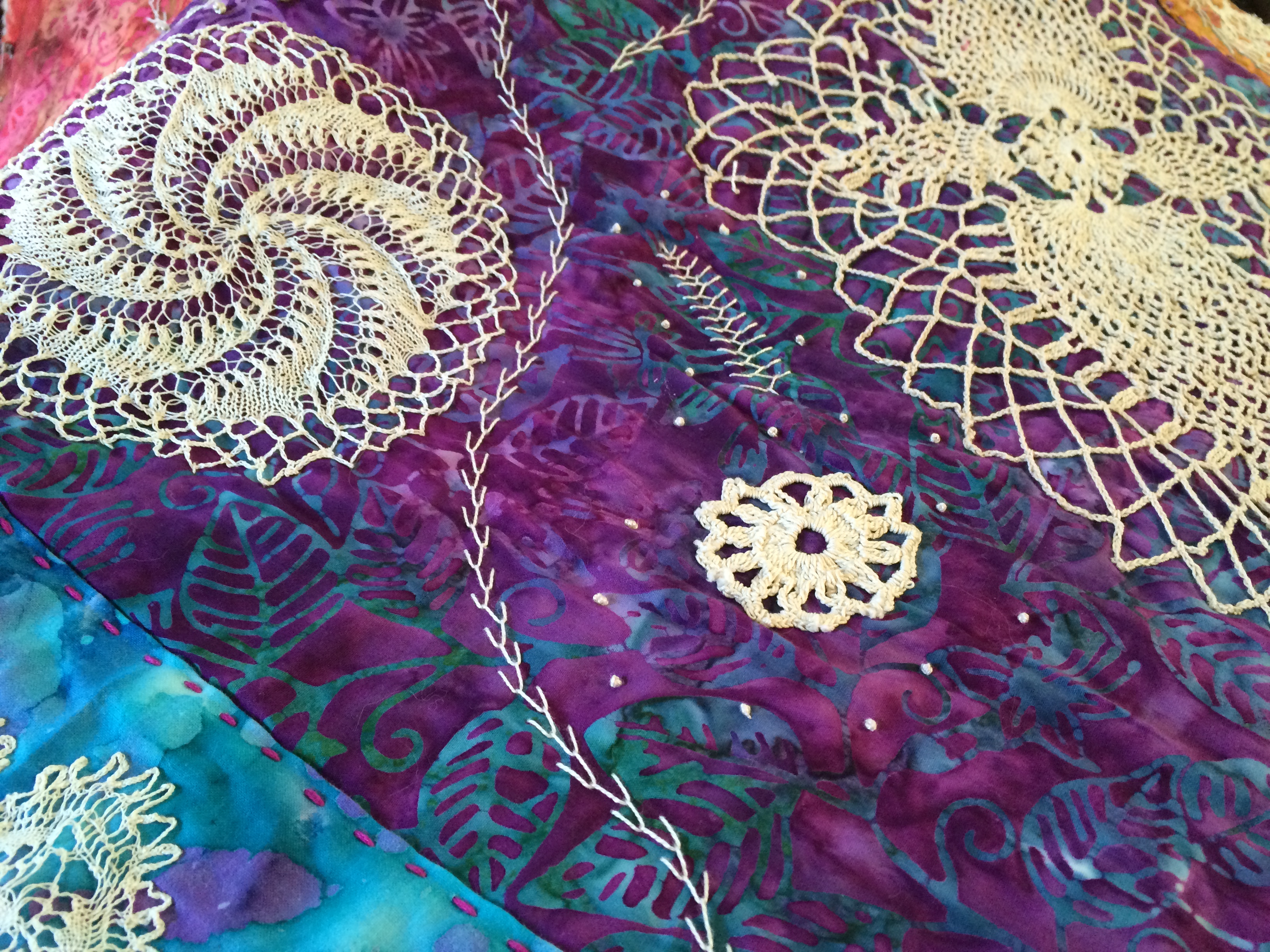
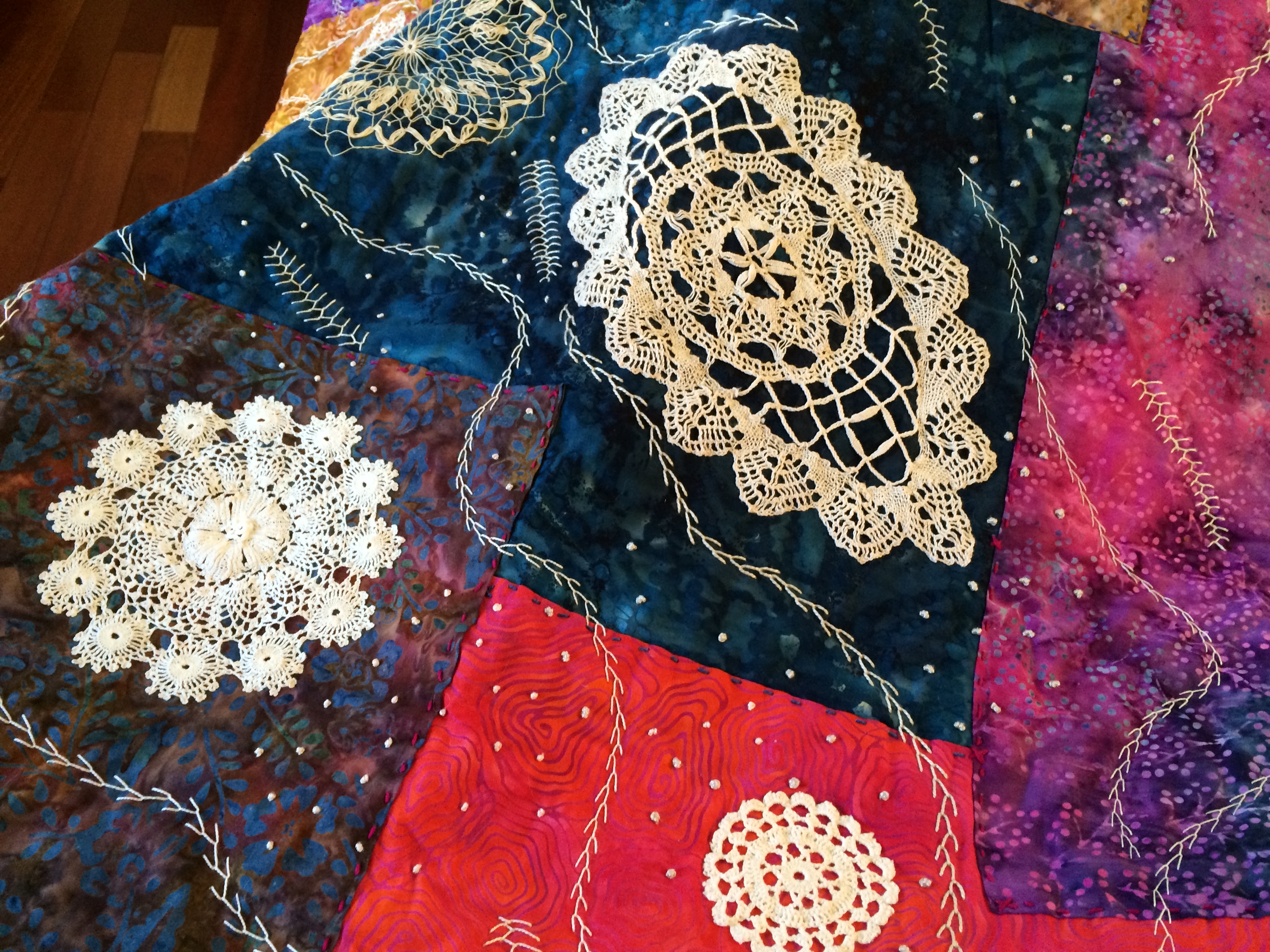
Usually, the covered quilt, too, feels like a blank slate, and more quilting is needed if the patches are as large as these. For this quilt, I decided to use some old hand-made doilies collected from antique shops, estate sales, etc, and stitch them directly onto the quilt. 

IMG_5045 IMG_5033 IMG_5049IMG_5036

The stitches used are feather, cretan, and french knots. I like using embroidery floss and perle cotton for stitching, and I tend to use long, sharp darning needles for the job, although it depends on the weight of the thread. With many layers to stitch through, a heavier, longer needle is often really useful. It cheers me no end to work on this one. Batik fabrics are so pleasingly saturated with color!

None of these projects required stitching on a sewing machine, though some of the others this winter have. This is enough for now, however. More to come another time.


Valuing Things for What They’re Worth

It’s been a while since my last post, and although there are many things to write about and share of late, this seemed equally as worthy of sharing as anything else.  I haven’t yet written much about my artwork yet, but this customer experience just taught me a lot more about what to expect when selling it.

Dear Customer,

Now that your money has been refunded and you have had a chance to have your say more than once now in our dealings together, I would like a chance to have mine.

Let me be clear: I am an artist and craftsperson who, similar to you, works very hard for a living at a point in time when every dollar counts, and time is hard to come by. I put my artwork and crafts on Etsy, which is for people like me, because right now it is not possible to earn my living from my art alone. I make very little money doing this — if, indeed, I make any money at all. Most artists don’t either, unless they’ve found a way to circumnavigate the rules on the site and have their stuff produced at a cheaper cost.

Customers who are likely to say “then don’t do it” are the reason why most artists and artisans in this country have stopped working, selling/making their art, or continue to do it, but then have to have 1 or 2 other jobs to stay solvent: the labor to make things like your bracelet gets shipped overseas and is paid at a very low hourly wage. I have heard many people argue, with good reason, why buy “real art” or artisan made stuff if you can get something “just as good” at Target? Why indeed. In that case — then please just go to Target (or HomeGoods or Walmart) and buy what you want there to decorate your home, or wear on your body. PLEASE don’t purchase it from an artist, whose time, skill and materials are something we’ve all been conditioned not to value.

We don’t, as a society, value labor. It’s something to ship overseas where poor people (who I guess we believe should feel lucky to be employed?) can just do it for cheap wages. As consumers, we just want a good deal for our money so we can consume even more and have things exactly as we want for the precious life’s energy we’ve poured into earning a meager living. Believe me — I totally get it. I really do. I live in the same society and have been conditioned similarly. Let’s face it — you could easily purchase what you are looking for at half the cost if you were to buy it on amazon, target, etc.

If I were a big warehouse operation, getting you what you want for a good price would be my job, as would customer service. I would simply pick up another bracelet from the hundreds in stock and send you a new one and no additional cost and find it easy to be kind, friendly, quick, communicative, etc. — because I would have no part in the making of or production of the item I sent to you. I would not be out any money or time of my own in order to do it, either.

So my recommendation is to do that from now on, and please don’t order anything further from Etsy or another site with those behind it who are actually doing the labor themselves, and who take pride in their work. You aren’t in a position to appreciate it, and the result is a frustrated customer and many frustrated artisans.

Here’s why: It would appear that you must’ve purchased several items from Etsy in search of one that fit what you wanted. The reason I know this is that you emailed me, in advance of your bracelet actually arriving, to tell me how unsatisfactory everything else was that you had purchased, and expressing your disappointment to me, saying that they looked like “kids bracelets”. My only guess is that you were attempting to prepare me for what you thought would be an inevitable rejection.

Amazingly — you liked the bracelet I made for you, but it broke. Although I offered to repair it for free, you insisted not only to pay for the repair (which I didn’t require), but that I use a different type of thread that you believed to be stronger. In order to get what you wanted, you then had special fishing line sent to me at great expense rather than trusting me to know my own work and materials. I haven’t had a single other bracelet like that one break yet, so I can attest to it being a strange fluke. Several people I know wear theirs and have had them for some time — still perfectly in tact. The thread, clearly, is a large part of what made it beautiful, no? Yet despite not being able to use the thread you sent and still providing another solution for you, it is now “the ugliest bracelet you ever saw”, and you just want a refund. I have now provided that to you, which seems like the only reasonable solution — in this particular case.

Although I appreciate your honesty about hating the bracelet and thinking it’s ugly (I tend to value honesty more than hot air) — I also have to admit that it was insulting and not pleasant to hear. The bracelet was ugly because you would not take the advice or expertise I offered to you, and because of my efforts to make things right and closer to what you were asking for.

You have lost little in this transaction besides frustration, time, and a few bucks in shipping when you sent the bracelet back for repair. Since I returned your fishing line to you (which I could not use) and its shipping papers so that you could return it and get a refund, you will hopefully not have lost any money there, either. You also have an ugly bracelet of your very own.

On the OTHER side of this, I am now out cost of the bracelet and its components, which had to be special ordered to make for you since you were ordering a custom-made piece rather than the one shown, which was already made and ready to ship. That also meant purchasing more than the amount of components I would need, so I am out that amount as well. I am out the time that it took to make the bracelet TWICE, and answer all of your emails. I am out the shipping costs, too. In fact, I am easily out far more than the cost of this one “ugly” bracelet.

I have also decided to stop accepting custom requests and to change my shop’s information now, because I keep encountering customers who clearly have a different expectation of what they should be entitled to in their dealings with me than what I am actually able to offer them. You are not the first, just the tipping point for this decision.

I hope, at the very least, this rather lengthy discourse has made it clear why this arrangement between us didn’t go well, and may hopefully, in future, bring you closer to what you actually want. In all honesty, I also hope it opens your eyes a little wider to consider what and how you consume, but it’s actually not my place. I find it hard to keep my mouth shut about certain things these days, but seldom do I ever wish anyone anything but what makes them happy. Do what makes you happy, and at least try not to abuse the time and efforts of others through a lack of awareness. It will save a lot of time and energy for those concerned, including you.

Certainly you taught me a great deal, and opened my eyes to many aspects of dealing with people over the internet that I hadn’t put enough time and effort into. I will be changing my business practices accordingly. As far as that goes, I am at least genuinely grateful for the lesson.

Warmest regards,

Natalie