Author Archives: Jeongyu Natalie Turner-Jones

Unknown's avatar

About Jeongyu Natalie Turner-Jones

I am an artist, teacher, and Buddhist practitioner currently based in the Midwest. As an artist, I work in the theatre as a director, movement specialist, occasionally as an actor, and most often as a teacher. I also work with textiles, fibers, ceramics and mixed media as a visual artist. Right now, I'm in the process of building my own tiny house on wheels, which I hope will offer greater freedom to pursue a life of service to others and making art.

Retreat Journal Part 2

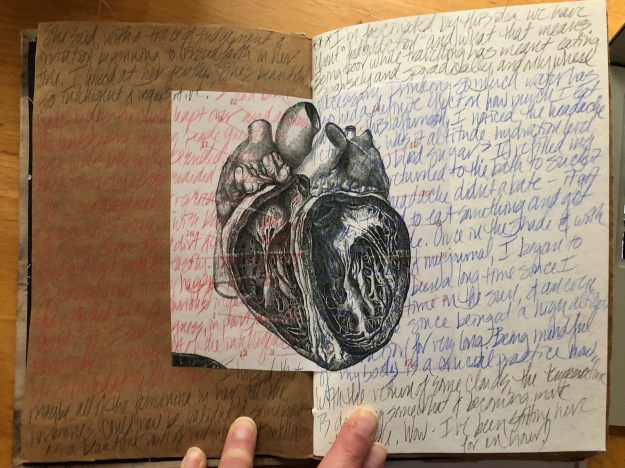
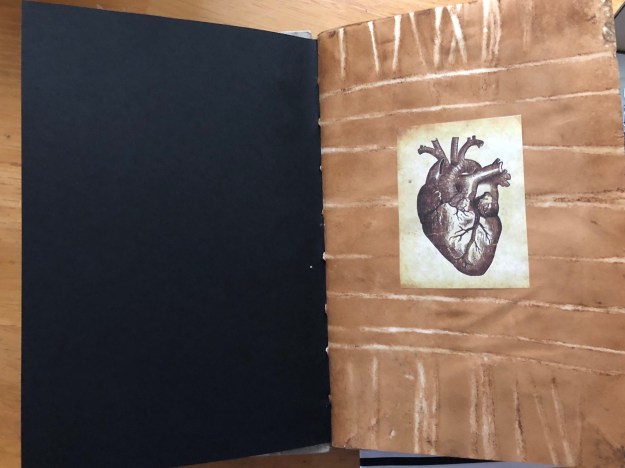
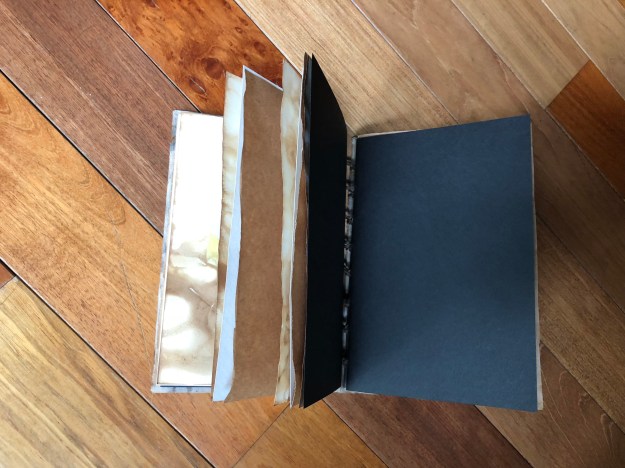
And on the inside. . .

IMG_6896

The colors are reversed; blue should be on the left, I think, and red on the right if I’m representing veins and arteries. . .I didn’t decide to use blue until I got to that page.

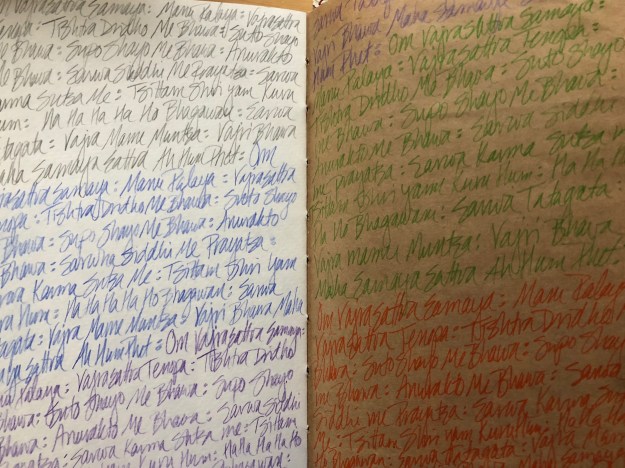
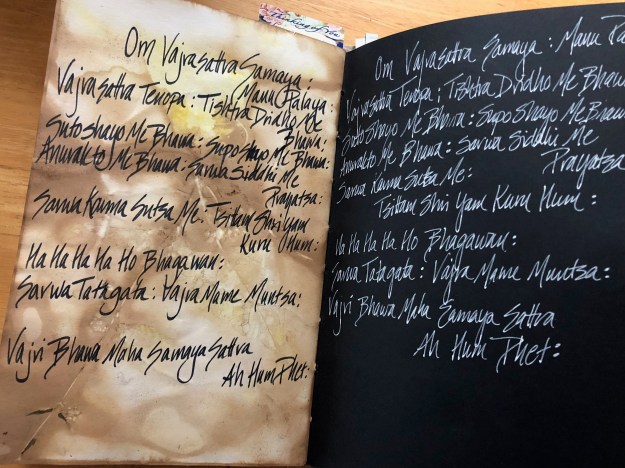
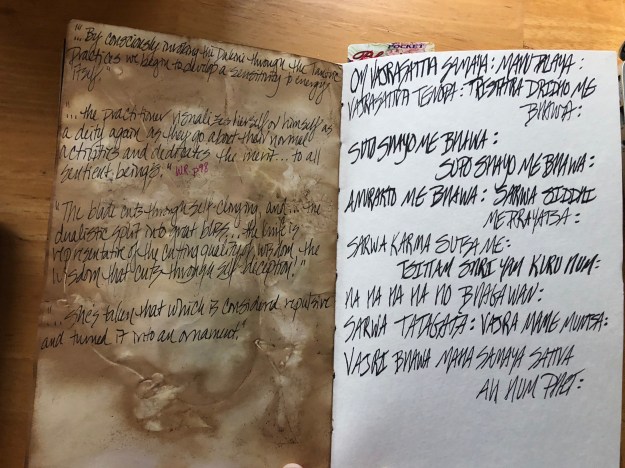
There’s also the efforts at learning the 100 syllable Vajrasattva Mantra. Copying mantras in writing always helps me to learn and contemplate them more deeply.

IMG_7890IMG_4229

IMG_1419

“. . .she’s taken that which is considered repulsive and turned it into an ornament.” — Lama Tsultrim Allione

Then there’s the note-taking that went on during the retreat itself — a big adjustment. Zen practitioners don’t tend to engage that on retreat, but this was more of a teaching/learning retreat. Getting the practices transmitted and solidified within a specific context and background. There was a lot.

IMG_7243

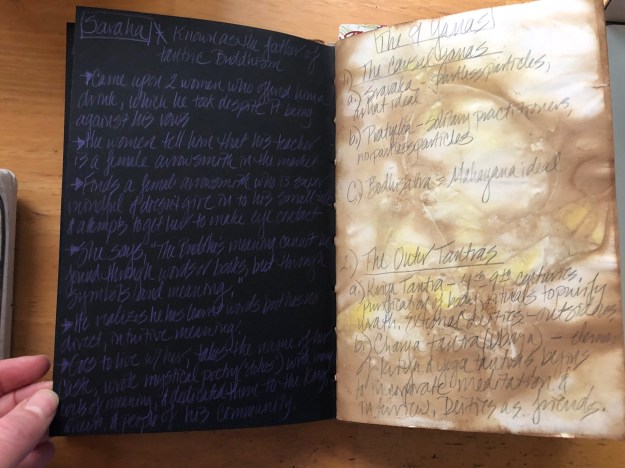
The overview of the story of Saraha and learning about the 9 Yanas

IT was a lot. And very necessary.

IMG_1274

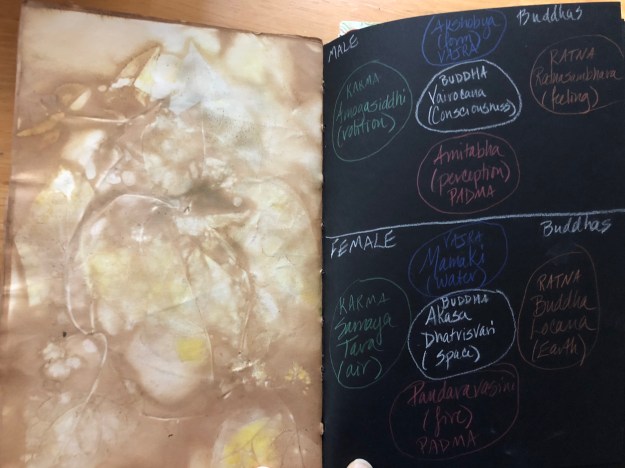
Learning the names of the Samayasattvas and their place within the mandala practice. . .

Sometimes it feels right to leave a page blank. Maybe I’ll come back and fill it in with something.

IMG_9591

The first two pages

Or not.

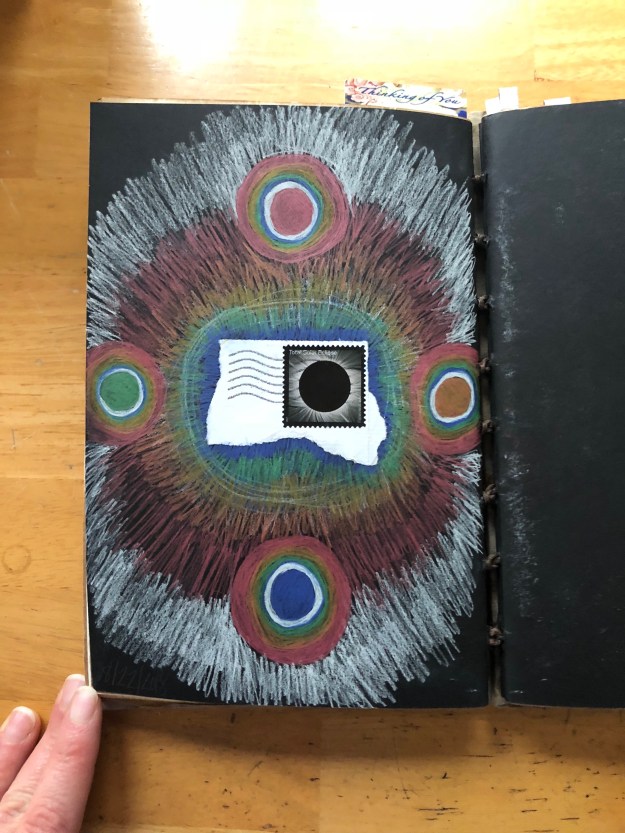
I’ve also begun playing with mandalas. Trying them on for size. I realize I’ve been incorporating mandalas into many things I work on for years now. I love the roundness. The completeness.

This mandala was a response to a post from the Tara Mandala Center about Brooding.

IMG_7351

There’s been a lot of that going on this summer. Many, many reasons.

IMG_2229

The quote essentially went on to point out that sometimes brooding is necessary; it often happens right before a tremendous time of growth, creative inspiration, or spiritual breakthrough. This has been my experience, too. Sometimes a reminder makes all the difference.

I  love the way the tone of a subject can shift from cool to warm in a heartbeat.

Just the slightest tilt in angle, and the feel is completely different.

Retreat Journal Part 1


I have made a lot of books over the last year. Some as commissions, some for a larger body of work, and of course the annual planner that my friends and students enjoy with me. I forget that it’s unusual and recently took it to a job interview. It became an immediate icebreaker.

This is the 2018 planner below:

I rarely make a beautiful book just for my own use as a journal, however. I don’t know  why. As in love as I am with all things books, I struggle with the process of journaling in a “beautiful” book. It’s hard to roll with the process as easily when I’m considering form,   content, writing, etc. Generally, when I write, I’m composing, so I do it on the computer and consider it writing instead of journaling. . .even though it’s really both.

Books as journals and books as art form, however, are two different practices entirely. And journaling in a book instead of on a laptop is yet another major shift in process.

Shifts are good. I needed one.

I decided to create a new journal for myself for a retreat this summer. Away from technology and immersed in natural environments, it seemed like the right time to engage in journaling as a practice. No other retreats I’ve attended encouraged journaling until this one.

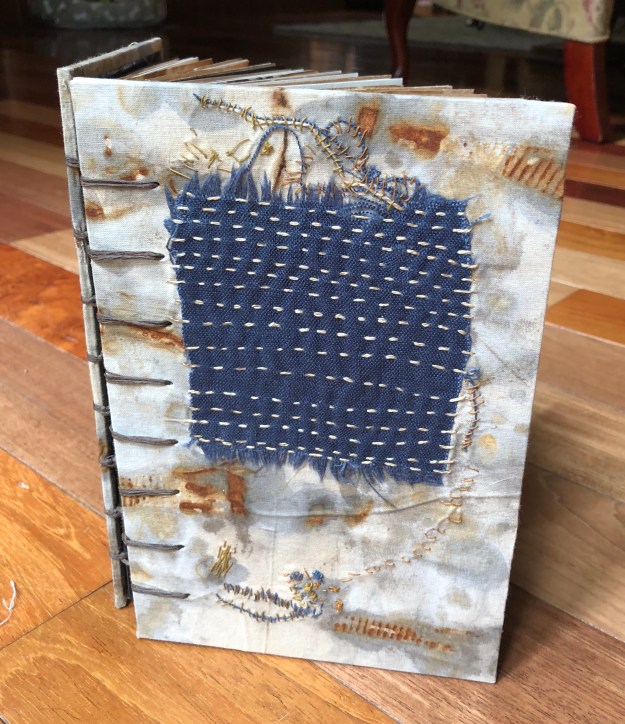
Here it is:

fullsizeoutput_f3b

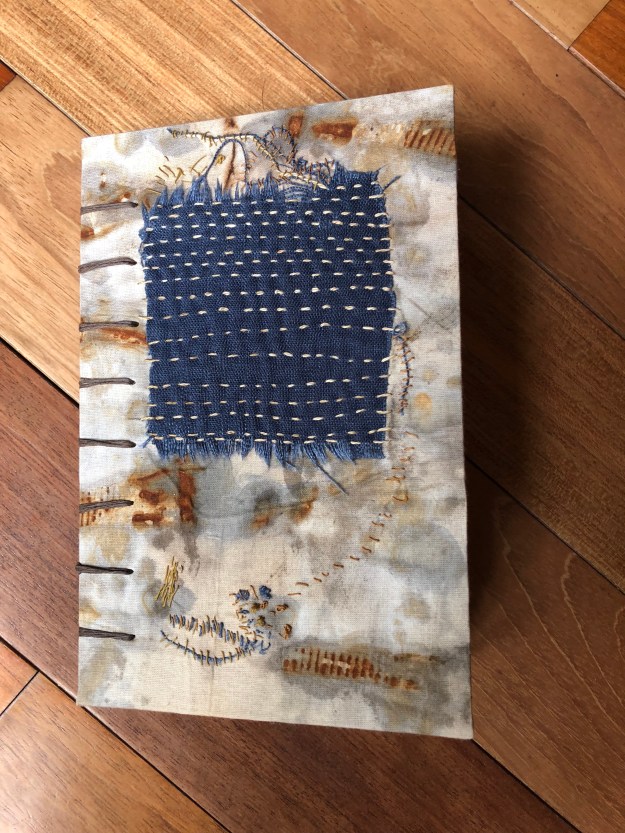
This is it.

I really, really love it.  And I had to get over that so that I could actually start writing in it and using it.

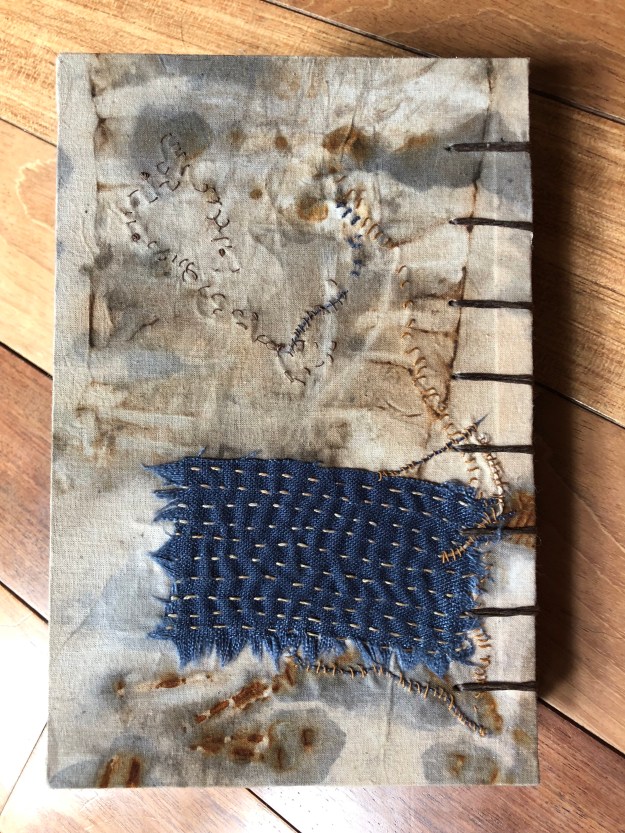
To make it, I started with some rusted scraps, the cardboard from some pads of paper, some linen scraps, and some thread from the eco-printing stash.

MCvwNgAgQ2K85f0uX+IMvA

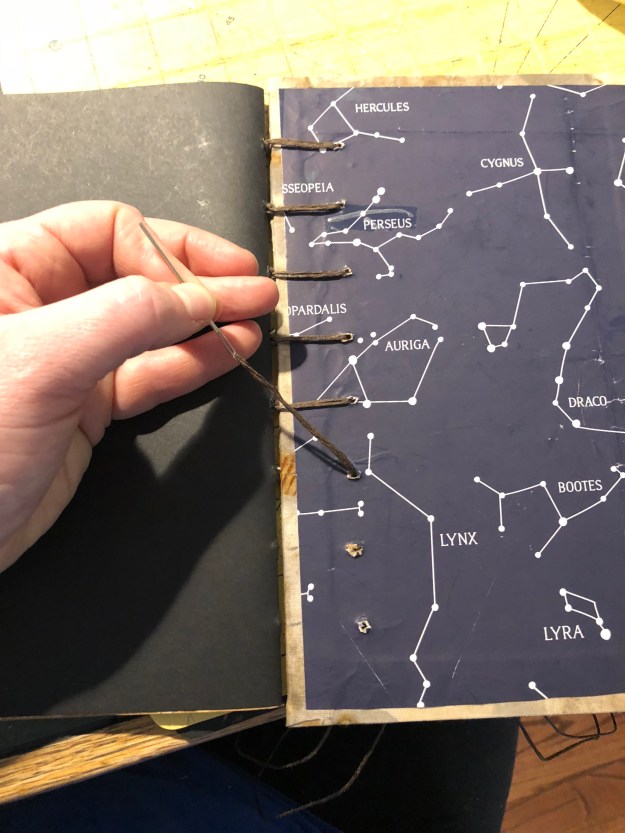
The paper on the inside of the covers is leftover Christmas wrapping paper that I upcycled for this. I love re-using paper for projects.

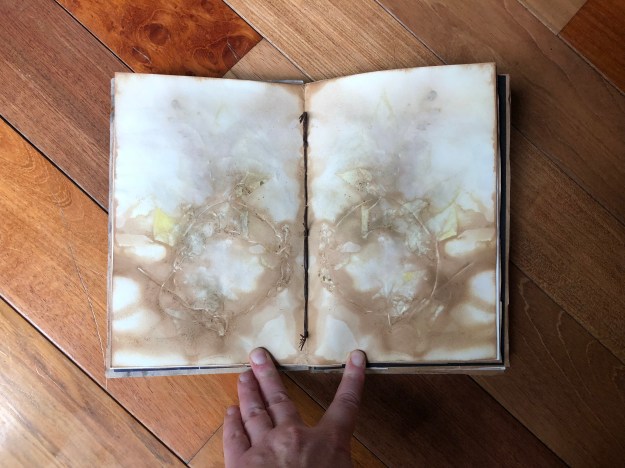
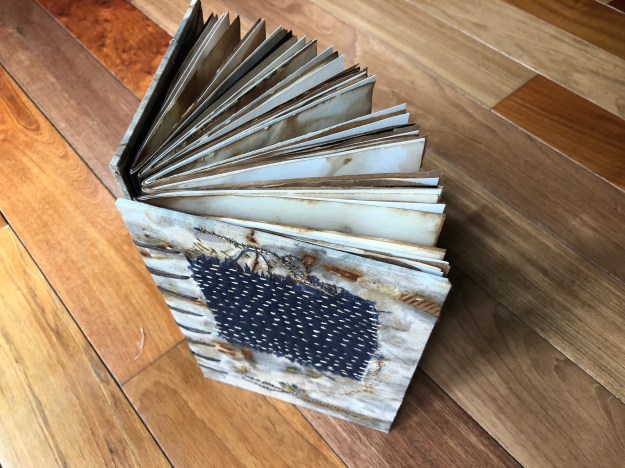
It’s coptic stitched with brown waxed linen. The papers inside are a mixture of eco-prints of weeds from Tom’s yard, watercolor paper, black drawing paper, and recycled paper bags.

SeFEOHGKRQO9ZJnDvSjJSg

Weed mandalas. . .

LnGMmYzFS9uCoVp8cMfRSg

haaz5442SAqGWpDsebnx6w

I’m absolutely in LOVE with the covers. . .

fullsizeoutput_f38

fullsizeoutput_f34

Using it has been SO much fun!!!

I have done some journal writing, note-taking, quote copying, mandala making, sutra copying, etc. It’s got a definite Zen aesthetic, but the practices I’ve been learning of late are from a Tibetan Vajrayana background. . .which is a TOTALLY different aesthetic.

And a totally different practice, as well.

As soon as I can get my phone to communicate with my laptop to update photos, I’ll upload some pics from the inside as well.


Full House

*Sigh*

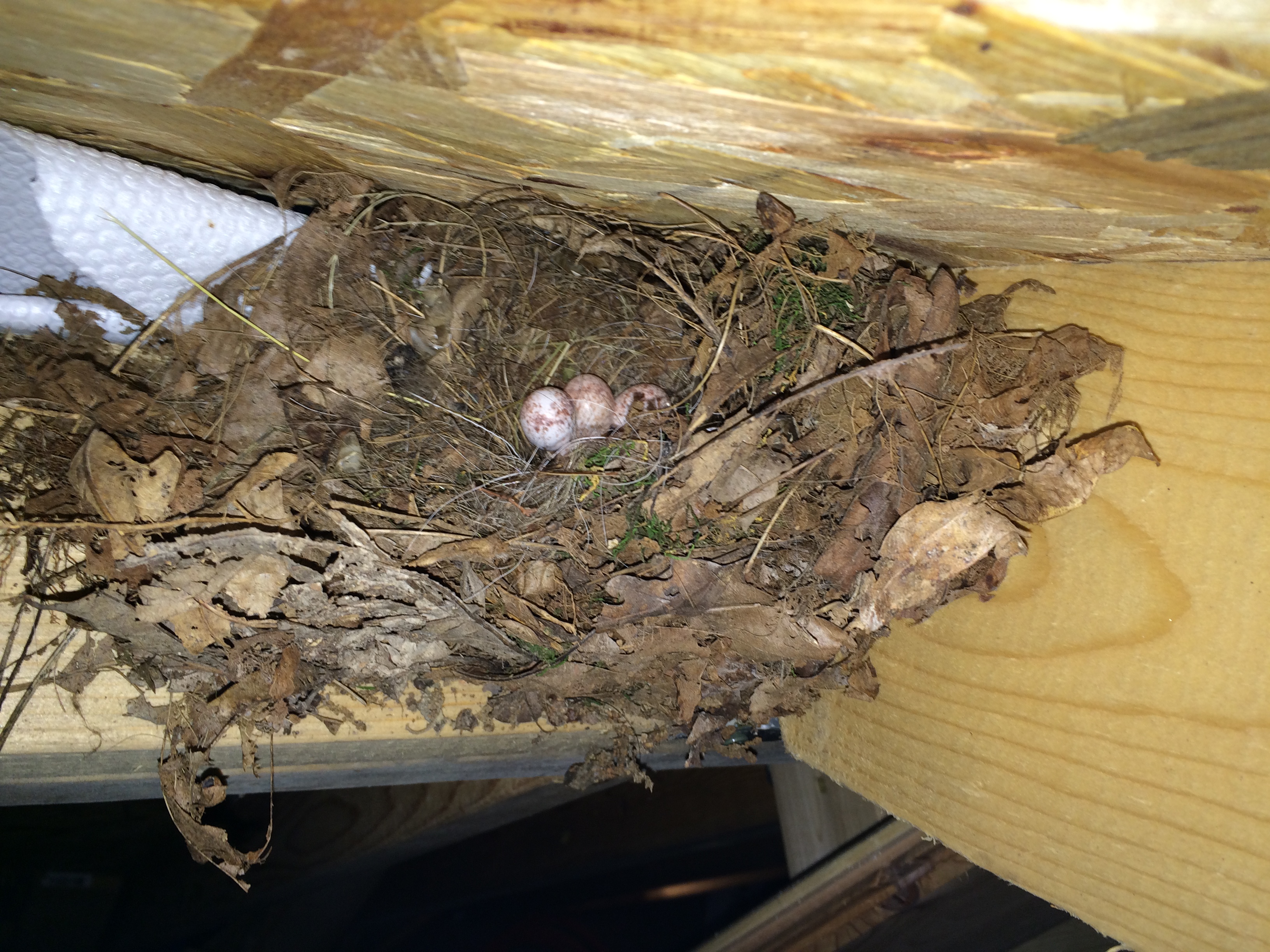
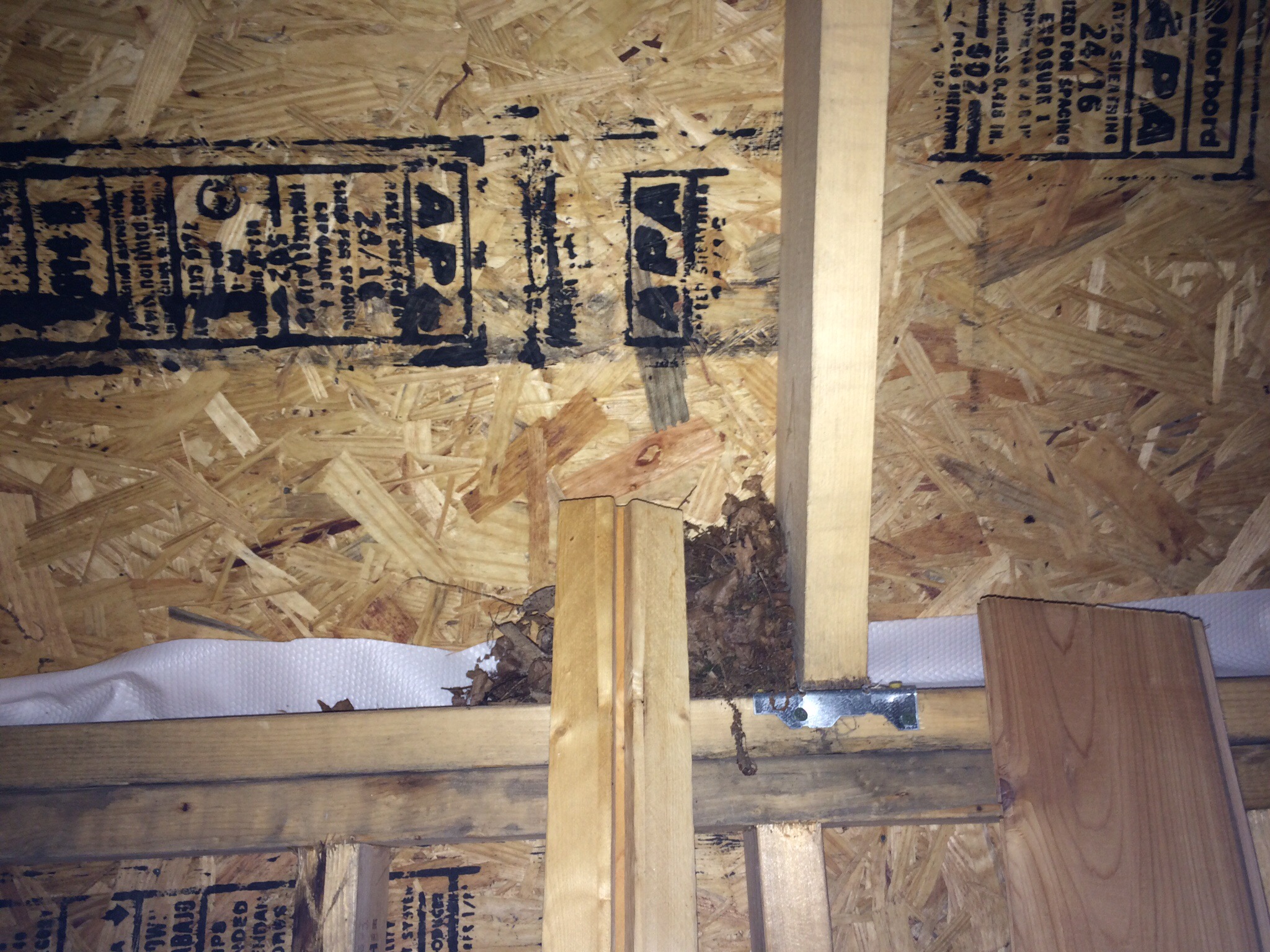
Well — here’s what I found when I climbed up in the loft and hung my camera over the nest:

IMG_6185

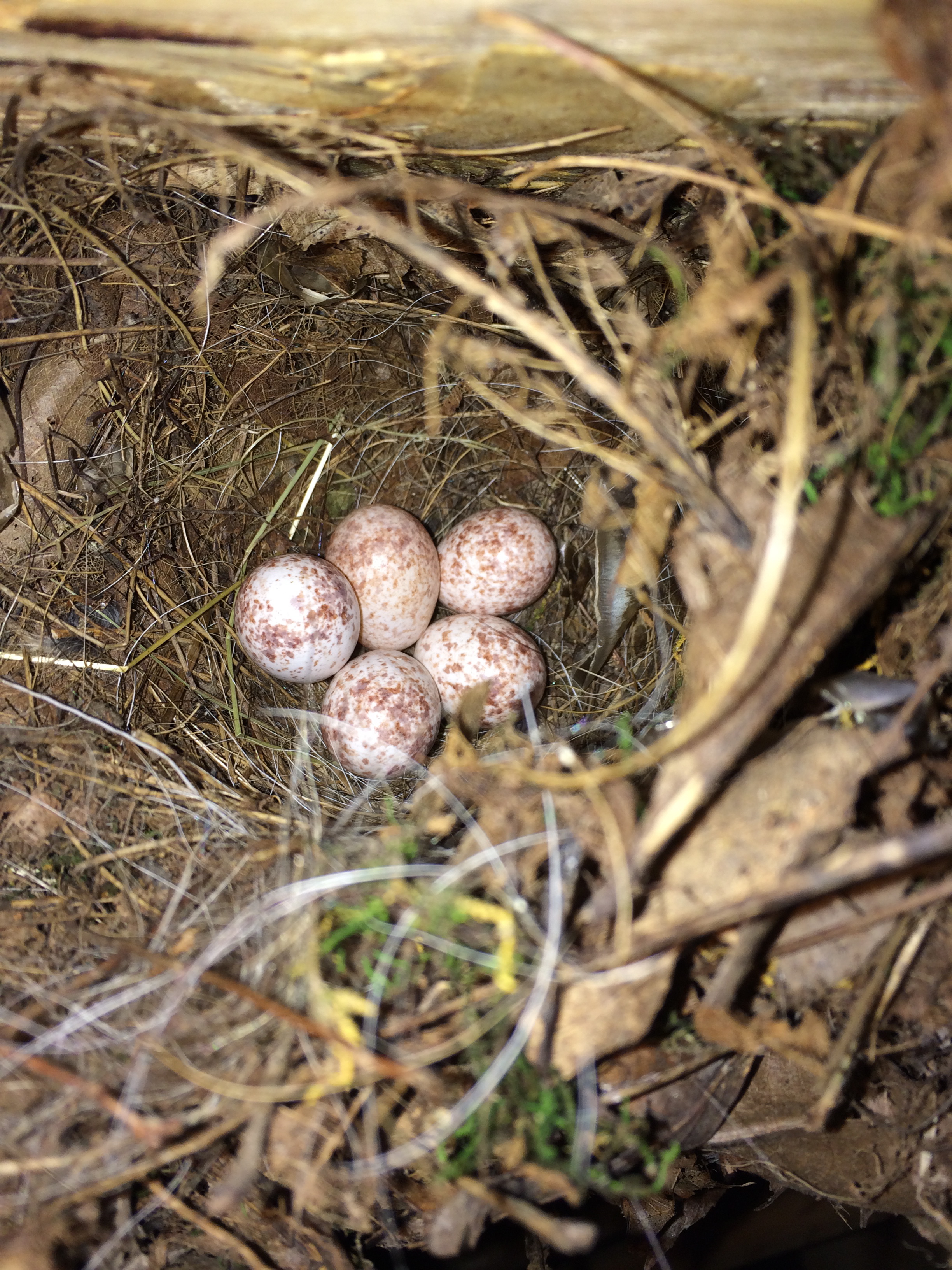
I could see a few eggs, but on the small screen of my cell phone, it wasn’t entirely clear. I made a second pass and got this picture:

IMG_6187

So the “squatter is now officially a “renter”. She’s a wren. These are wrens’ eggs. All 5 of them.

*Sigh*

All of the heavy *sighs* in this post are sighs of frustration and acceptance. I have a house to build. It’s effortful and requires learning new skills on a regular and ongoing basis in order to continue and make progress. it takes up a lot of time and energy to think everything through and make constant adjustments around weather and various other conditions that are in a constant state of flux.

In other words, it’s really hard.

On the other hand, the only way I can continue is to accept the changing conditions around this project with complete acceptance. If there’s one “tough love” lesson that life has taught me, it’s that I’ll suffer much less in the long run if I can take in the circumstances and conditions around me and simply accept them.

Often that means getting through layers of frustration, irritation, anger, disappointment, grief, sadness or one of many other negative emotions first. The key is not to create a story around the emotion as it arises, and to recognize it as it’s arising. It sounds easy in theory, but it’s a practice all its own that requires diligence and effort.

If I can stay with even the intention behind the practice, the emotion will do what it was designed and created to do: move. It can move through, and move on.

As long as the intellectual mind doesn’t get involved in rationalizing anything to do with the emotion, it cannot hang around for very long. In fact, it may be so brief that it’s simply a wave of something that washes through and over, cleansing the pallate. When it’s gone, there is this amazing space all around that is palpable and offers tremendous clarity. Following the clarity is acceptance and an understanding of what action needs to be taken next.

That said, I will take the observation offered by my mother (“Those birds are going to sh*t all over that area of the house, you know.”) and cover the surrounding area with leftover house wrap to hopefully make the cleanup much easier. Then I will need to learn how not to startle her too much so that we can adjust to one anothers’ presence and hopefully find a way to share the space amicably until it’s time for her and her fledglings to move on, which according to the Missouri Conservation website will be sometime in early August at the latest. I don’t know how long she’s been there. I was away at ITF in Nebraska last week, and didn’t go indoors much the week before that.

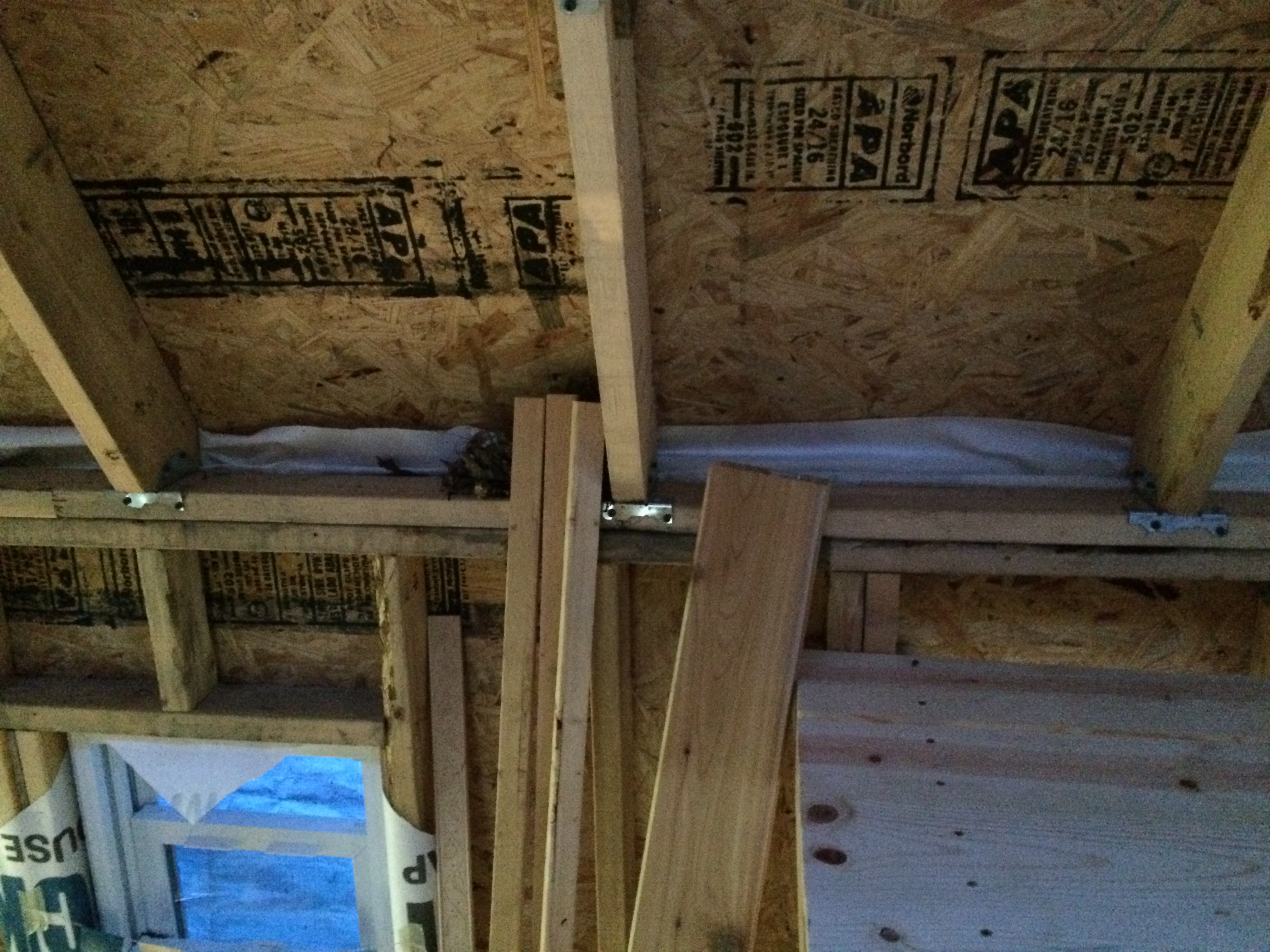
She doesnt’ instantly fly off when I walk in; she only revealed her position when I disturbed the wood near her nest.

IMG_6188

I may try taking my cushion down there to sit in the loft so she can get used to my being in there with her, and hopefully it will settle her nerves a bit.

There will be some readers who don’t understand the choice I’m making in how I handle this situation — I realize that.

The simple fact is that the wren nesting in my house cannot change her nature any more than I can change my own. I’m building my nest in her territory, and she’s building her nest in mine. Each of us would insist that we have the ‘right’ to be there. As the only one between us with a rational mind to work with, however, and recognizing the situation we find ourselves in, it’s incumbent upon me to find a way to make this work peacefully and amicably for both of us.

Since wrens tend to nest near humans and in the same place  year after year, however, next year there will b a separate Tiny house waiting for my new seasonal guest that will offer her safety and privacy when she comes to stay.

Progress, Paradox, and Navigating the Changing Terms and Conditions   

Working outdoors right now is a craps shoot because of the rain, and a lot like building a house in the Dagoba system because of the humidity. Seriously — the humidity is at 65% right now, and when it’s 85 degrees farenheit, it means you will be soaked through to the skin if you move or breathe outdoors for more than 3 minutes. 

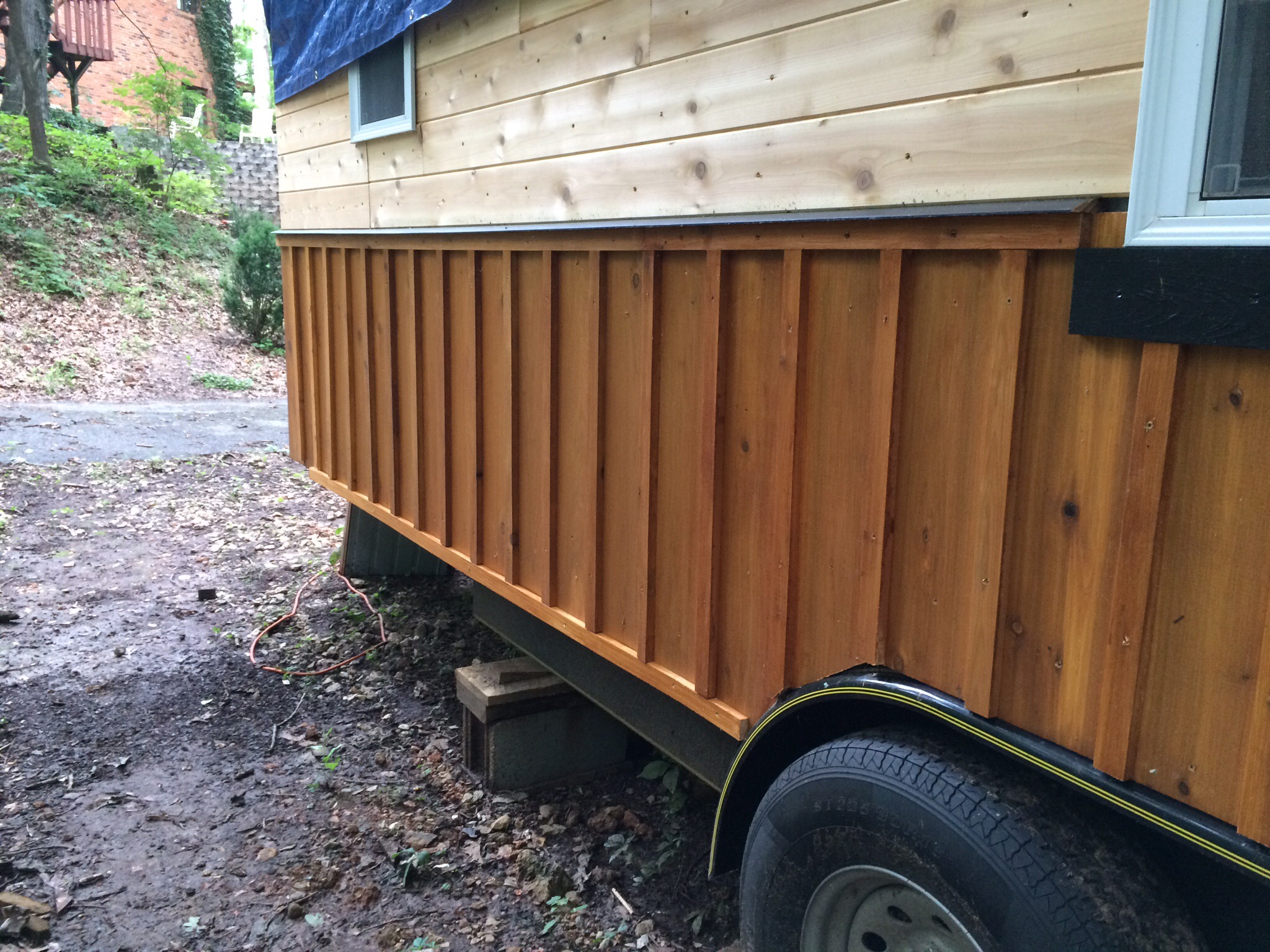
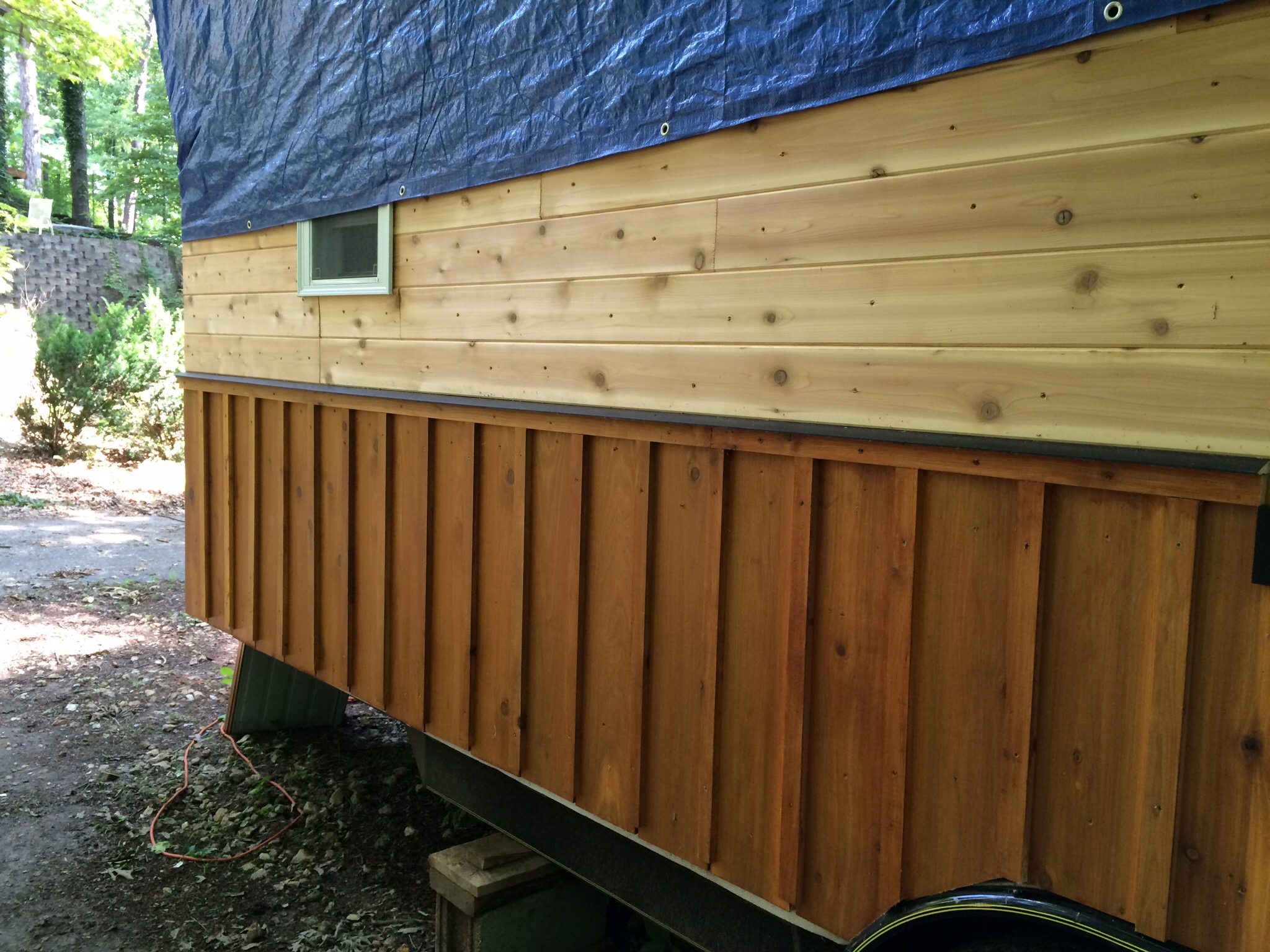
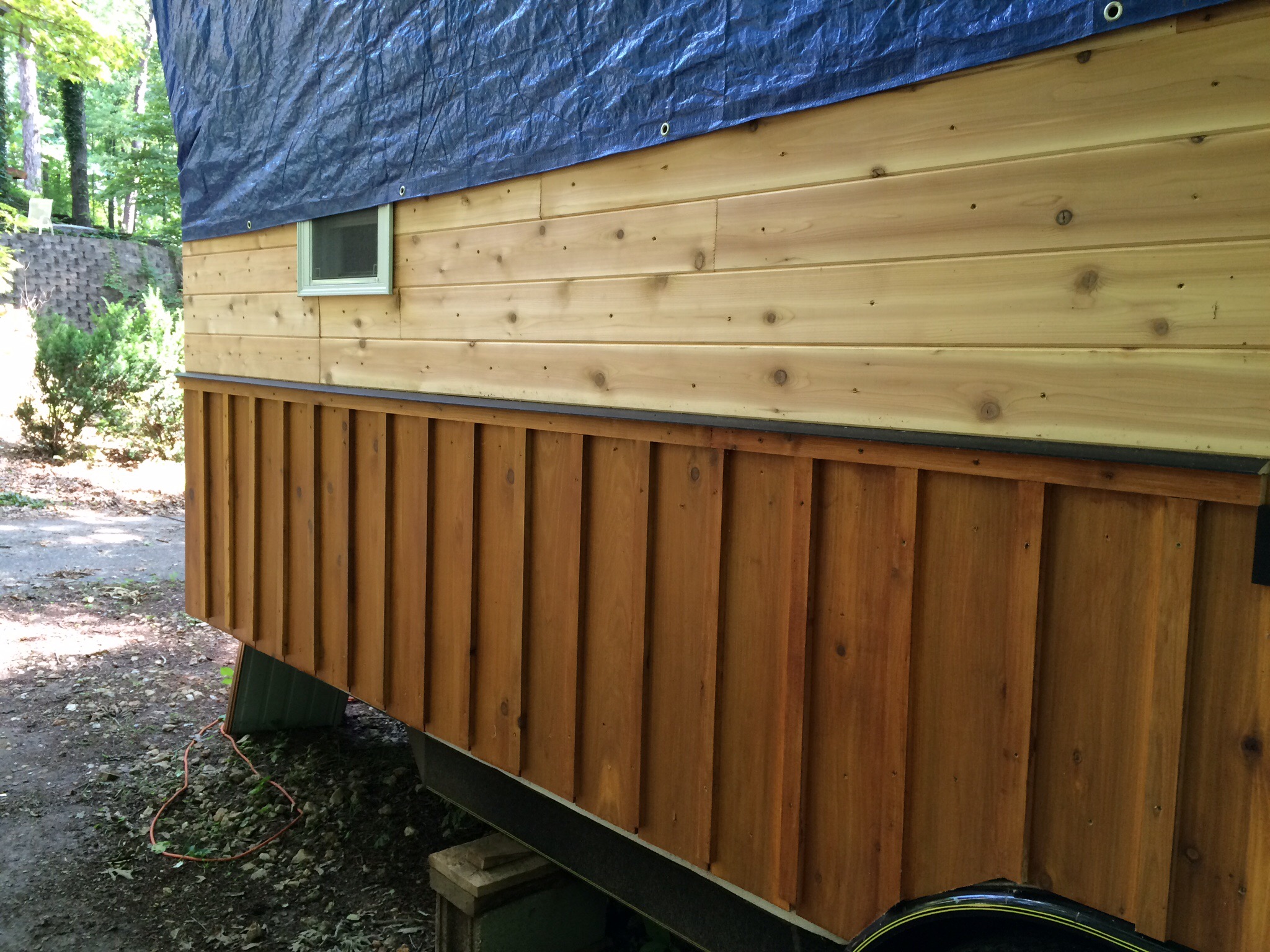
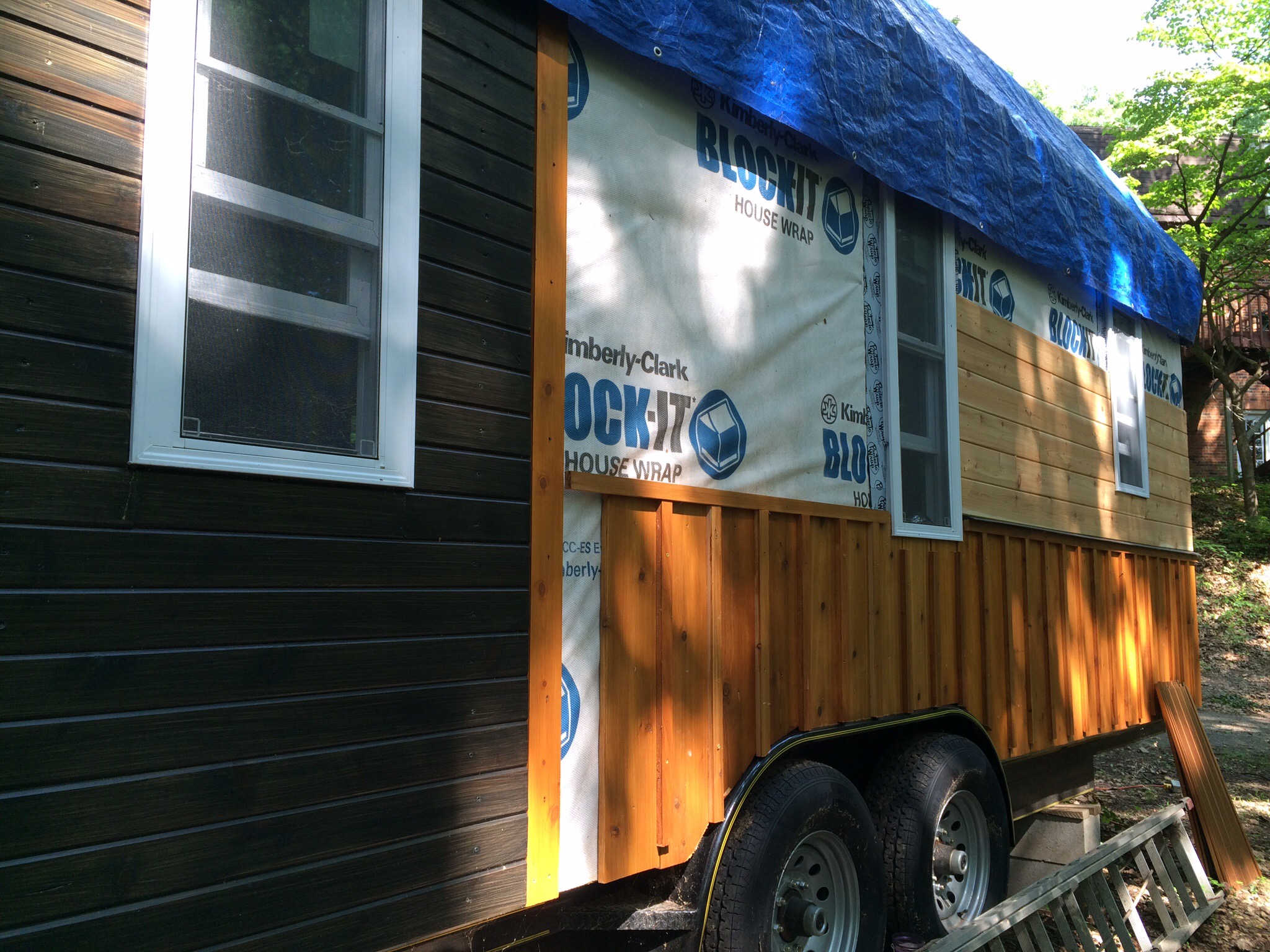
Even so, today I managed to snatch about 3 hours of work and got the East-facing side of the house caught up with the West-facing side: 
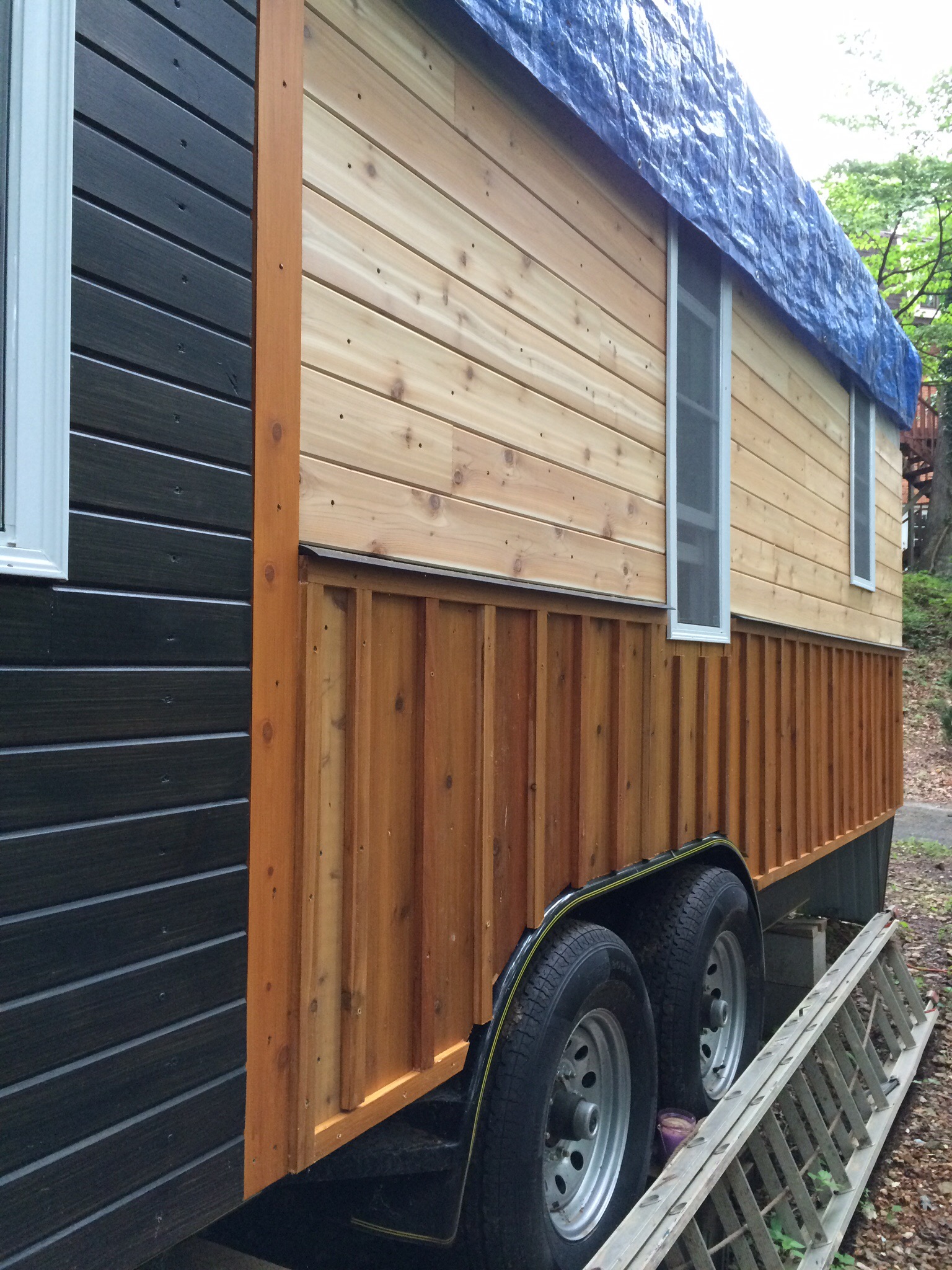
It now matches the other side. See? 
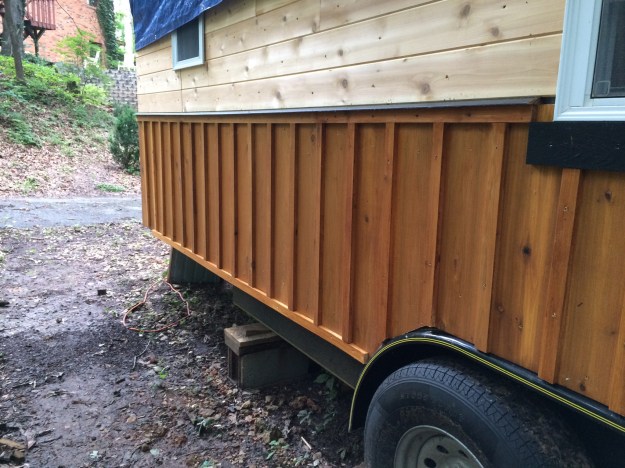
  
Can you tell the difference between what I did today and the way it was in the last post? I’ll give you a hint: look at the bottom of the trailer. 
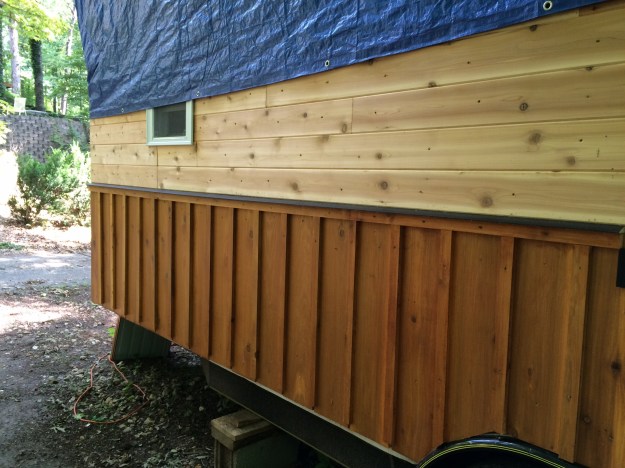
  

This is what the East-facing side (which I worked on today) looked like in the last post:
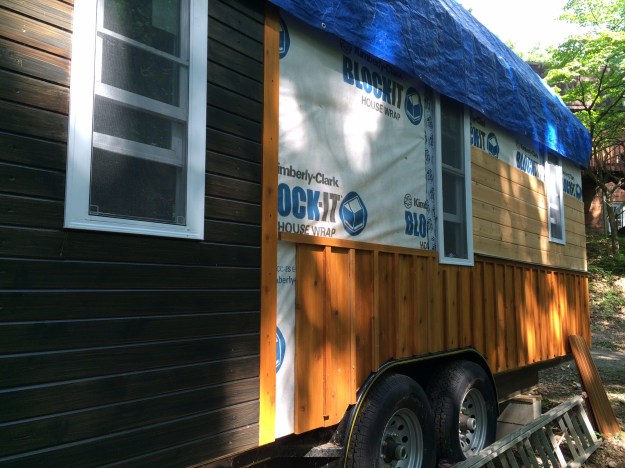
  
It was a fair bit of work, but it only took about 3 hours. To give you some idea, here’s what I got accomplished in about the same amount of time yesterday:
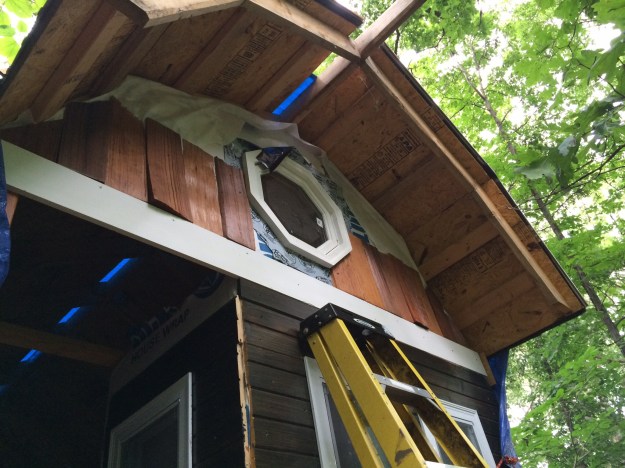
  
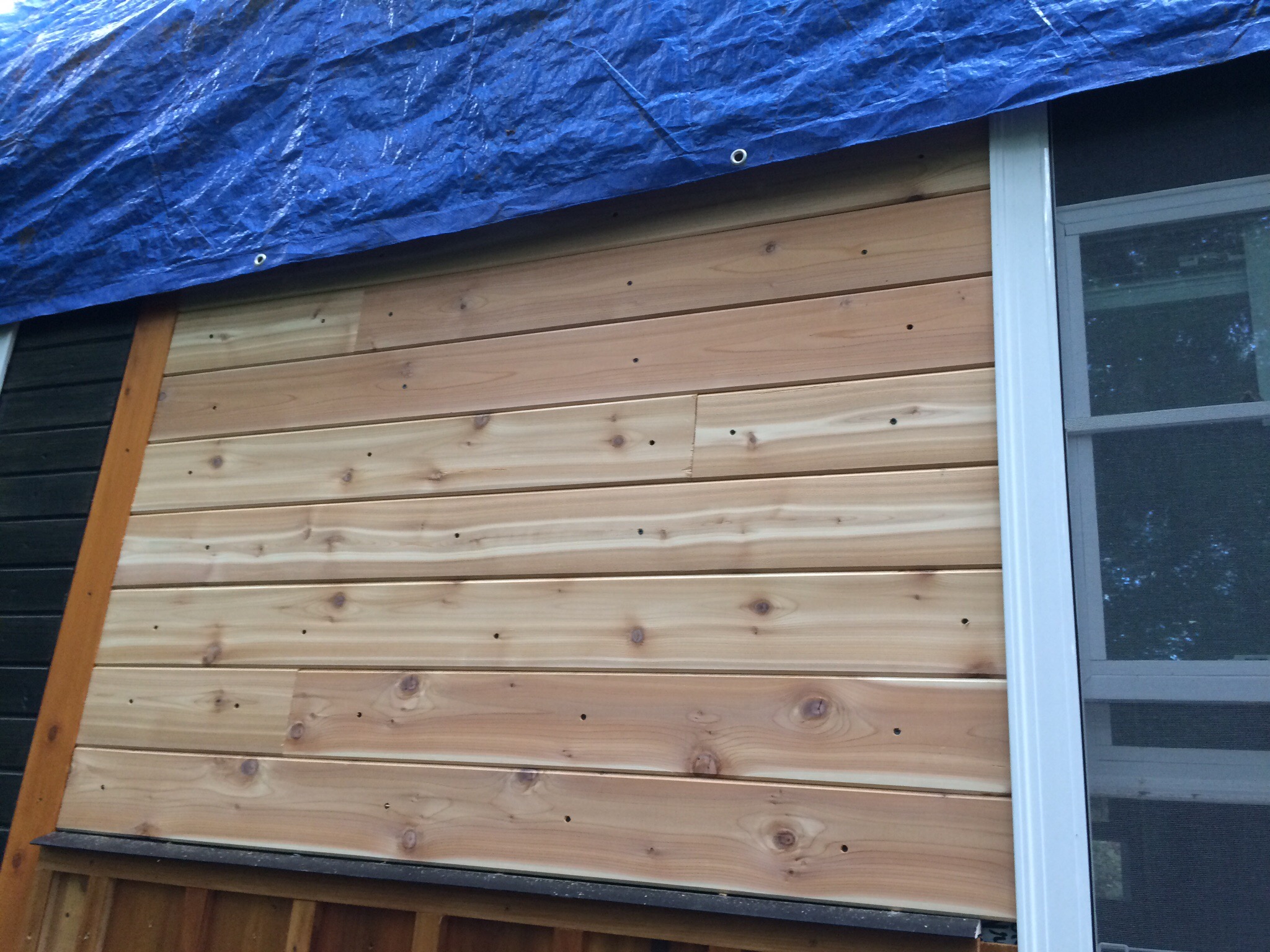
The shingles. Not anything else — just the shingles. (Oh — and the sealing tape around the window.) To get the shingles to fit and line up side by side means climbing up and down the ladder. A LOT. Lots of up and down. See this one shingle that fits so perfectly under the right side of the window?
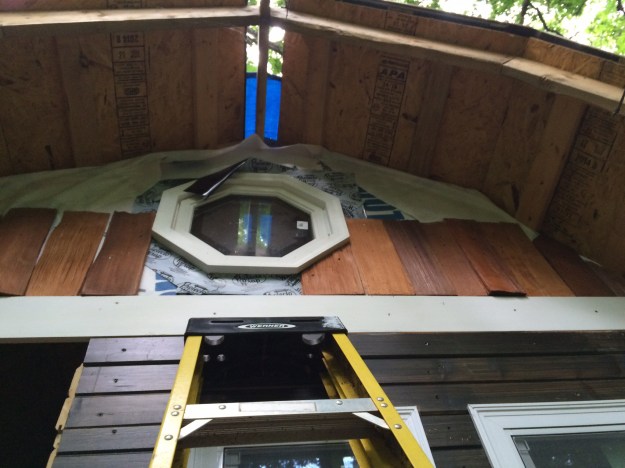
  
That one shingle required no less than 8 trips up and down the ladder to cut, fit, etc. As I recall, I did the other gable during the late fall and early winter when it felt great to climb up and down the ladder hundreds of times to cut and fit the shingles for the gingerbread effect. It kept me warm and it was artistically fullfilling and fun. 

In this weather — well, frankly, it sucks. 

I’m going to leave that job until it has to be done and pick it up again later on. I made the mistake of thinking I could do it after a hot yoga class yesterday morning and I was SO wrong. After 3 hours of shingle fitting, I was done. For the day. It took major coconut water to recover from that mistake. 

I was really grateful, however, for a break in the weather today — which was not expected.

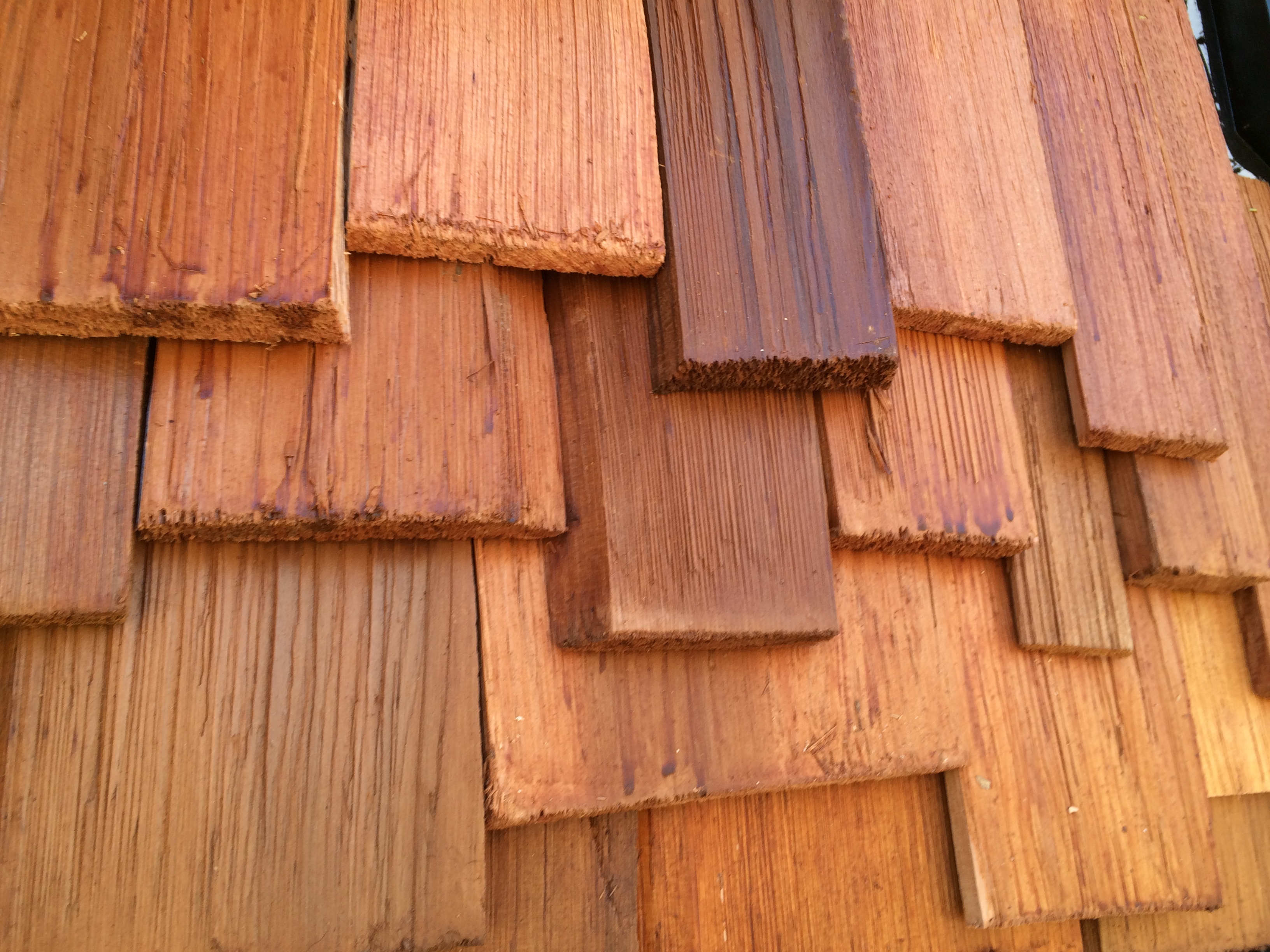
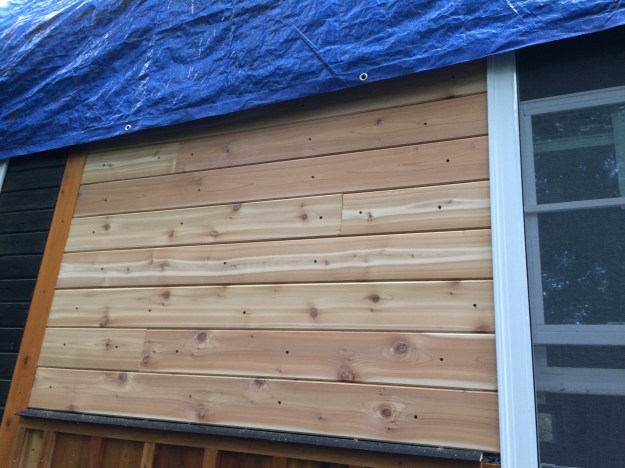
I really love cedar. It’s so beautiful. Look at the different shades and patterns in the wood. There is a lot of cedar sitting in the interior of the house and it has become the dominant smell when I walk in. If the budget allows, I’m going to put cedar on the walls and ceiling indoors, too. 
  

Another thing about working outdoors in this location (besides just the humidity) is the wildlife . . .by which I mean bugs

They’re everywhere

Even if I have only just put down a stack of wood that came out of the car, when I pick it up again, there will inevitably be several creatures that accompany it onto the sawing table. In order to be non-harming, they have to be noticed and moved.  They’re the neighbors. They’re not going anywhere anytime soon. 

The mosquitoes and no-see-em’s are also neighbors that seem not to want to go anywhere anytime soon, but the tiki torches help a lot to deter their presence, as does the deep-woods bug repellent. 

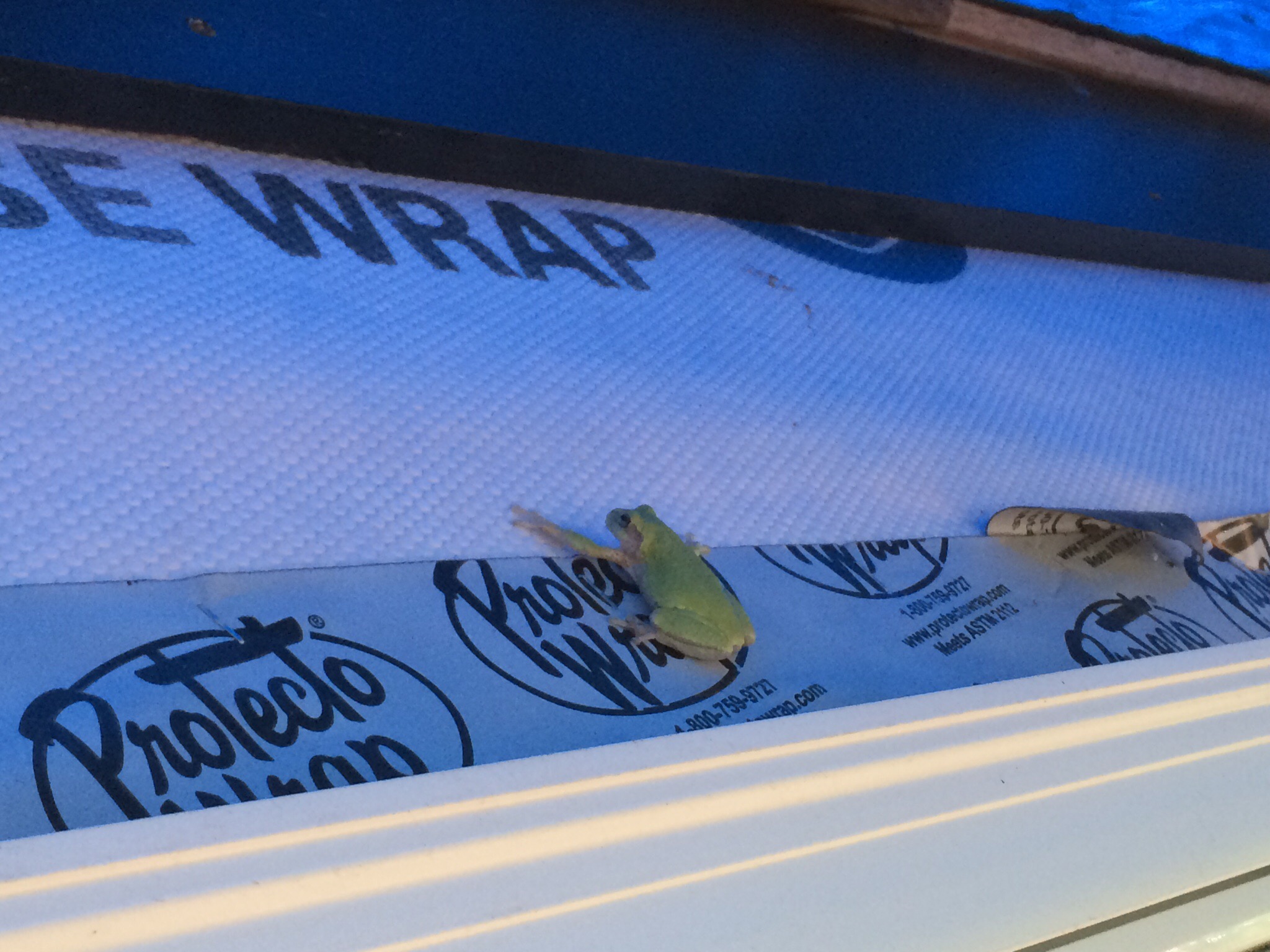
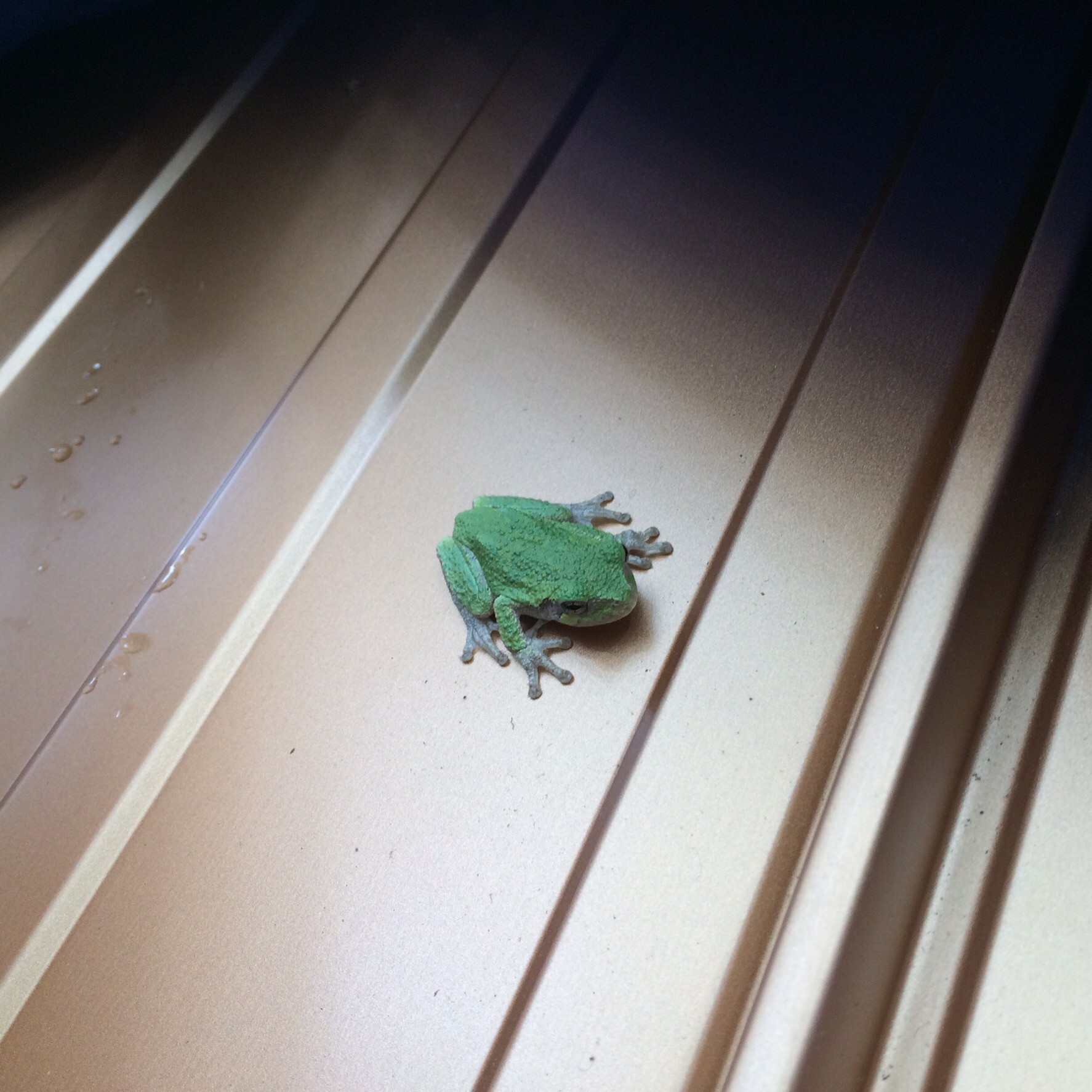
Not all of the neighbors are nearly so annoying, however, and some of them are kind of cute and interesting. When I lifted the tarp to go higher with the cedar T&G today, for example, I ran into this guy again. 
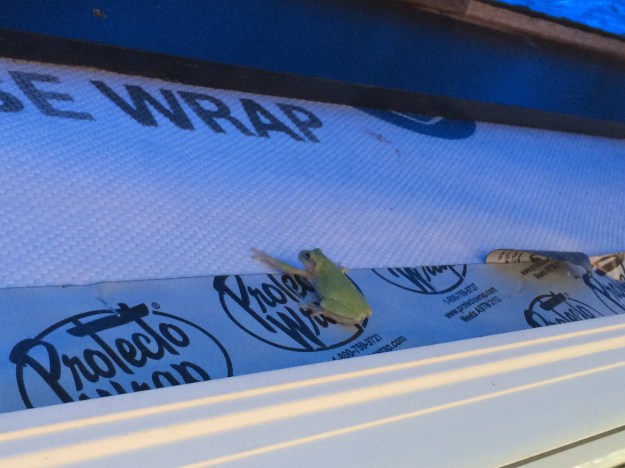
  

He likes it under there. Lots of bugs to eat, as I may have mentioned already. (!) The last time I saw him, about two weeks ago, he was on the actual roof in the same location.
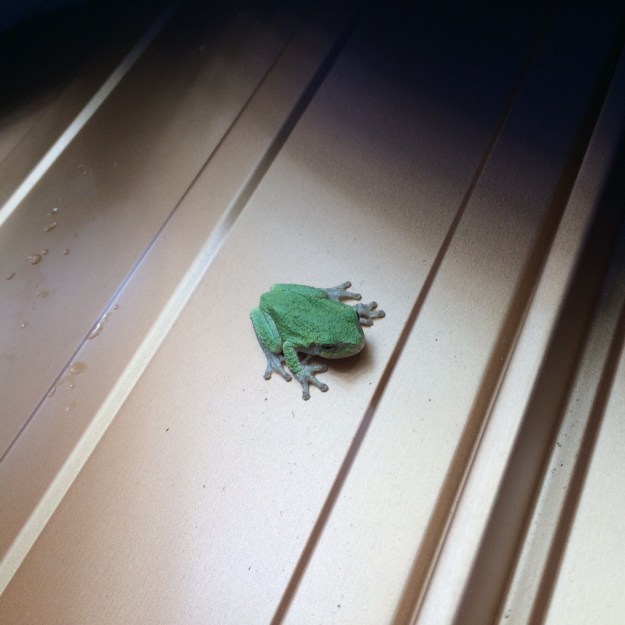
  
That was about 3 weeks ago, though . . .  So . . . either he grew (which they do a lot of during the summer) or it’s just a different froggie who happens to like that side of the roof. 

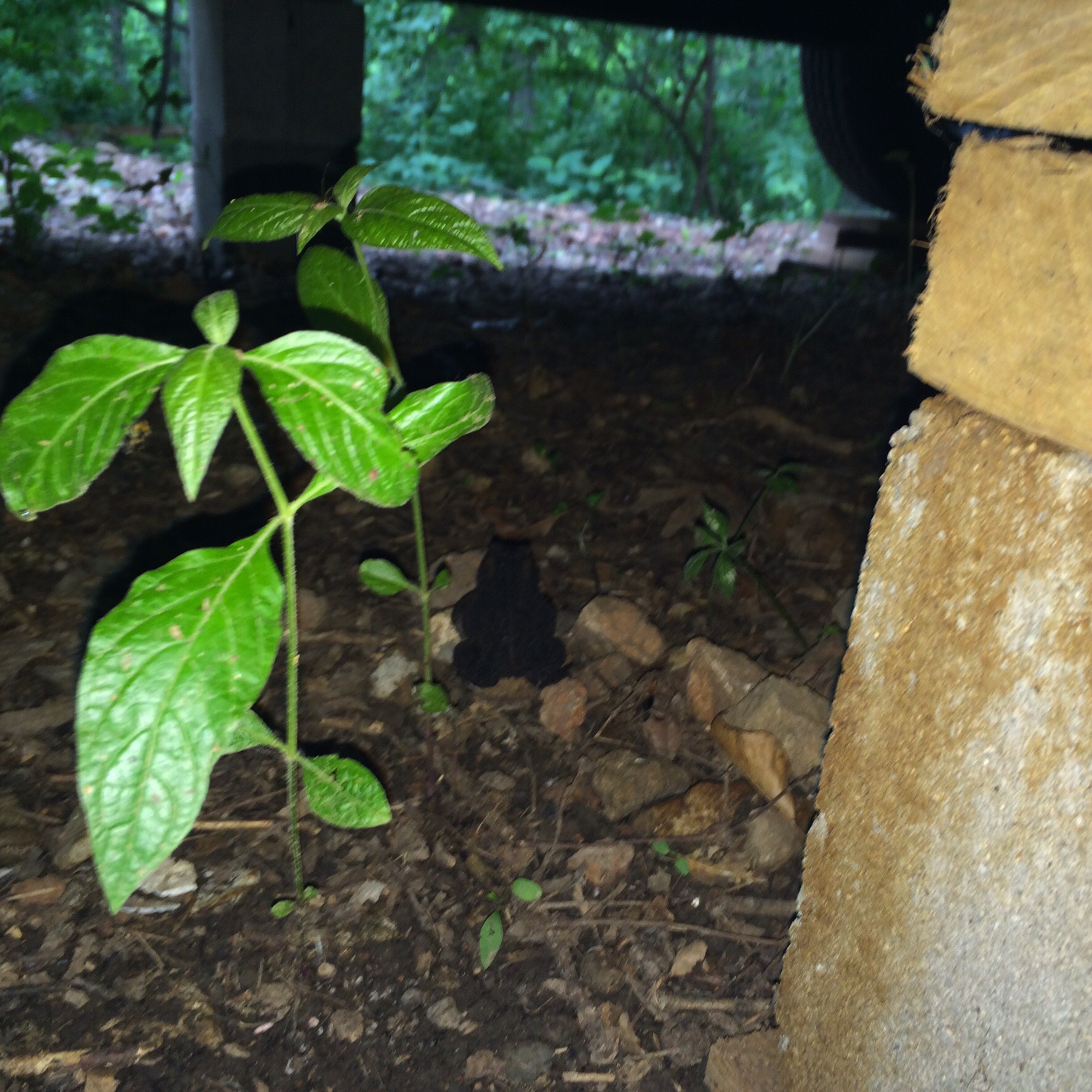
There’s also this ninja toad that darts around under the house:
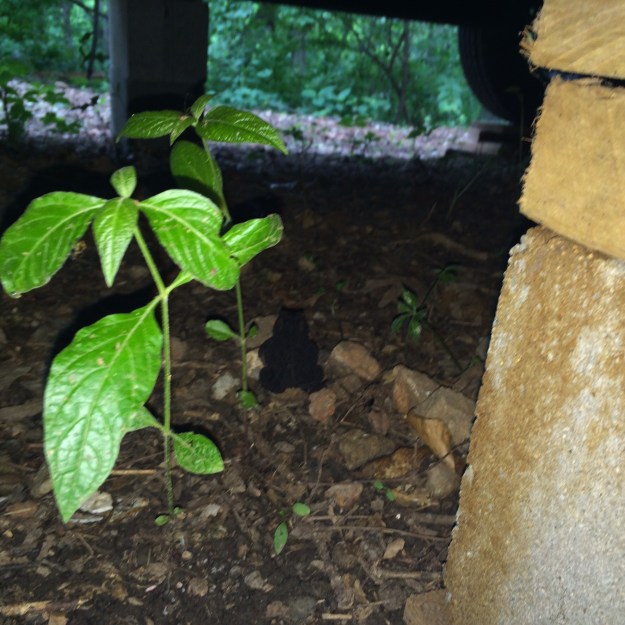
  
He’s so quick and so black that he blends in with everything. You just see movement out of the corner of your eye and when you look again, there’s nothing there. I managed to catch him this time, however, although we wouldn’t be able to see him without the flash.

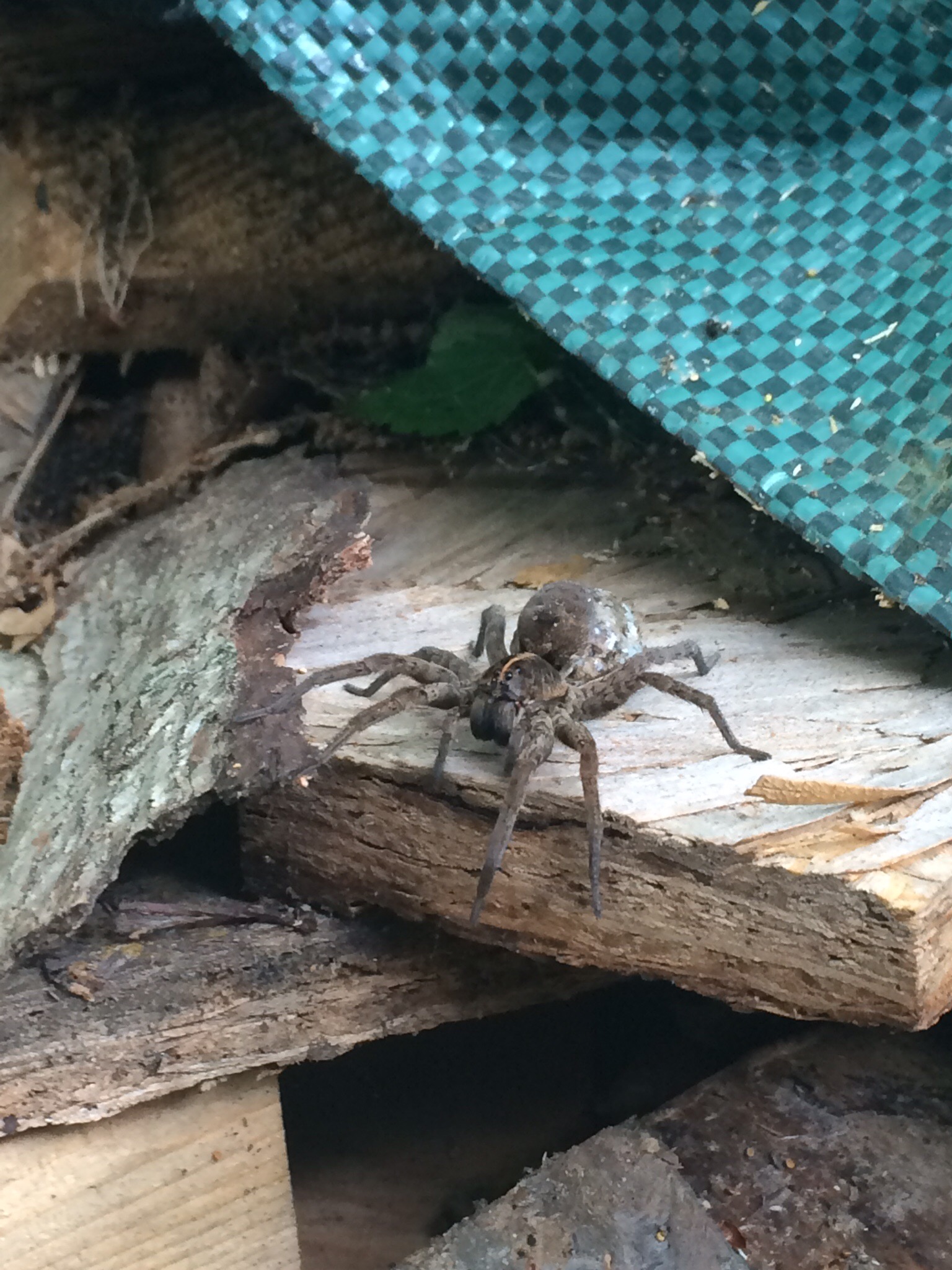
And (WARNING: Arachnophobes beware!) there is a Wolf Spider that’s become rather territorial about the scrap pile:
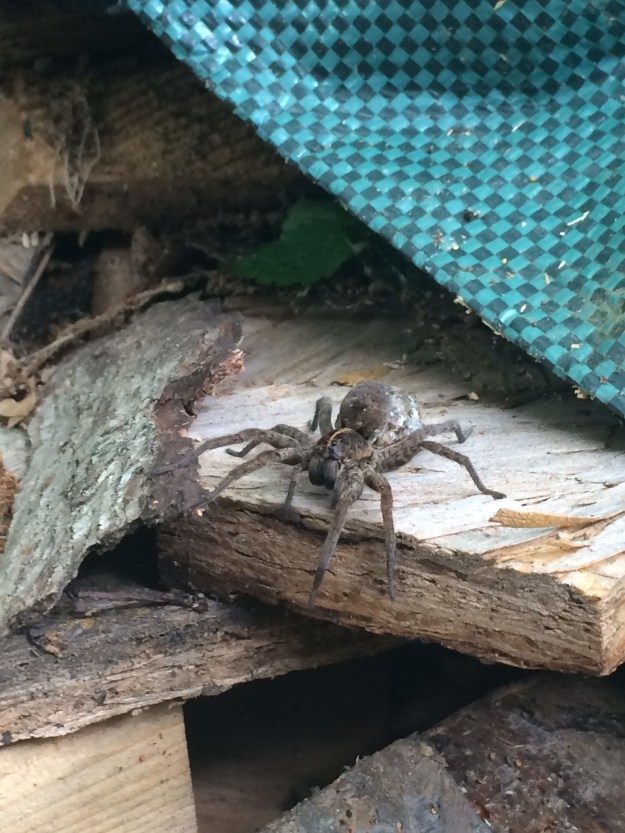
  
She’s pretty big, actually. But as intimidating as she looks, she’s a serious neighborhood ally alongside the frog and the toad. They all eat mosquitoes and bugs, so as far as I’m concerned they’re part of the team. Wolf spiders are pretty harmless, too, and gentle natured, apparently. 

Unless they don’t want you messing with their wood pile. 

Ah, well. We all have priorities. 

And we all have nuissance neighbors, too, right? 

Well — aside from the mosquitoes, there are Vandal Squirrels. They are into destroying all kinds of stuff and aren’t nearly as happy to share space as the rest of the neighborhood. I don’t understand these little bastards, but I need to get a door installed ASAP to keep them at bay. Here’s what they did to my sweet little fairy lights: 
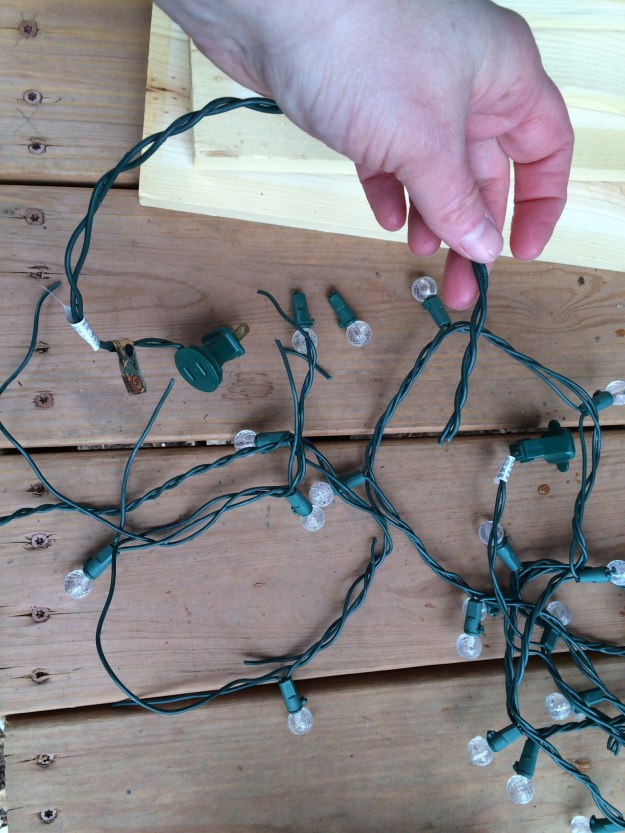
  
I’m still finding little bits and pieces of those lights around and under the house. 

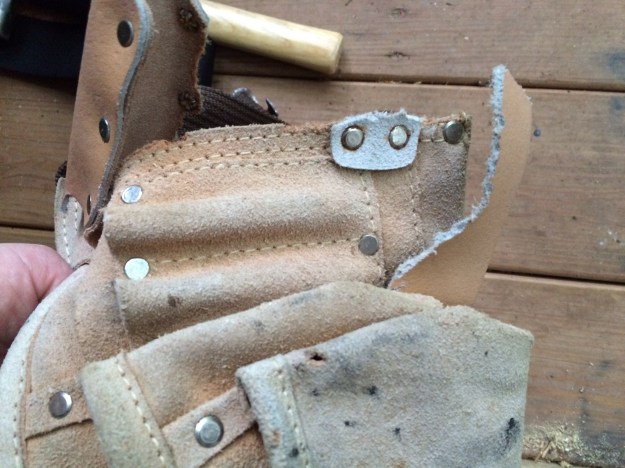
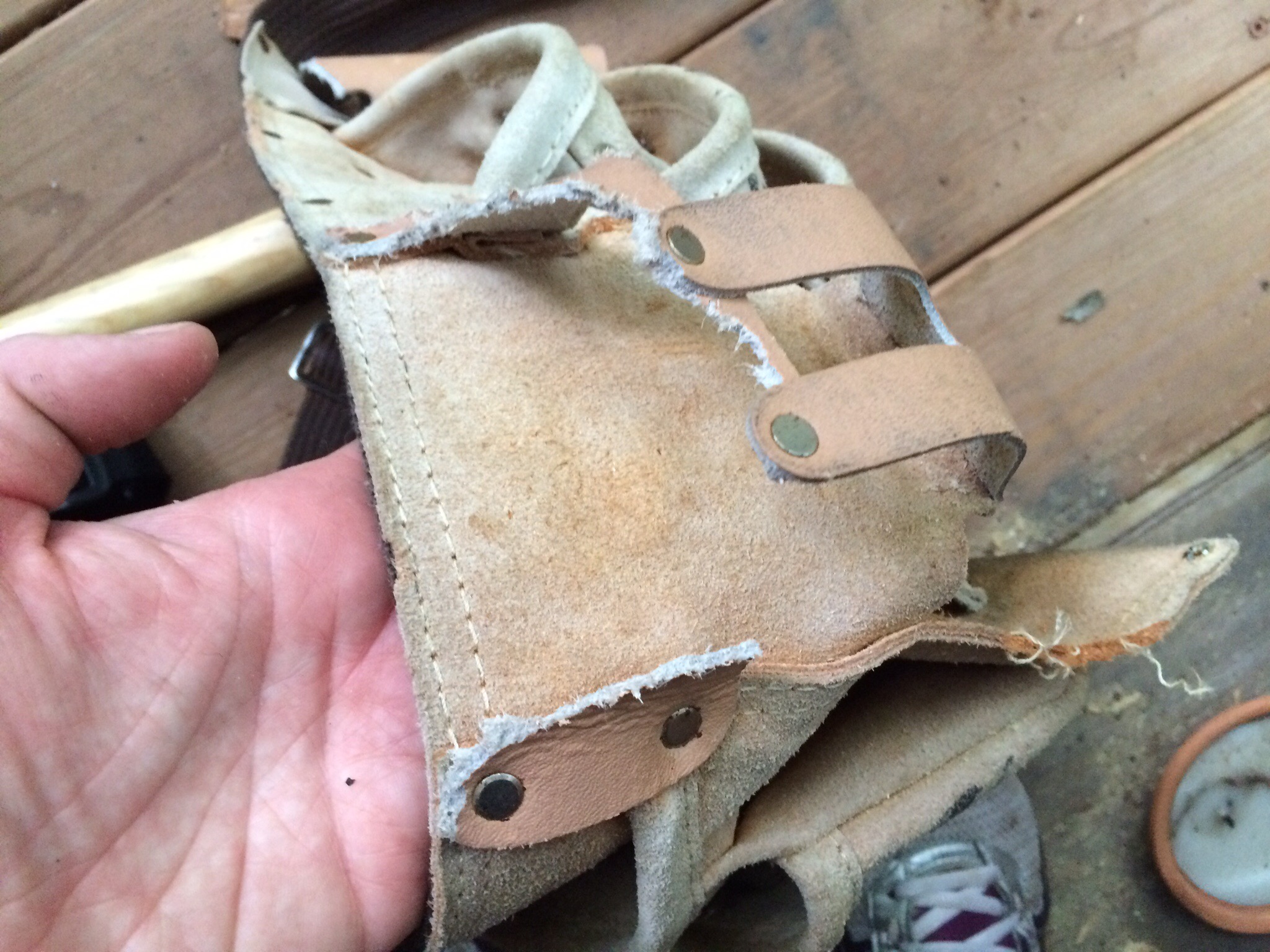
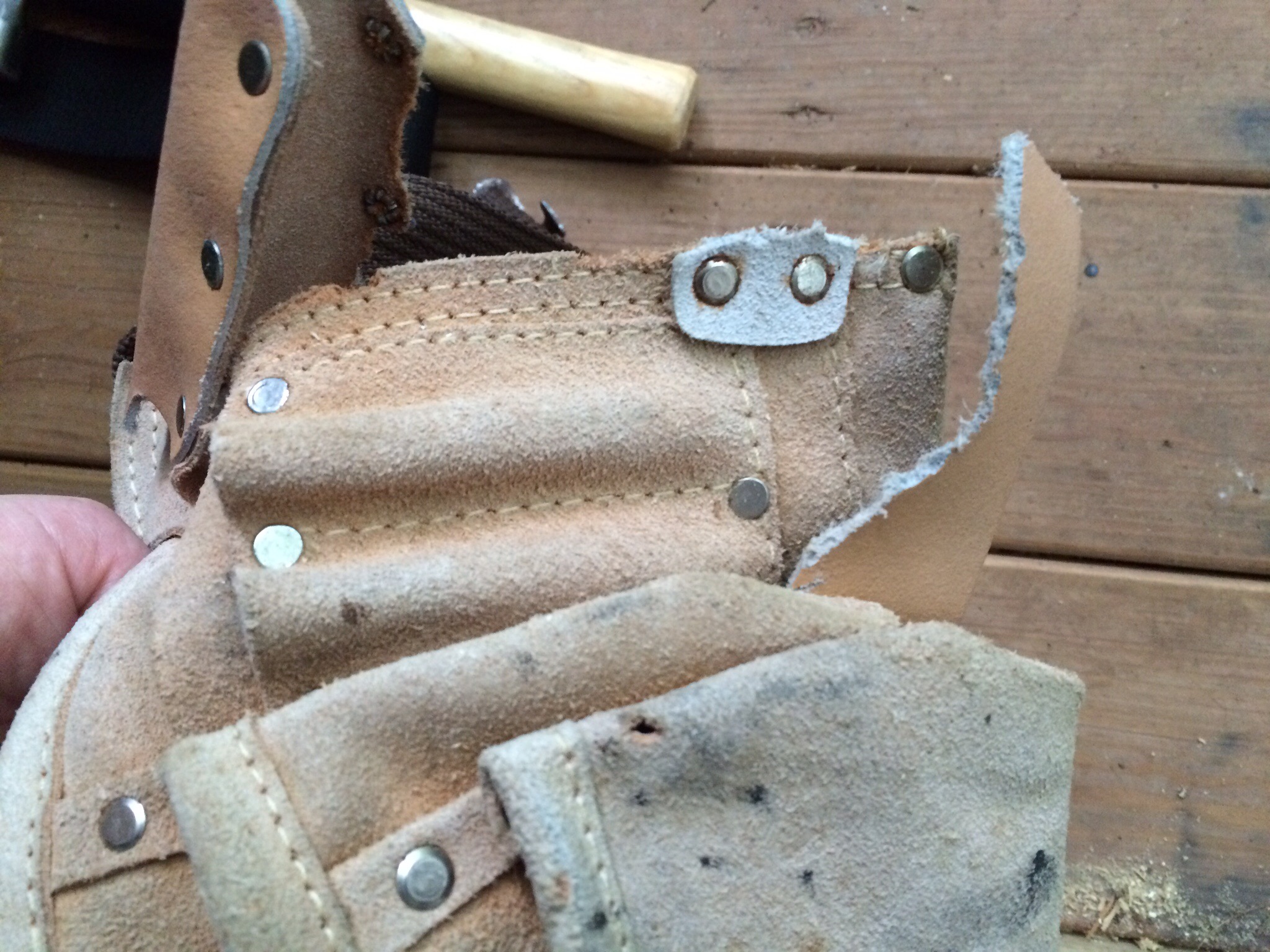
I also replaced my tool belt for the second time today. The first belt was canvas with leather on it. They ate it. It was winter. I get it. They were hungry and food was likely in short supply. It doesn’t explain the lights, but still. 

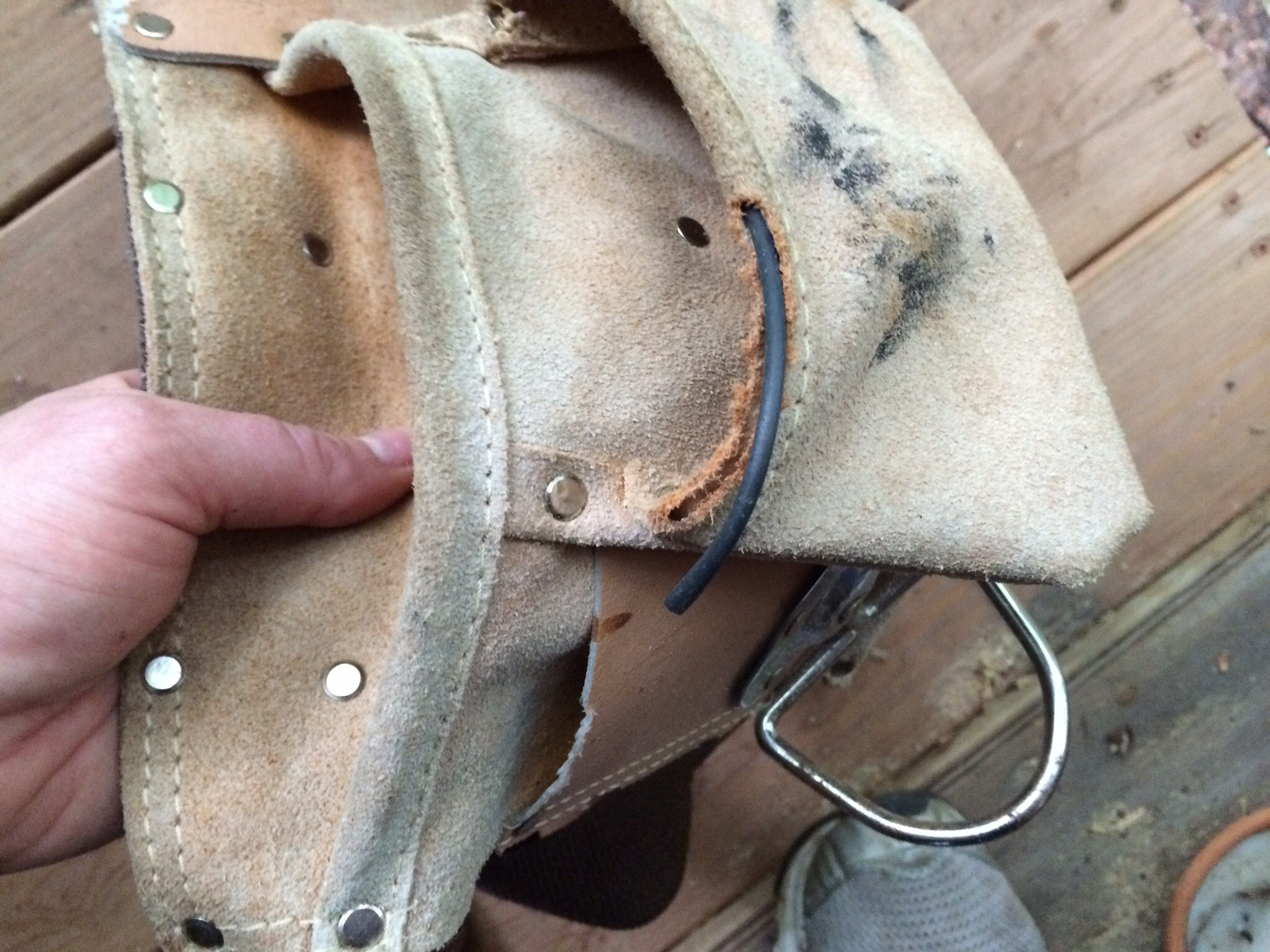
The second tool belt they ate was once my dad’s. Check out what they did:
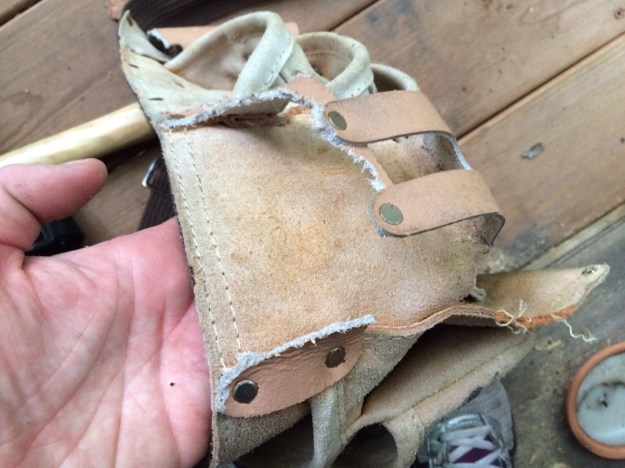
   
   
I kid you not — they did it just last night. I wore it yesterday with no problem.  

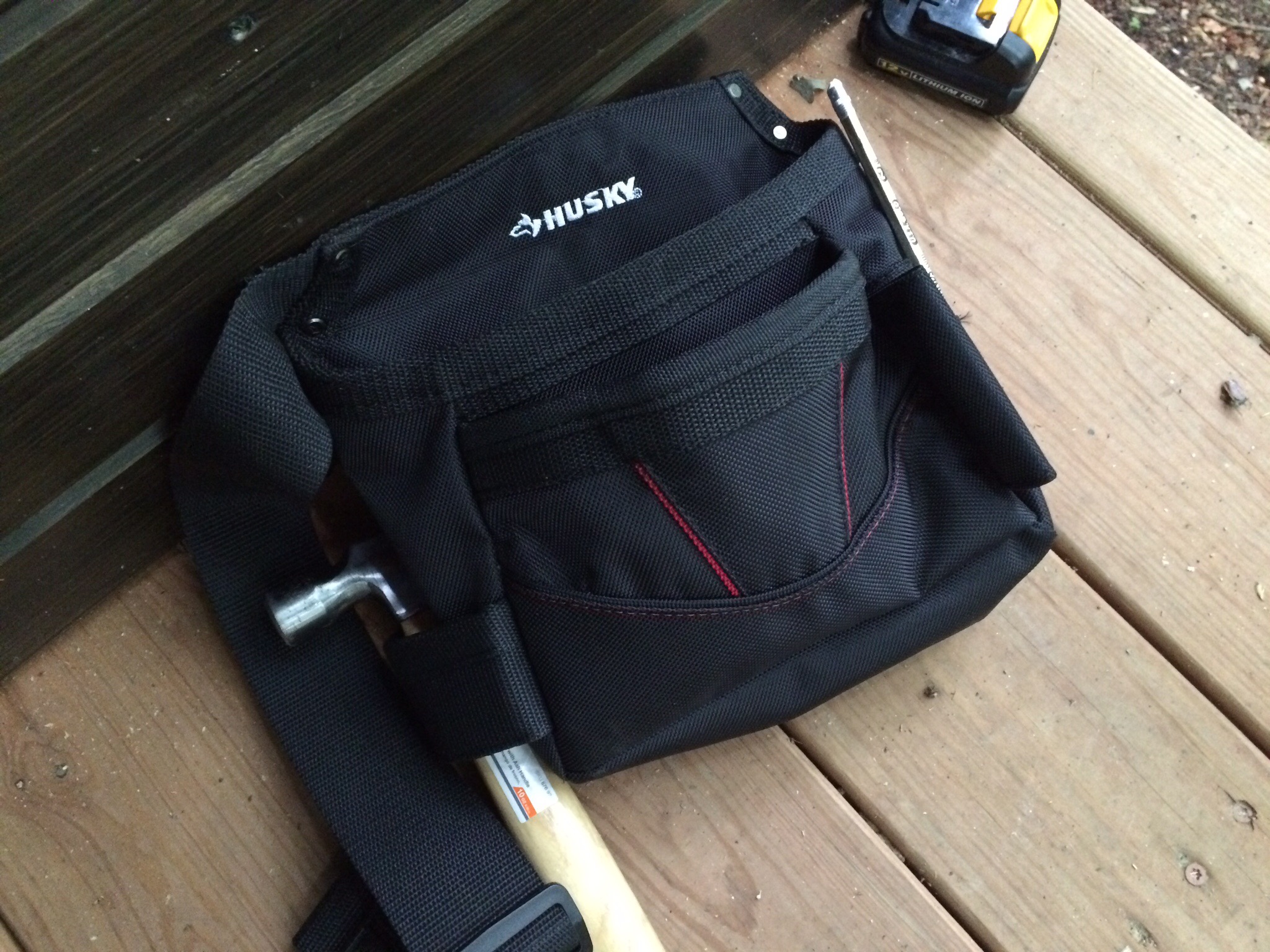
Frankly – once they start in on a tool belt, a little more disappears day by day until it’s entirely unusable, so I replaced it with this one today when I went out to get more cedar. 
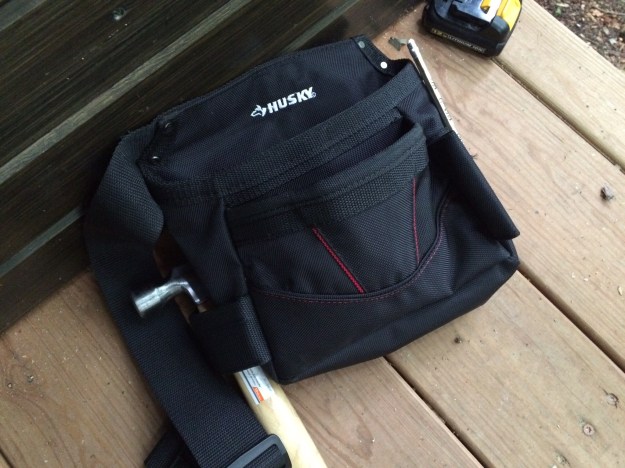
  
It’s not canvas and its’s not leather or suede, so I’m hoping they’ll leave it alone. I’ll leave the other leather one out so they can eat it, and hopefully be distracted away from my new tool belt, which I’d like to use. 

Presently, there is also a squatter in the tiny house, which is another reason to get the door put on sooner rather than later. I had to use my flash to get this next picture because it’s dark and overcast outside, and there aren’t any lights in there yet. When I went into the house today to gather tools, etc, I moved some wood against the wall and the “squatter” went flying out. 
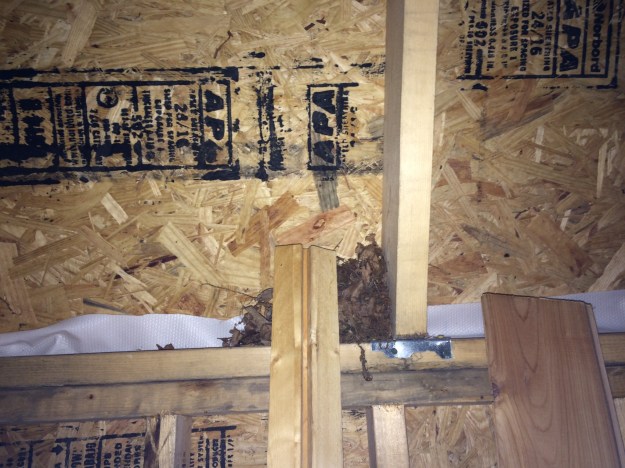
  
The ladder was outdoors at the time or I would’ve climed up into the loft to get a look in there since it’s right next to the loft. 

I’ve decided that as long as there are no eggs, the squatter is OUT.  I’ll be going in tomorrow even if it rains to finish installing angle ties at various joints throughout the house, so I’ll get a chance to look in on it. 

If there are eggs in there, however. . . well, I’ll probably let her stay and get the little ones seen to until they’re independent. . . and THEN — the whole lot of them are out

(If that’s the case, you’ll be getting lots of updates about the “renters”.)

*sigh*

Although it’s pretty awesome all told, the whole truth has to include serious physical discomfort of the kind that would make most people really cranky, unhappy, uncomfortable, and resentful — which is why I don’t invite over many helpers. Assuming it were possible to plan around the rain so as to avoid jerking around someone’s schedule for days or weeks at at time, they’d still be coming over to “help” in really uncomfortable conditions that would be untenable for someone with a low tolerance for bugs and creepie-crawlies.  Because they’re everywhere

Remember how cranky Luke Skywalker got when he was stuck in the Dagoba system visiting Yoda? Remember how there were things crawling over everything and it was really damp and humid and mucky? Well, that’s not far from the truth of what it’s like down there right now. I may not be training to be a Jedi Knight under these conditions (which would make anyone cranky — let’s face it), but building a house in it is definitely a Jedi lesson of sorts. Many things will look easy after this. 

I don’t mind the creepie-crawlies and non-vandalizing neighbors so much, but the biting insects combined with the heat and humidity make for a pretty uncomfortable day’s work. I just pulled a tick (attached!) out of my hair as I was writing this, in fact. 

There’s really no option but to accept the terms and conditions, and do your best if you have no choice, which is what I do. Most of the time it doesn’t bother me too much. But if I had a choice, I’d probably choose to go to the pool or do something else that’s less uncomfortable. 

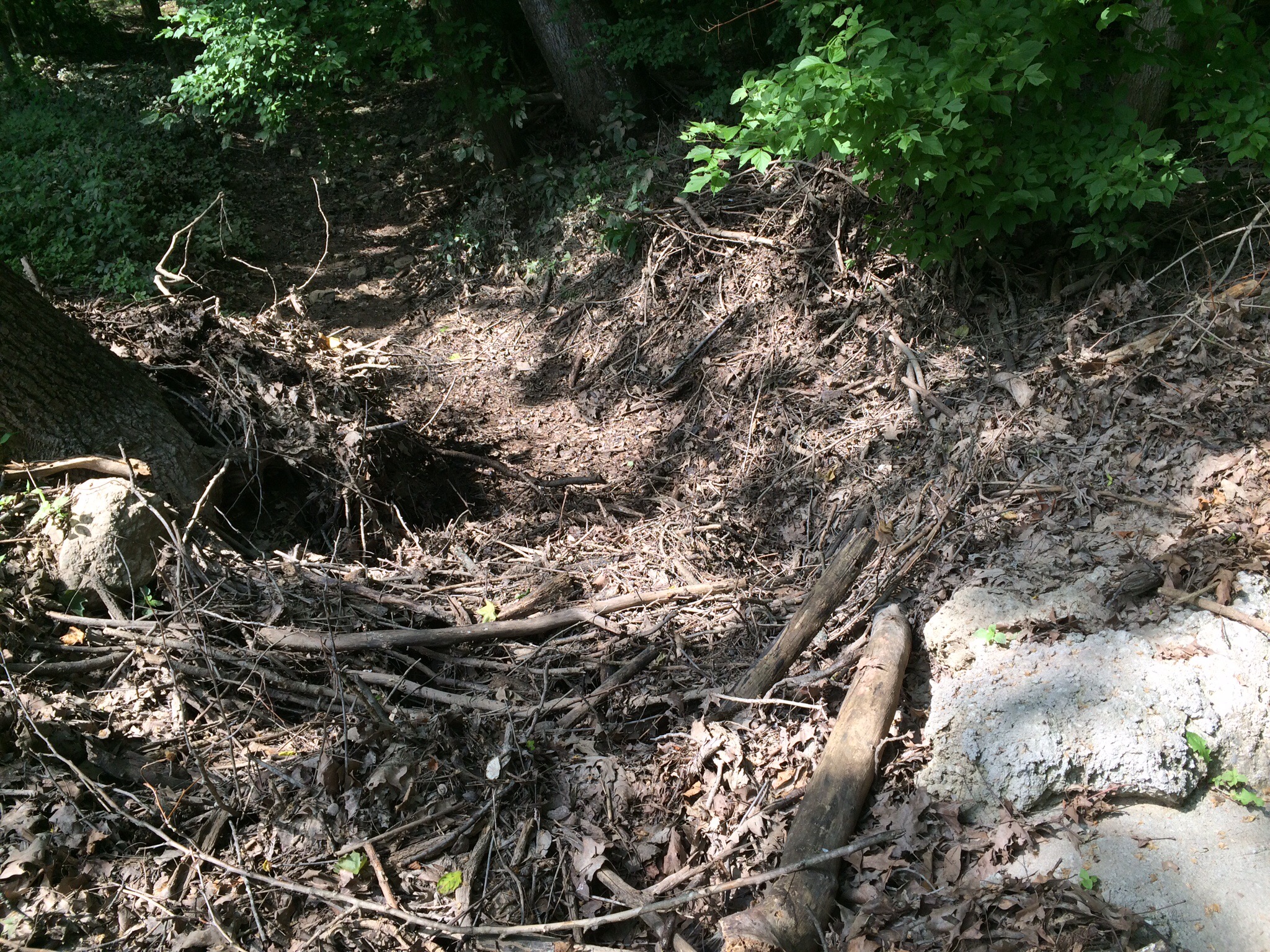
Also, it’s fine if I’m just managing my own work and discomfort; I usually even enjoy it now. After the springtime clean-out of the creek culvert a few weeks ago, most outdoor jobs look pretty good by comparison. That was a hot, dirty job that would likely have given Mike Rowe a run for his money. Fortunately, we got to it before all of the heavy rains started up, or the resulting flooding would’ve been seriously problematic for us and our neighbors. I’m really, really glad we did this when we did; if we’d waited any longer I’m not sure how it would’ve gotten done. We caught a brief moment when there wasn’t any water in the creek on that side, and the culvert was completely blocked over with heaps of leaves, branches and even a 15 foot tree — all of which had come from upstream. Armed with pitchforks and gloves, Dad and I dove in. Here’s the before picture: 
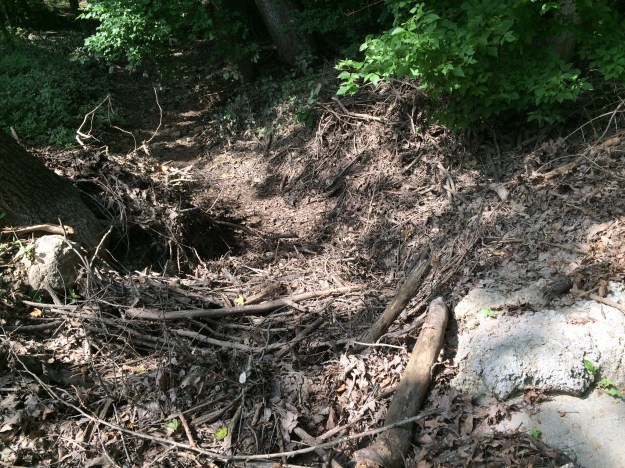
  
I don’t have an after picture, but perhaps I should get a “current” one for comparison. With all the rain we’ve had here over the last month, I’m so grateful that we’re not confronting problems with flooding. So many people are right now. We also have the fortune not to be confronted with drought, for which I am also grateful. 

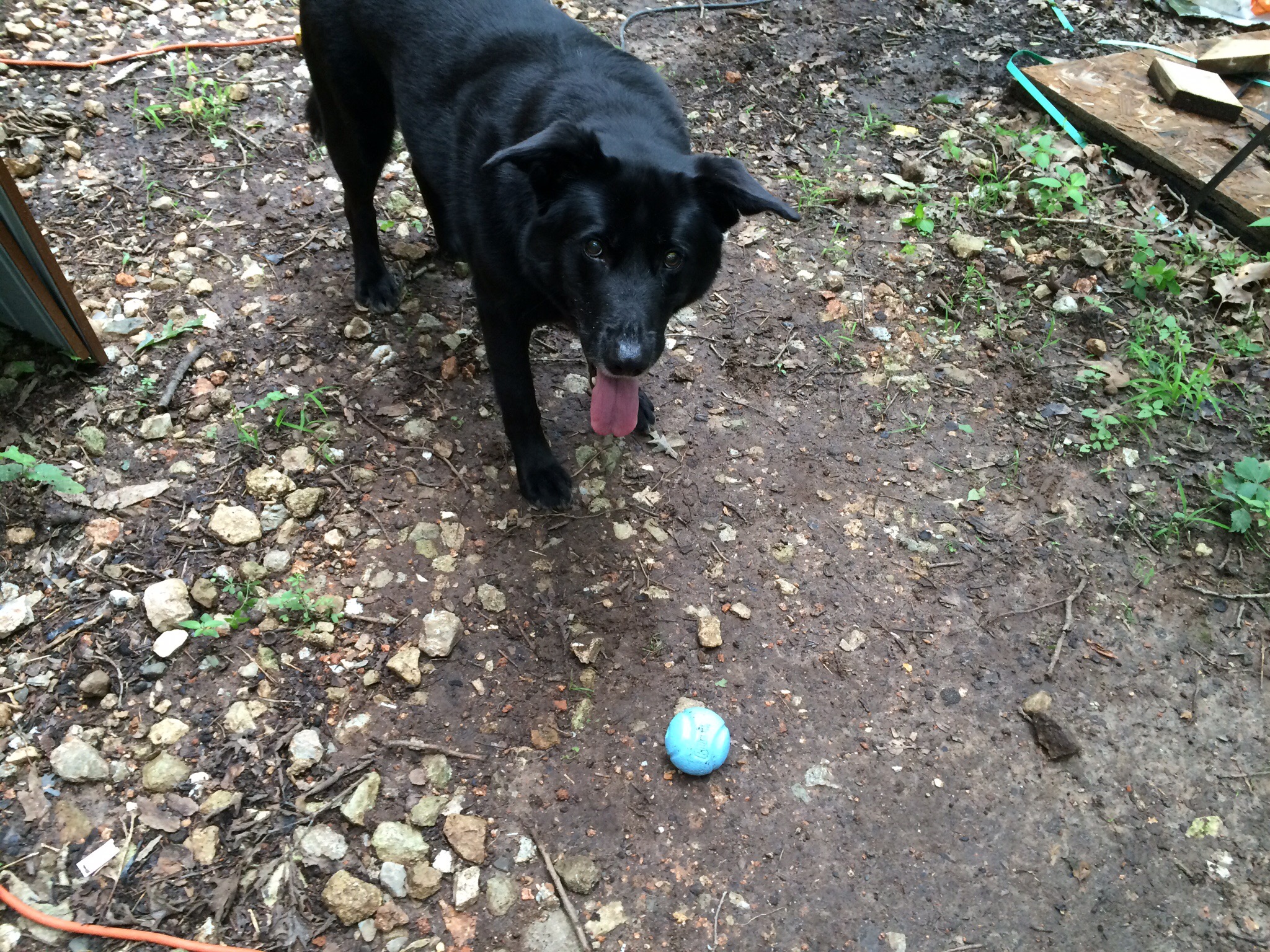
So for the mean time, I’m pretty happy pretending to be Luke Skywalker in the Dagoba system with my very own version of an R2 unit. But most of you know him as Noah.  He’s pretty good company, actually, and never complains, unlike the real R2D2. 

Noah spends most of the day just like this:
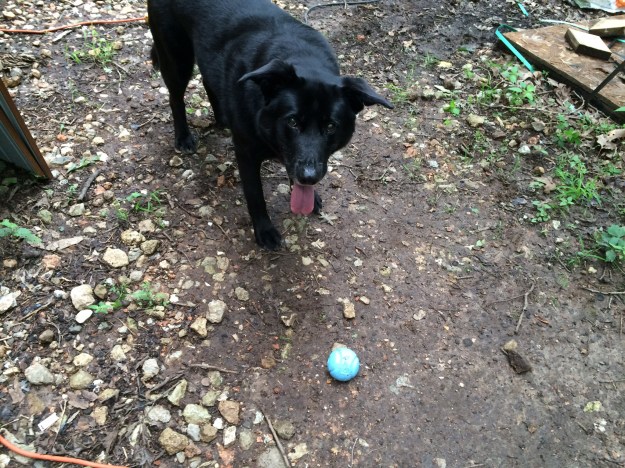
  

It makes him about as useful as R2D2 was in a similar environment, but much cuter and no sass. Small breaks to throw his ball again make him soooooo happy! They’ve become little opportunities to check in, be mindful, and reconnect to what’s all around. Noah’s always been the most effective, loving mindfulness teacher. No joke.

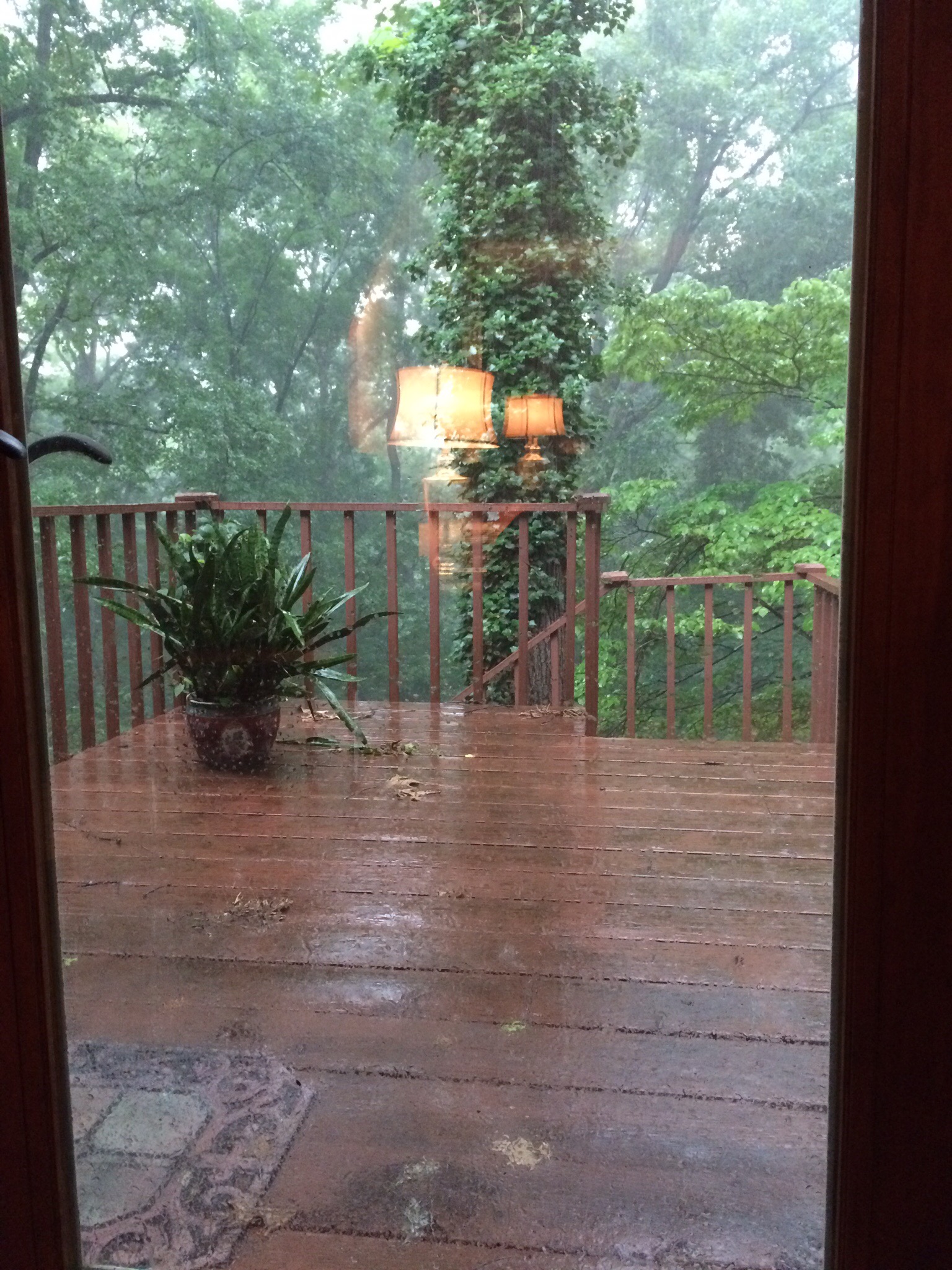
 As I write this, indoors, clean and dry, the weather radio is going nuts and now it looks like this outside:
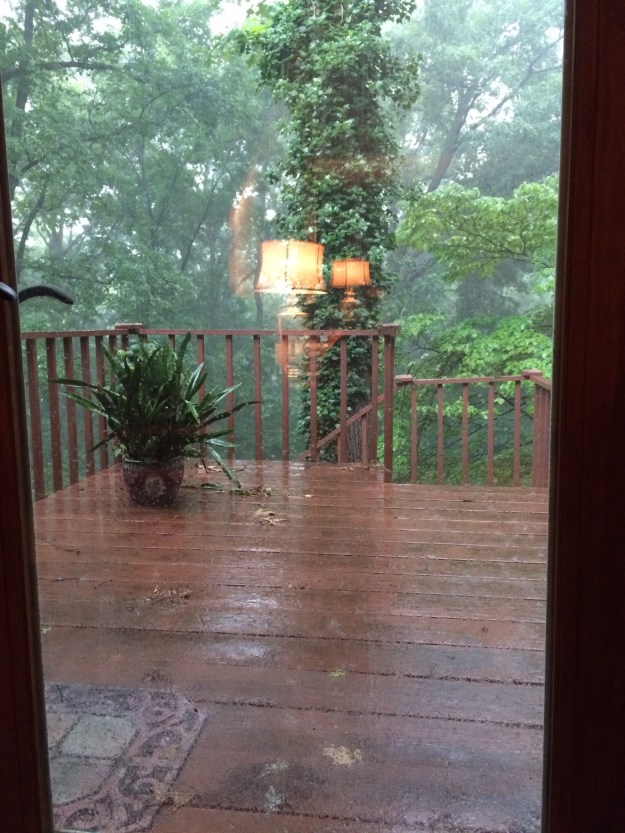
  

So much to be grateful for. 
 

The Tiny House Update That’s Been a Long Time Coming. . .


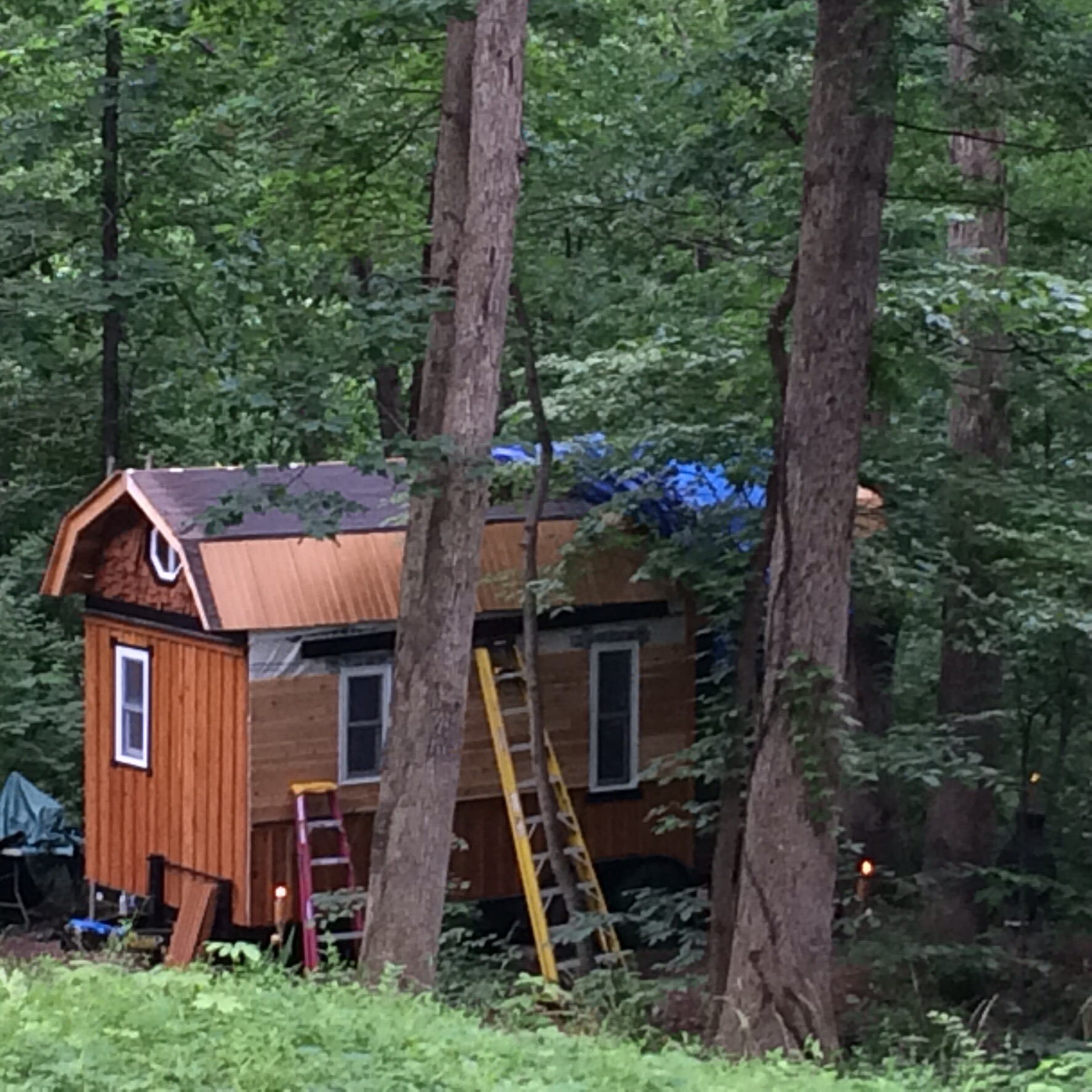
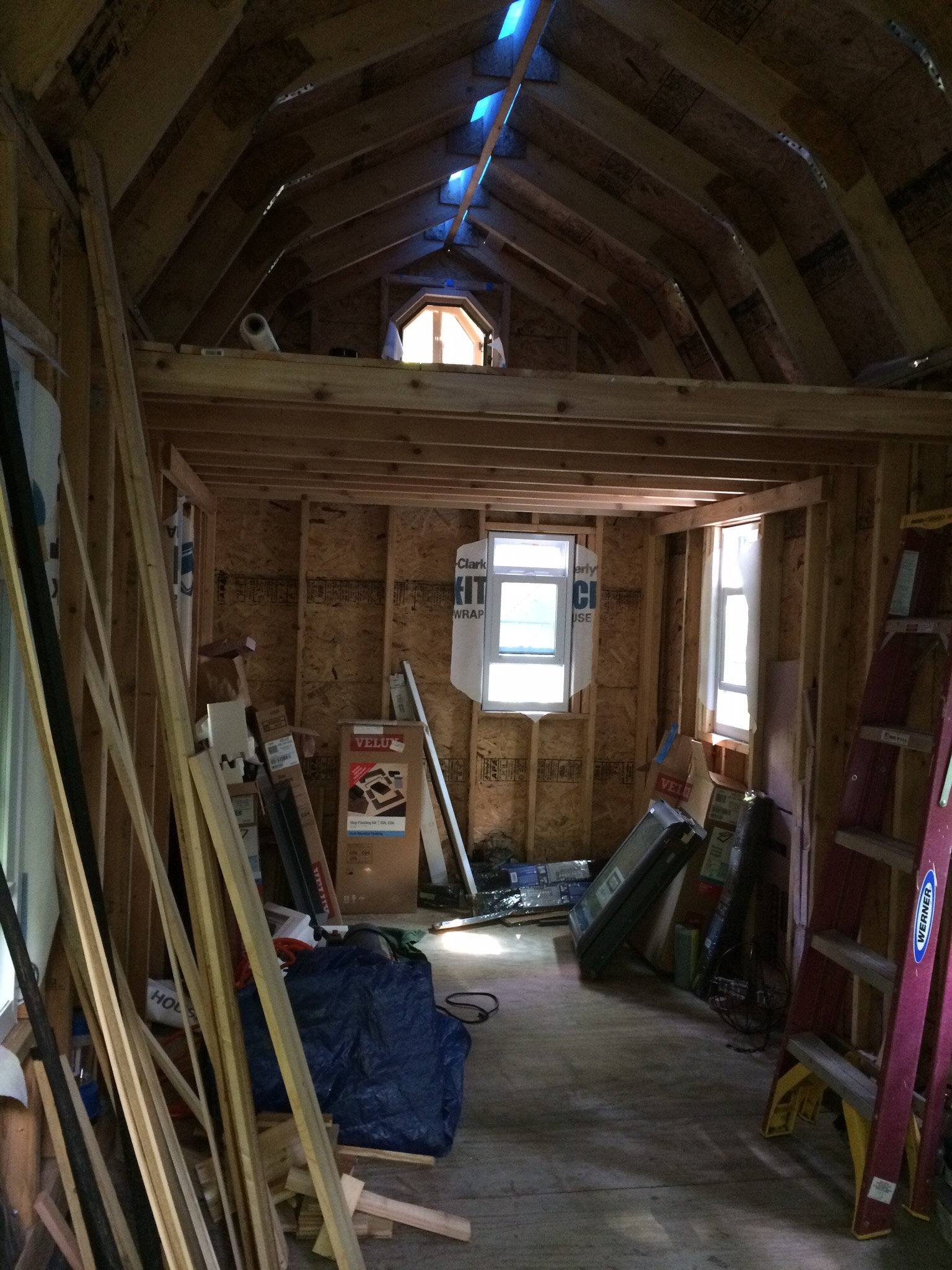
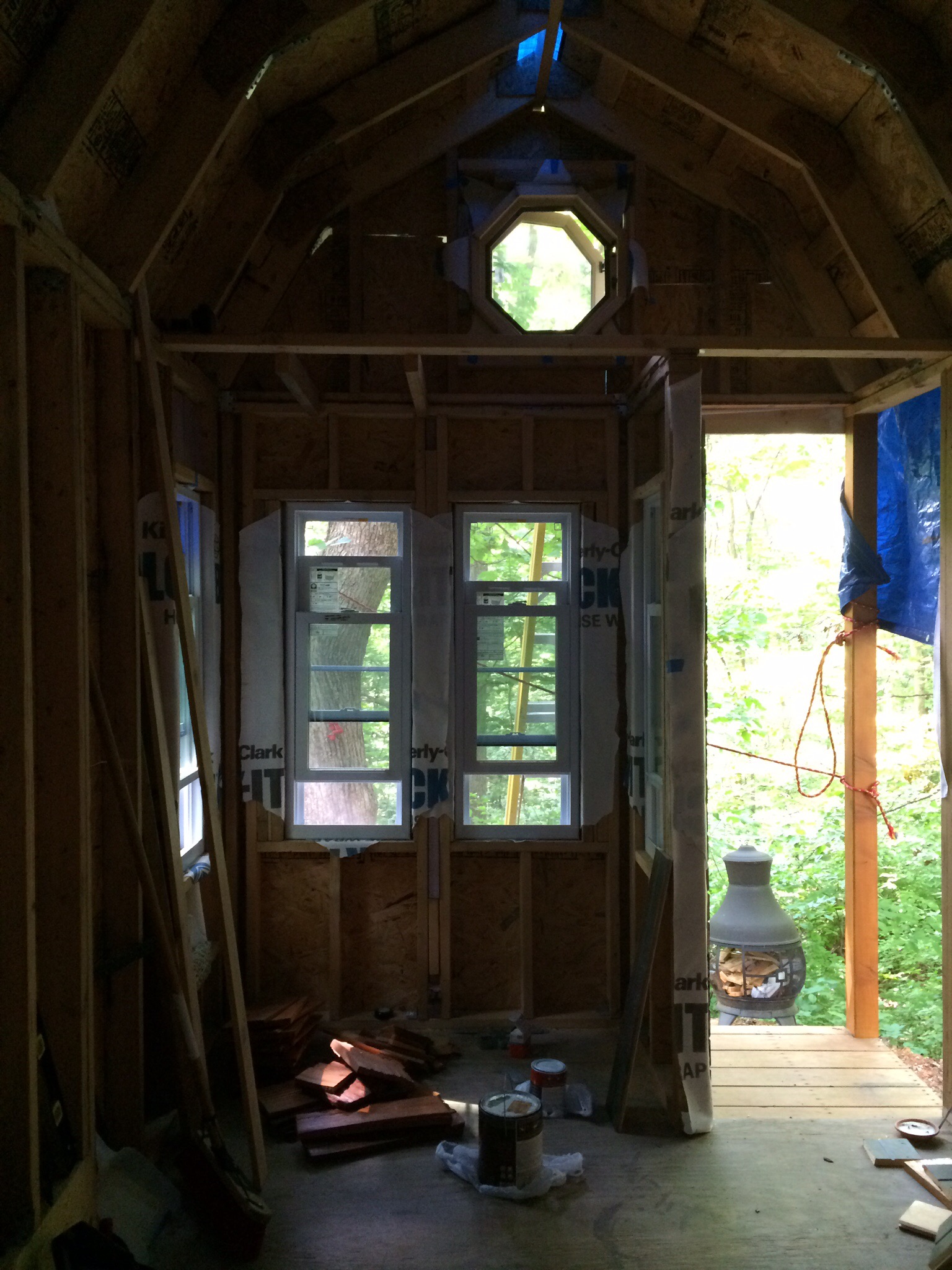
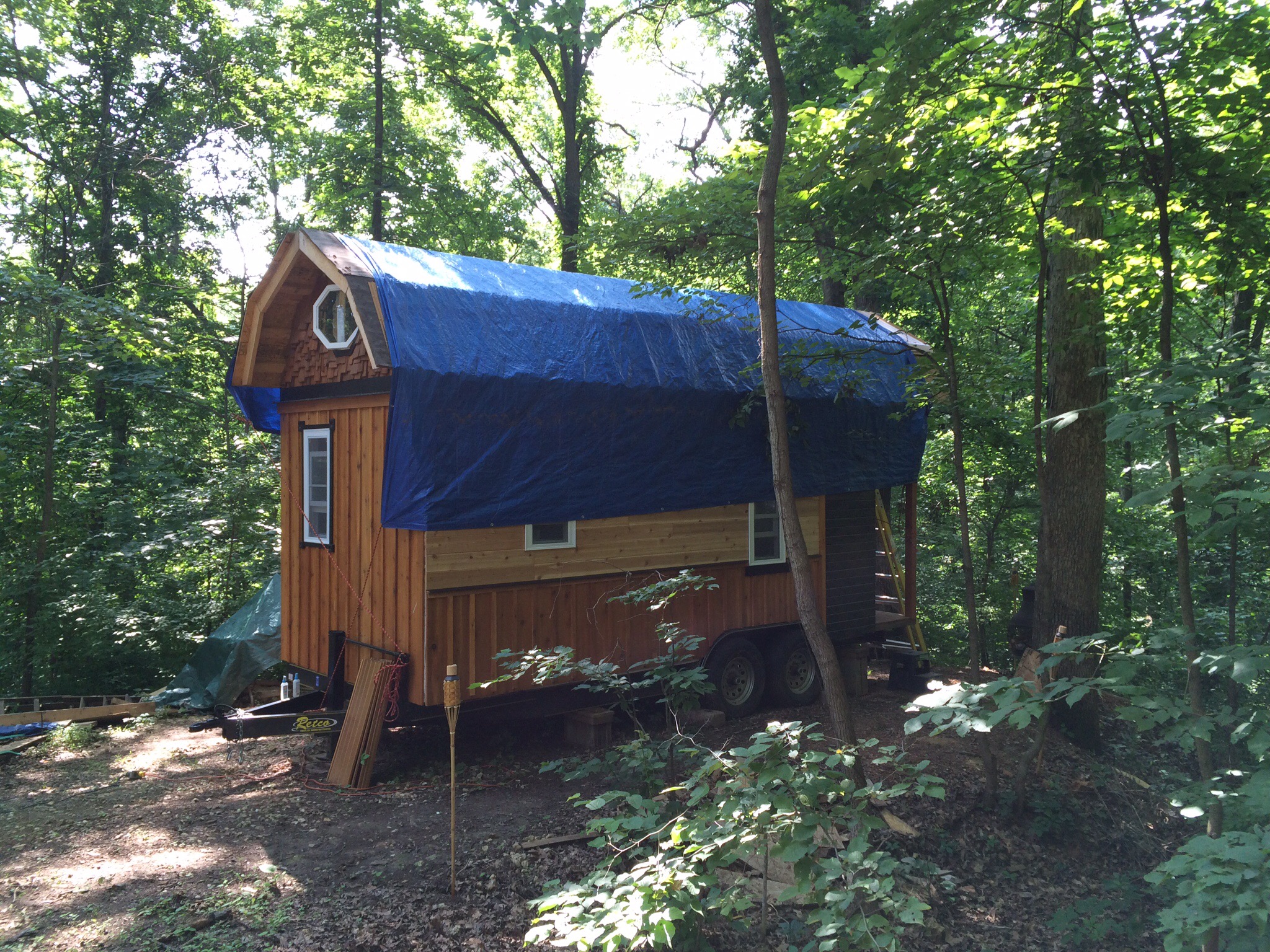
The  Tiny House is definitely coming along, and this first photo pretty well represents where it is at the moment. The rain and inclement weather throughout June put the kabosh on continued work on the roof, but before it got too bad, we were able to get a fair amount of it done. The skylights are the next step before the roof is done and dusted. 
  
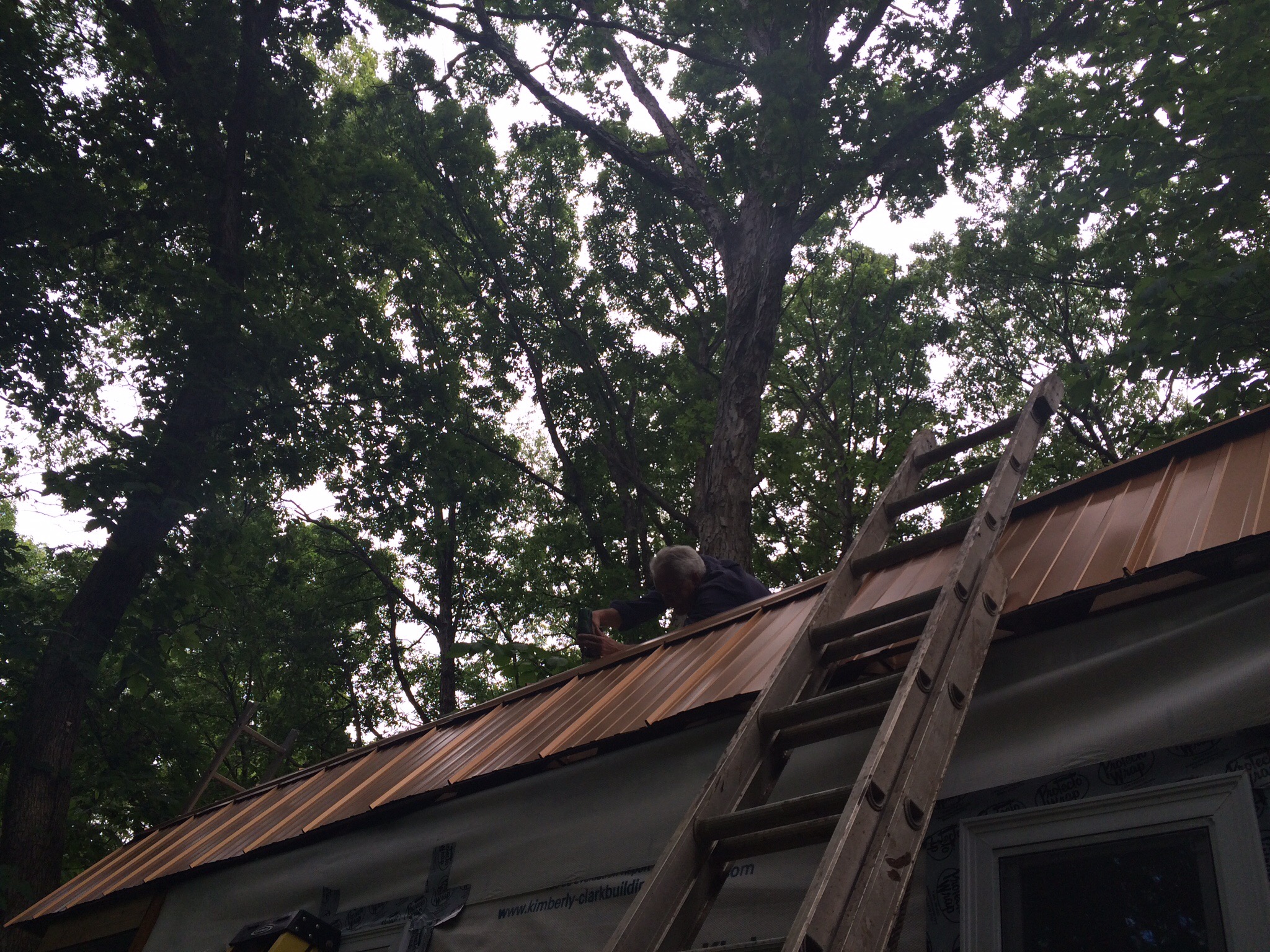
My friend Bob came over in May to help me get the roof started up again, and offered some excellent suggestions for finishing the exterior. Once we’ve got the house under roof, it’ll be time to move inside and tackle the wiring and insulation! It’s been important to remember of late that the work ahead is not as brutal as the work already completed. 
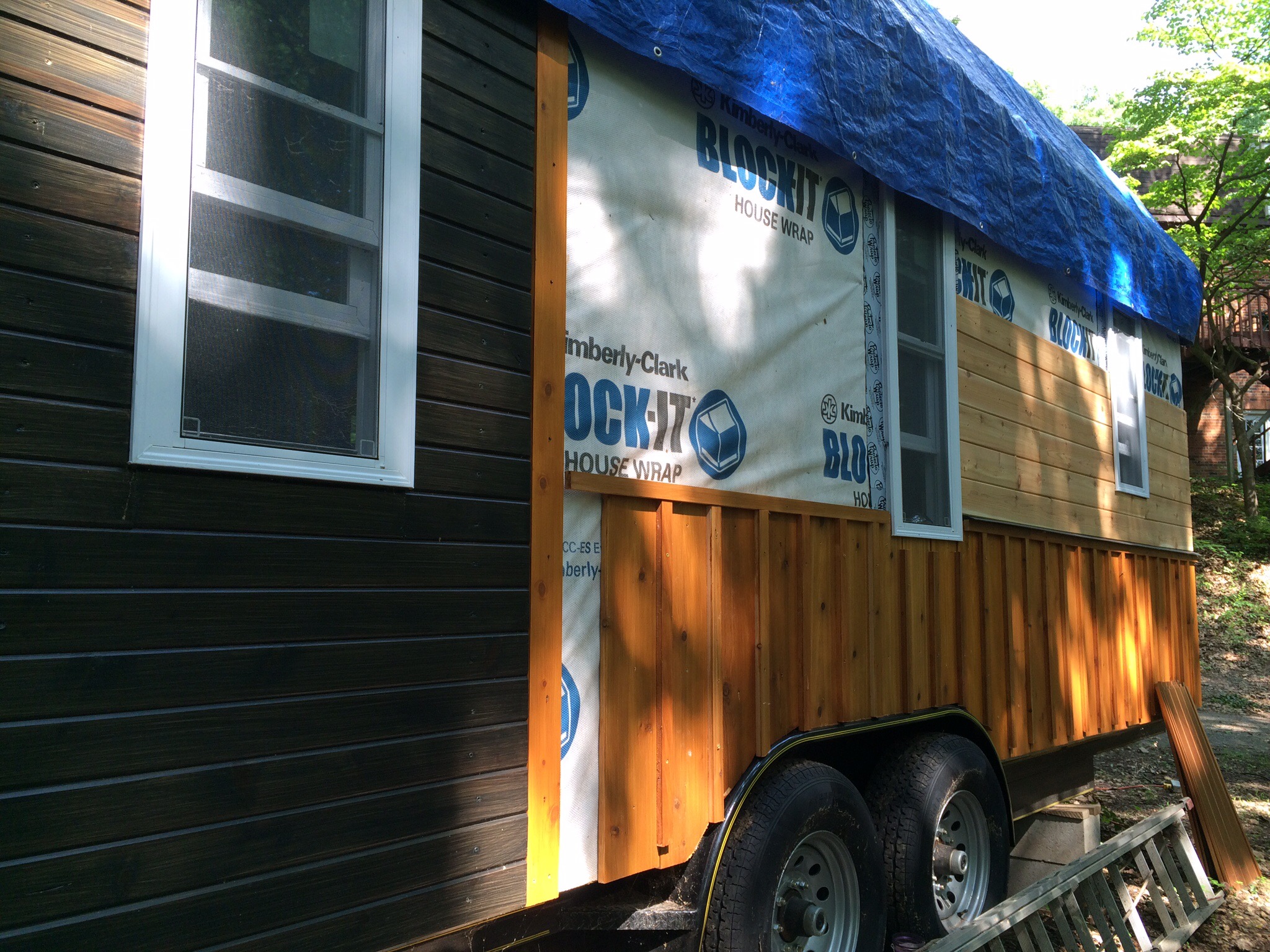
There’s not much to say that cannot be said better through pictures, so here goes: 


Thanks for stopping by! I’ll be updating more frequently as the summer goes along!

Threads That Weave Lives Together

Our lives are comprised of a series of patterns, interactions, and influences that combine in the most unpredictable ways as they come full circle.

As a theatre practitioner, much of who I have become started through the relationship with my high school drama teacher and dear friend, Tina Croghan.

Tina & I in Chicago after a night out. When I lived up there, she and Tim visited regularly.

Tina & I in Chicago after a night out. When I lived up there, she and Tim visited regularly.

Tina was diagnosed with Spastic Paraplegia several years ago, and began working with the Spastic Paraplegia Foundation (SPF) soon afterwards. Since joining, she has taken on hosting conferences in St. Louis and has devoted tremendous time and effort in support of SPF. This week, Tina and her husband, Tim, are in Seattle, WA for the SPF conference. 

Right now, all of the proceeds of items sold in my Etsy shop will be donated to SPF.  Here is a direct link to the shop: https://www.etsy.com/shop/ZenUrbanCoyote

Theatre has been a part of my life even before meeting Tina, but it was because of theatre that I began working with textiles. While directing a theatre production of The Seagull a few years ago that had a spare budget, I began piecing together tablecloths, curtains and other items for the play by hand. After the play closed, I turned them into quilts — including the purple one that has become part of the “ZenUrbanCoyote” identity. The process of repurposing and transforming something so simple– and that somehow carried so much meaning — was the start of a new investigation into what it means to create.

A year later, at the rehearsal for Tina’s retirement party, I found myself stitching on one of the Seagull quilts, contemplating the irony that we had done the musical Quilters together while I was in high school. Tina and Tim ran our drama club like a family, and those of us who were a part of it continue to think of one another that way to this day. 

For more information on Spastic Paraplegia and the extraordinary research that is taking place on this rare and debilitating disease, please visit: www.sp-foundation.org.

Cloth, Stitches, and Simplicity = Breath and Space

Since winter has finally decided to settle in, and doing any building in this weather is no longer possible until it lets up, it’s a perfect time to share something else that is very near and dear to my heart:  stitching cloth by hand.

While the tiny house building takes a break, it’s a perfect time to share some of the stitch work that has been taking shape over the winter. It isn’t that I had given it up while working on the house — far from it. 
When I started this blog up originally, it was to write about and share textile projects, theatre and movement projects, writing, subversive ideas, and anything Zen or Buddhist-related. The tiny house started becoming the primary focus of the blog somewhere along the way, and everything else — despite its continuation as part of normal, everyday life — has taken a back seat on the blog.  

In all honesty — it’s a relief to have a break from the building work and to settle into greater space, quiet, and other aspects of life. During the winter, few things can beat sitting in the warmth and stitching on something in the evening. It quiets the mind and creates space to breathe and contemplate; not just the piece being worked on, but with anything that arises. When the urge to stitch arose a few years ago, seemingly out of nowhere, it began with simplicity and organic process. After taking a few years to play and explore in a wide variety of directions, the simplicity of cloth, a needle, and thread continues to be a tremendous source of joy, creativity, and provides a space for contemplative insight.  

The instant that an outcome or result enters the picture, the joy, space, and creativity dissolve, and I may as well be designing a spreadsheet in Excel. This is the one place in my life where things can be 100% organic, fluid, relaxed, and entirely free from expectation. A sanctuary.

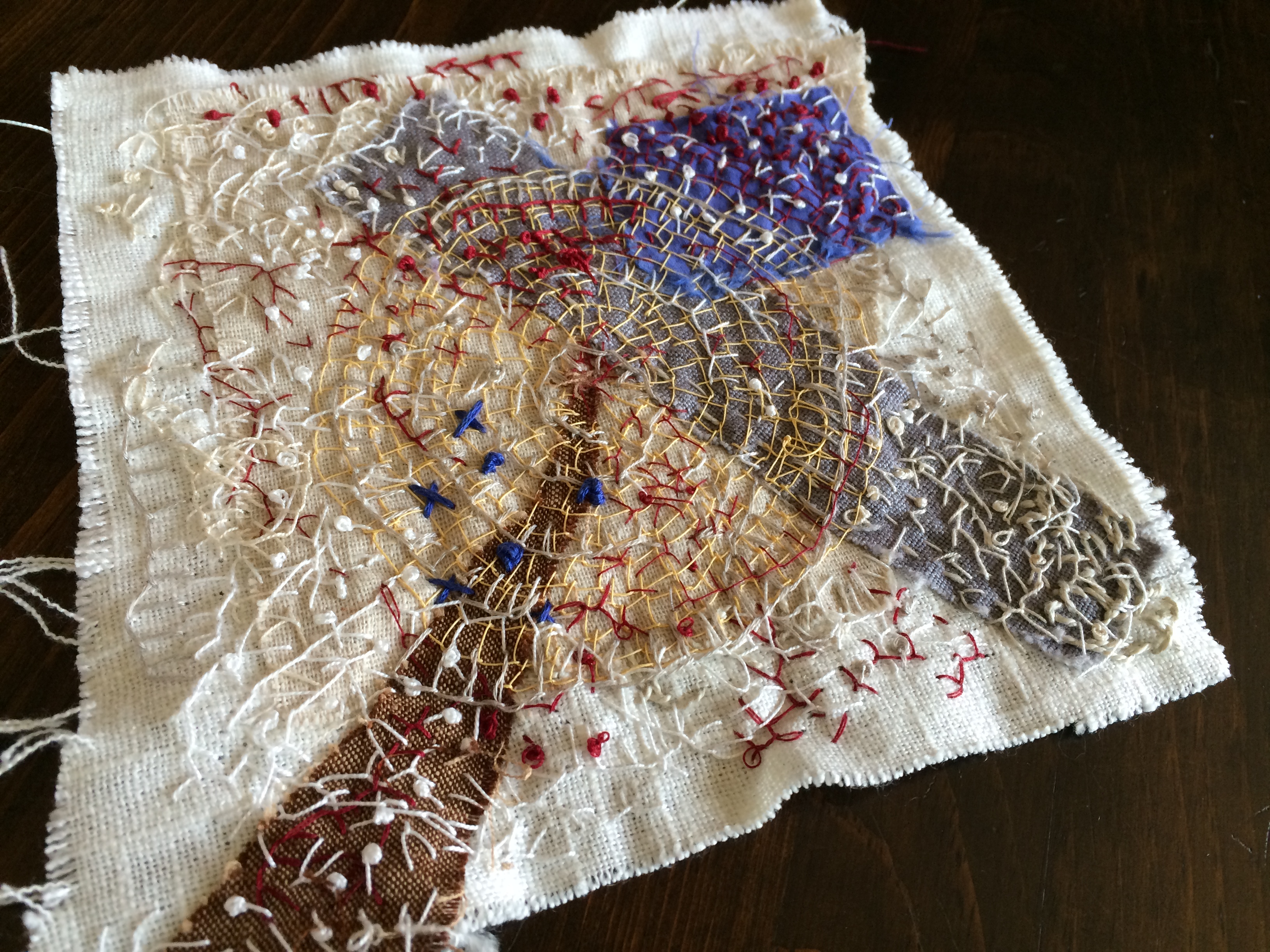
During the tech process for A Christmas Carol last November, I knew that it would be wise to keep my nervous system grounded and slowed down with a piece of stitching at hand. Recognizing that it would need to be something that I could drop at a moment’s notice and play with in poorly lit conditions, I started with assembling scraps into tiny collages.

This was the piece I started with first:

"The Missing Piece"

“The Missing Piece”

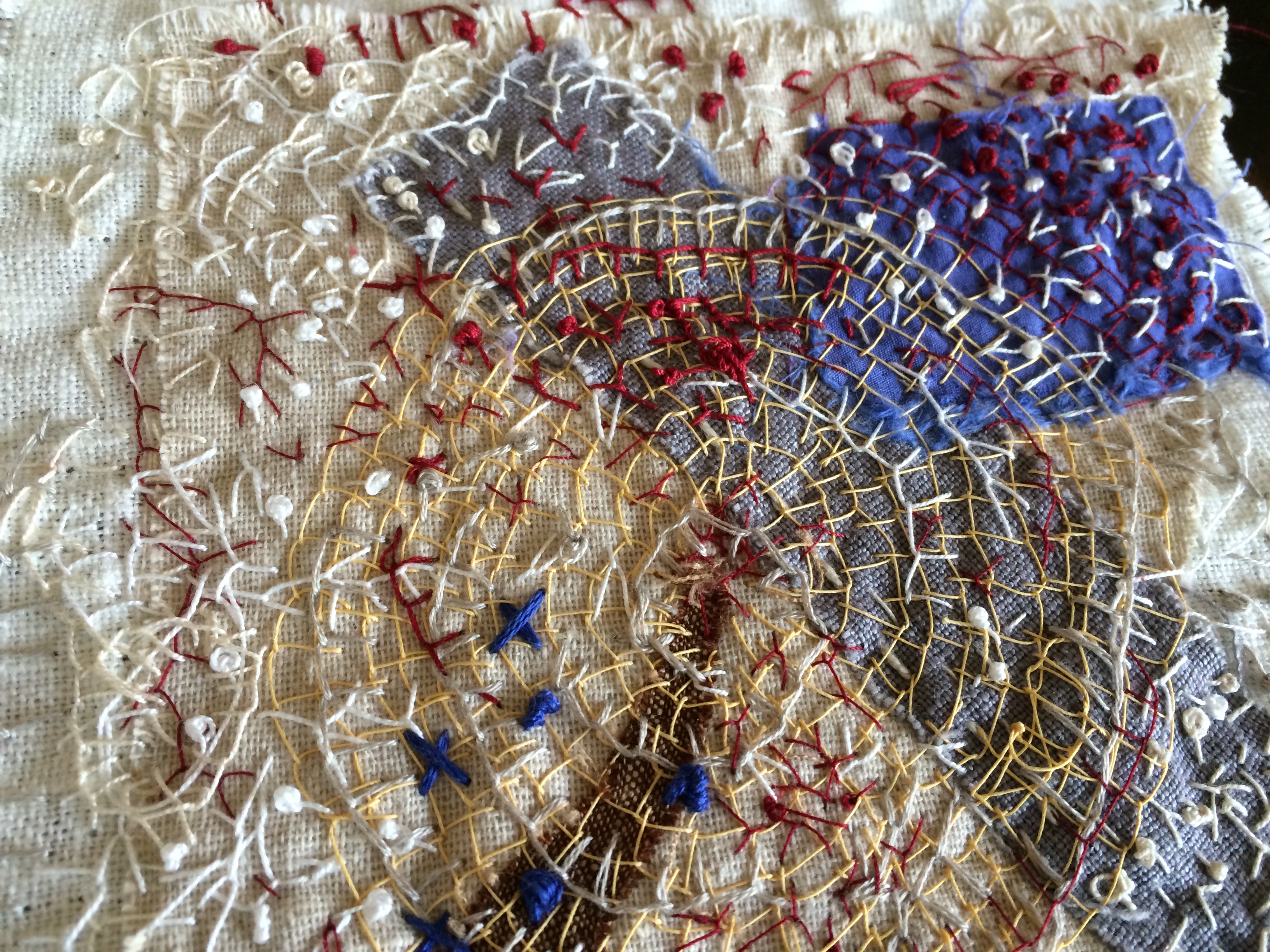
"The Missing Piece" Detail close-up

“The Missing Piece” Detail close-up

I call it “The Missing Piece” because it reminds me of the shapes from the story book by Shel Silverstein. It’s also because as soon as I started working on it, I realized how much I had missed the tactile simplicity of stitching something. The impact of it is instantly beneficial and calming.  Working in a circular fashion is also very soothing, as is the pleasure of changing the stitch at a moment’s notice, breaking every known rule imaginable, and just playing until that particular thread runs out. The inspiration to work that way comes from the fiber artist Junko Oki, and her trademark technique, “Woky Shoten”, which means “unbroken stitch”. It’s incredibly fun and freeing. (There are several more to come in another post!)

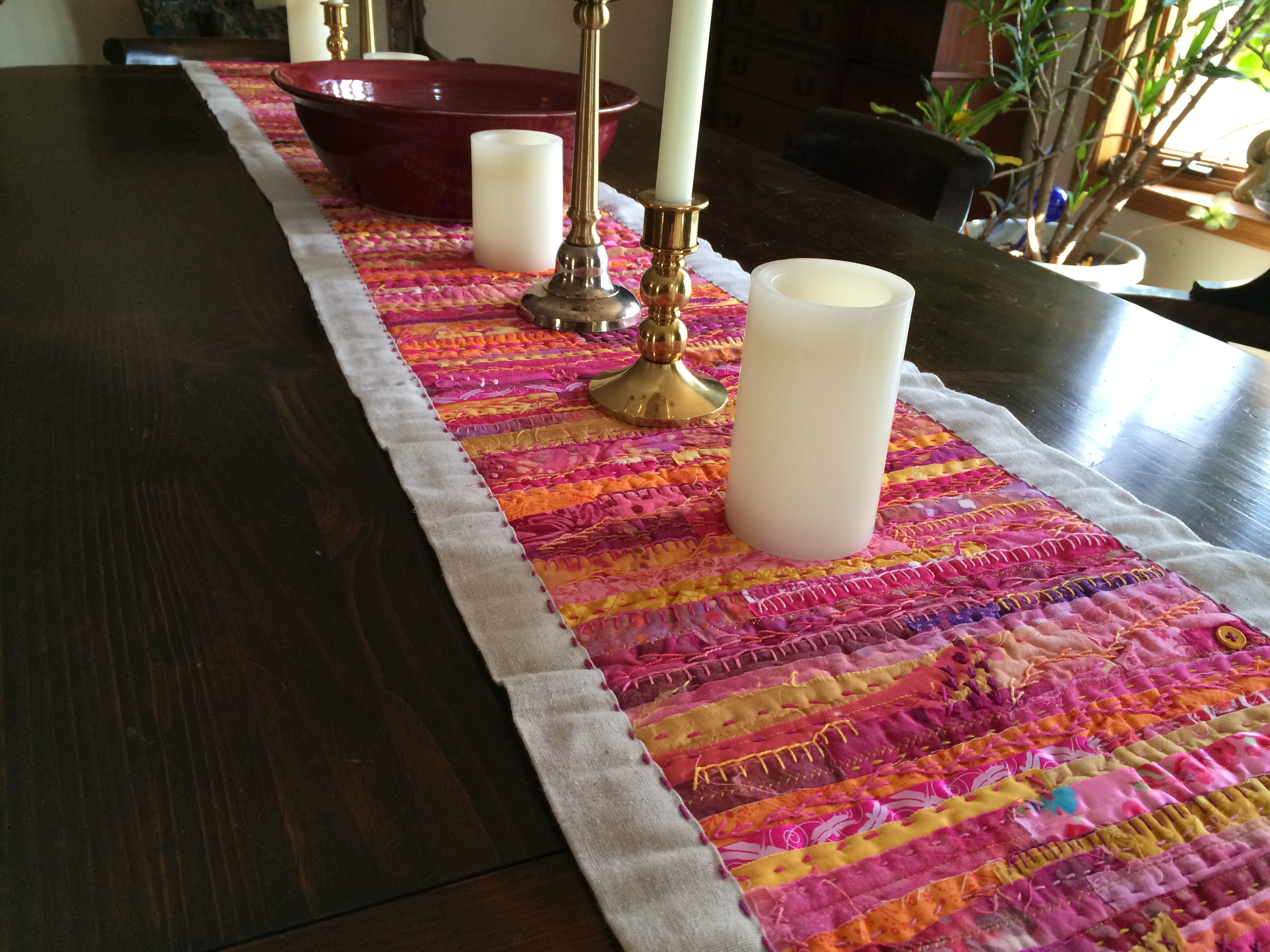
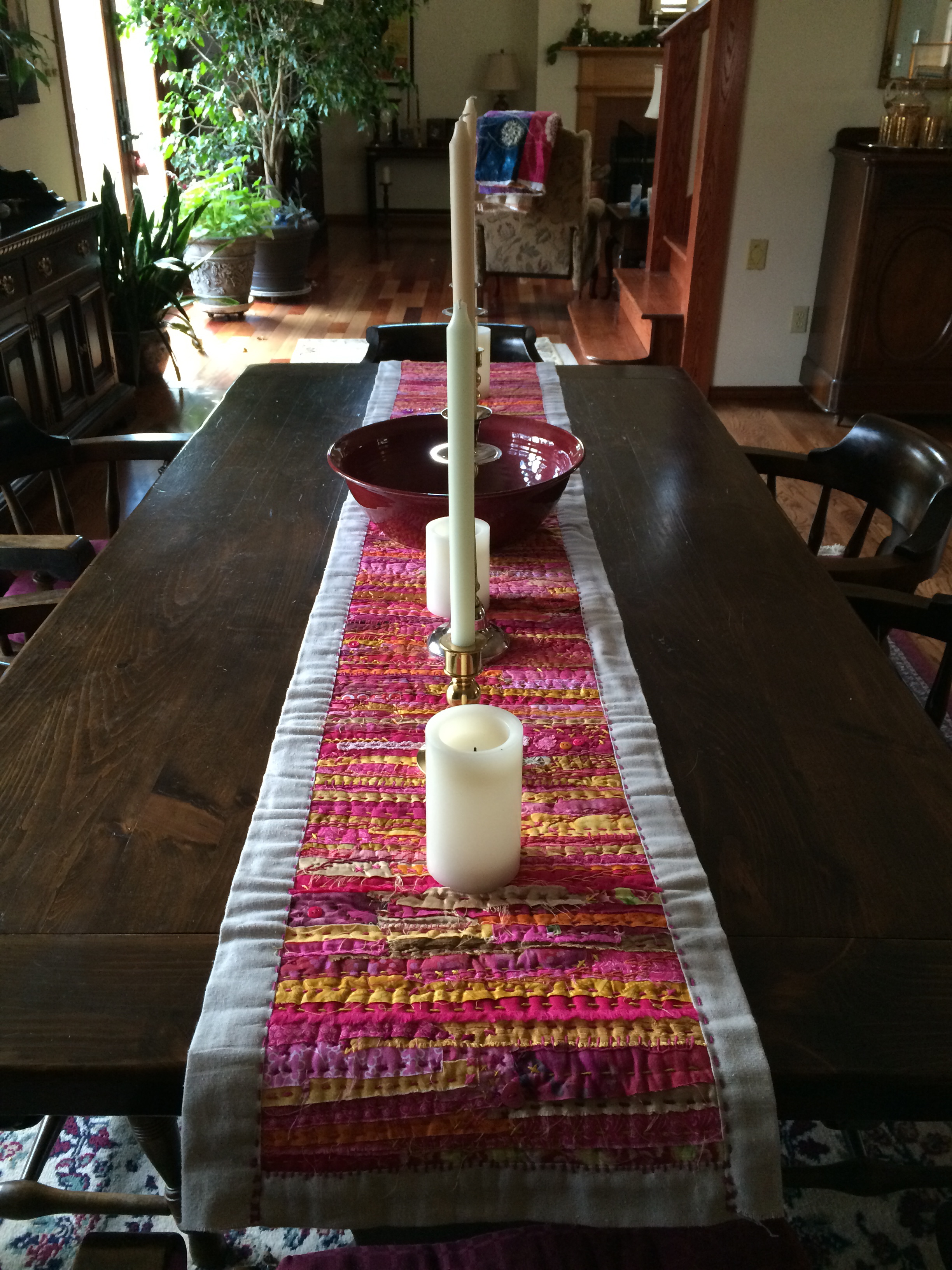
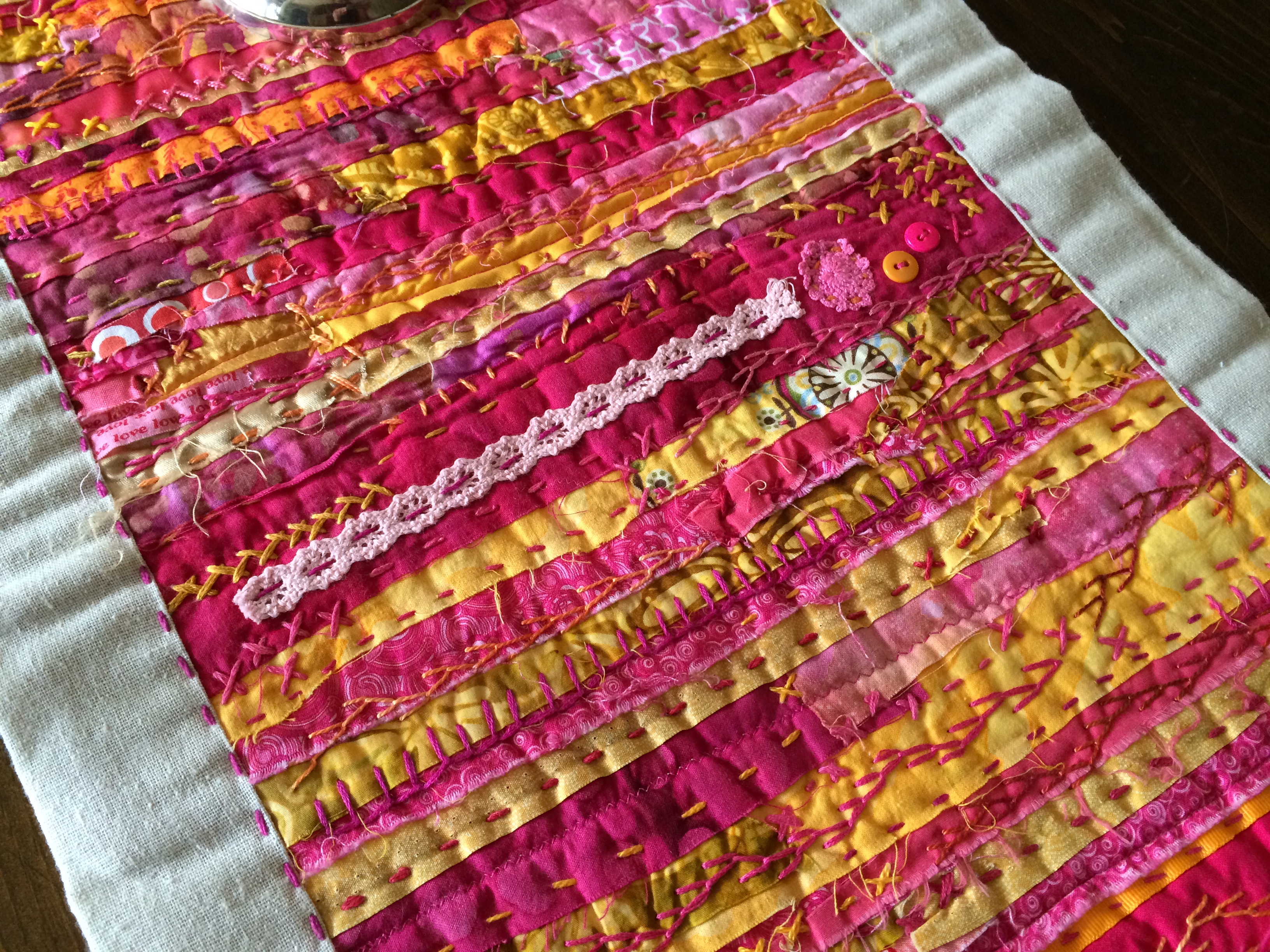
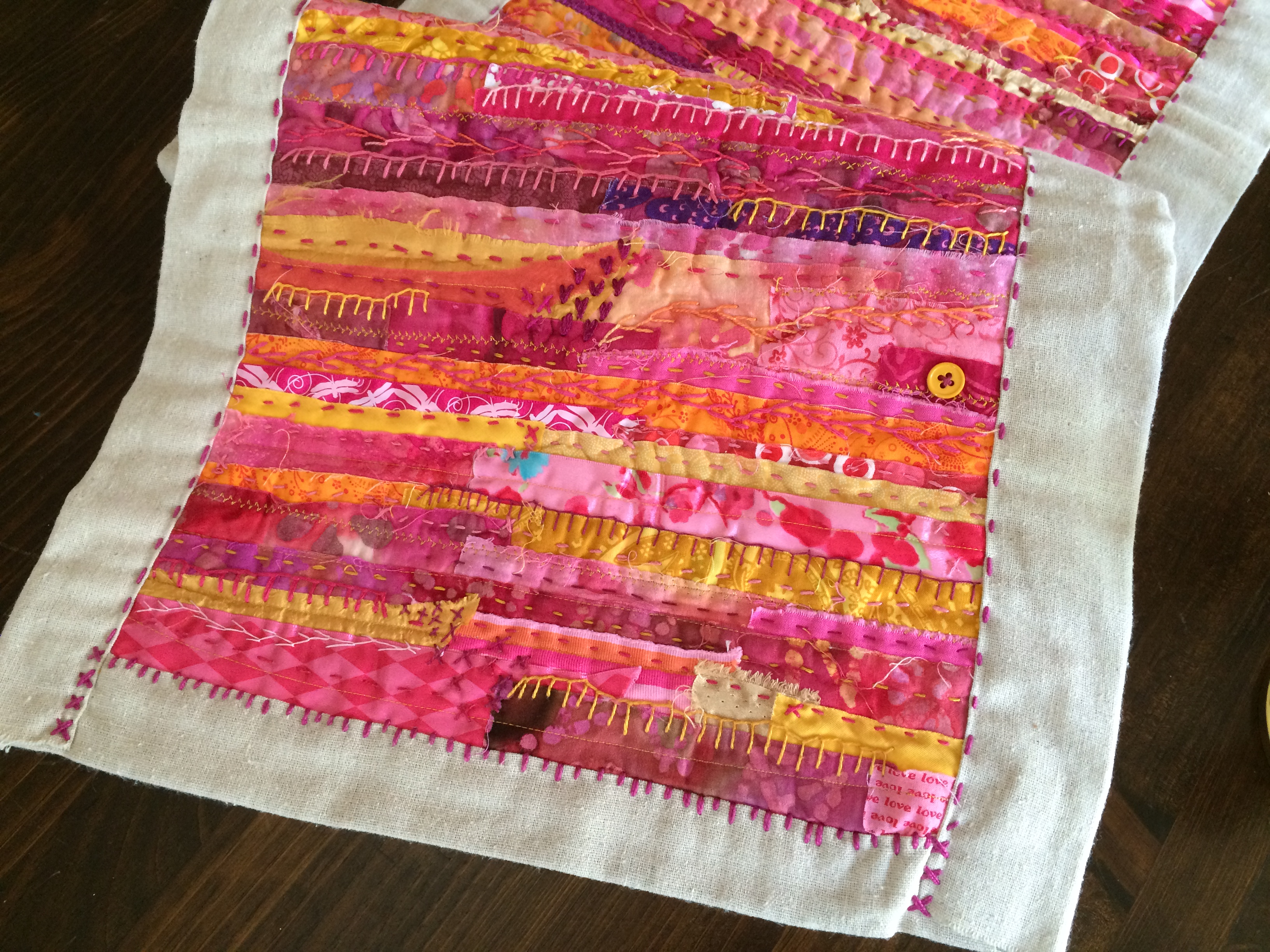
As Christmas began approaching very quickly, however, I remembered a table runner I’d started for my mother back in 2012, but had never finished. At the time, it felt like too much stitching (you’ll see why in a minute!), so I put it away for a while. It was another perfect piece to work on during tech rehearsals, and turned out beautifully. I love it; and I’ll probably never make one like this again:

Sunset Table RunnerIMG_4951 IMG_4924 IMG_4939

The table runner matches some of her hand-thrown ceramic bowls, so she was thrilled. It’s covered in kantha stitching, blanket stitches, feather stitches, french knots, and heart stitches (which I made up). The strips of ribbon, selvages, and other scraps are fused to the batting. . .making for very stiff stitching and sticky needles. Now that I have a greater familiarity with different ways to fuse fabrics for collaging and stitching, doing something similar in future could be a much more pleasurable experience.

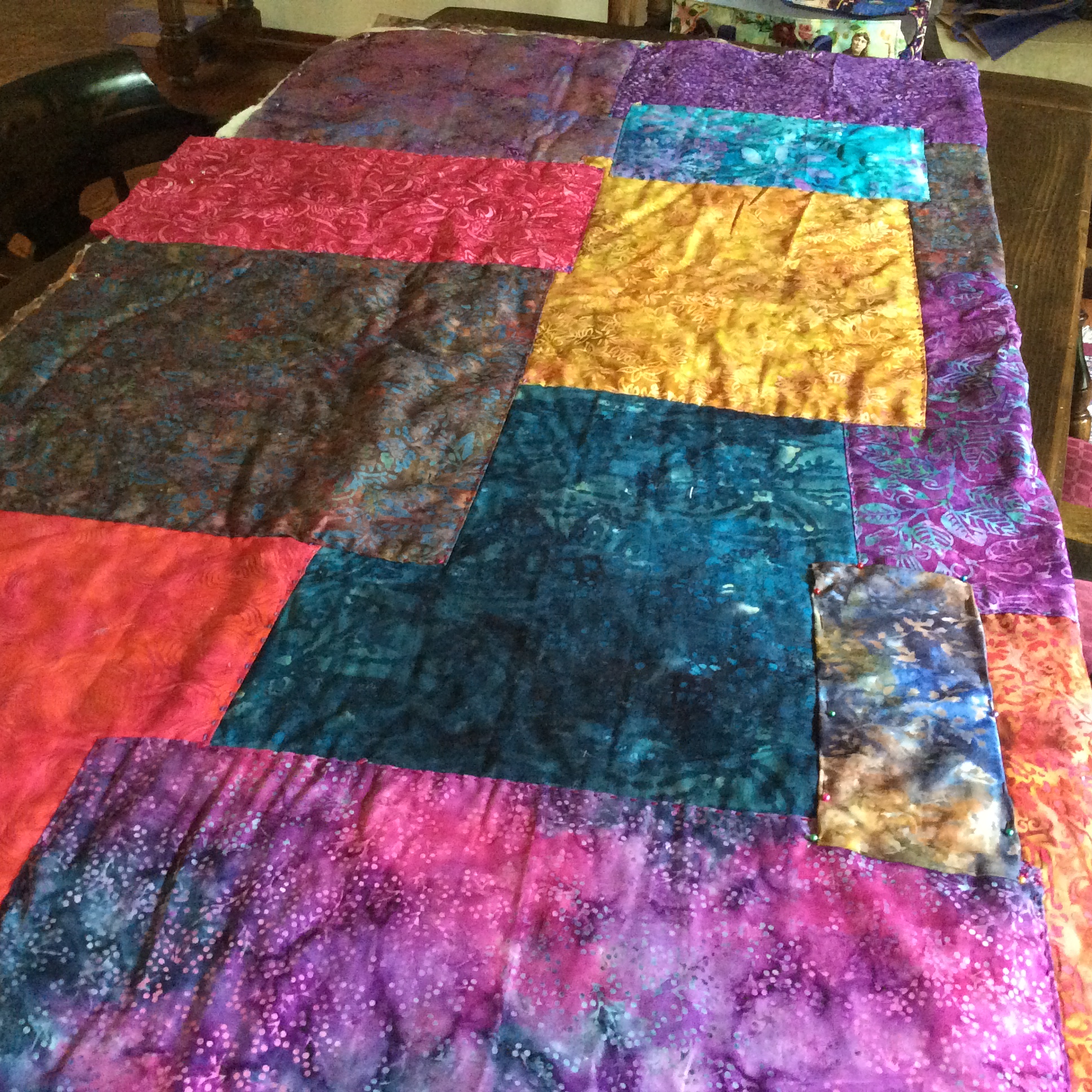
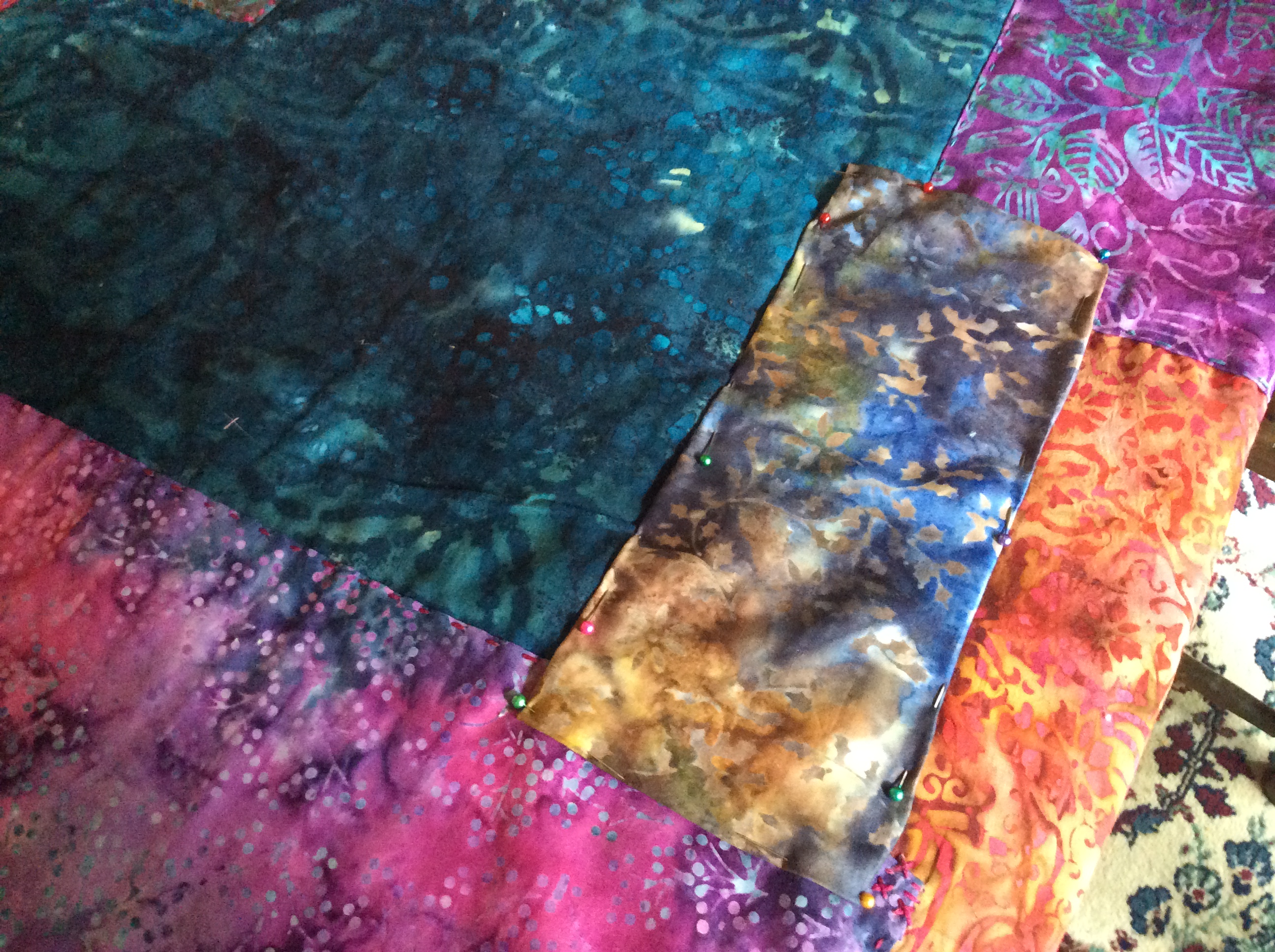
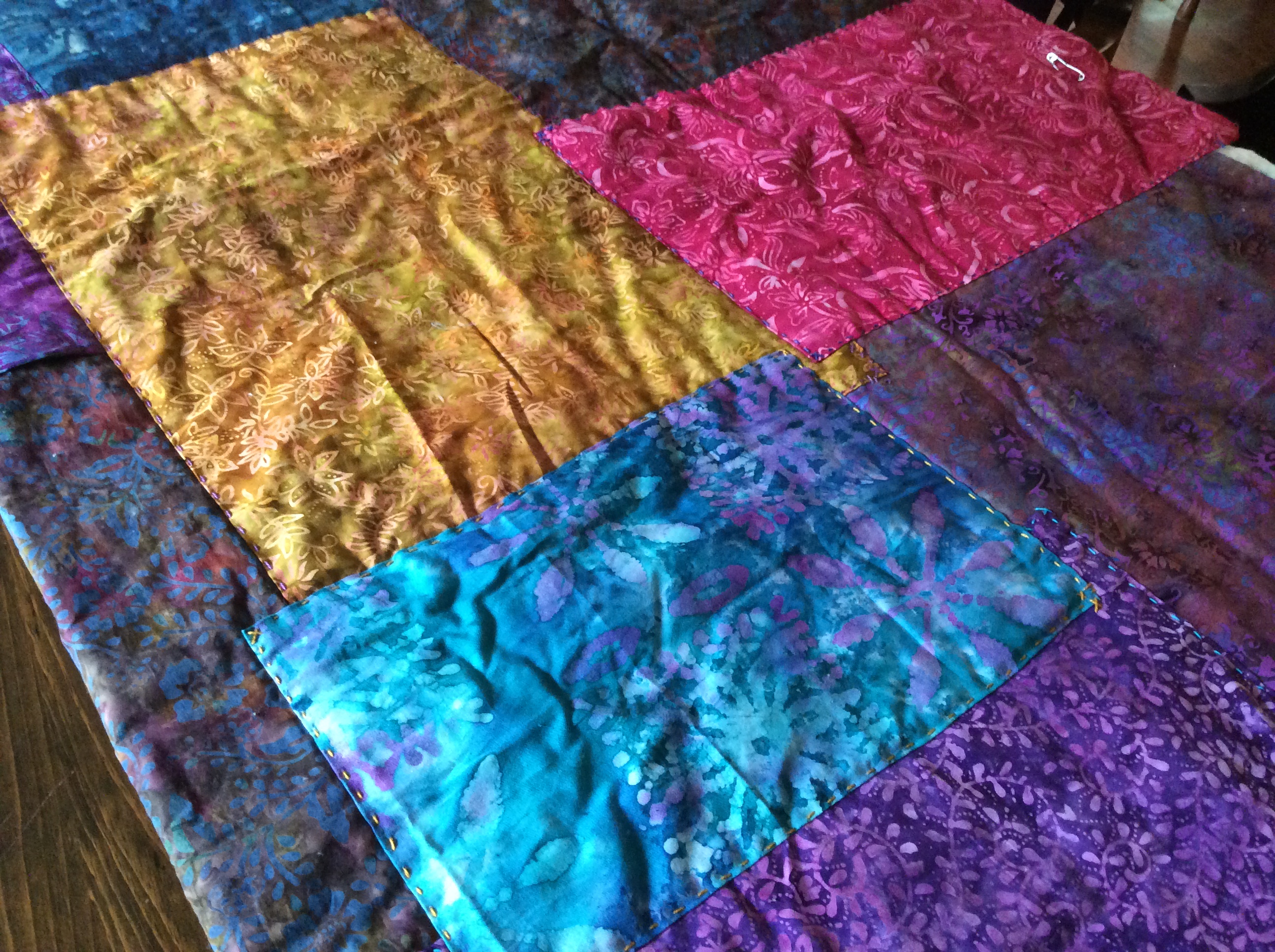
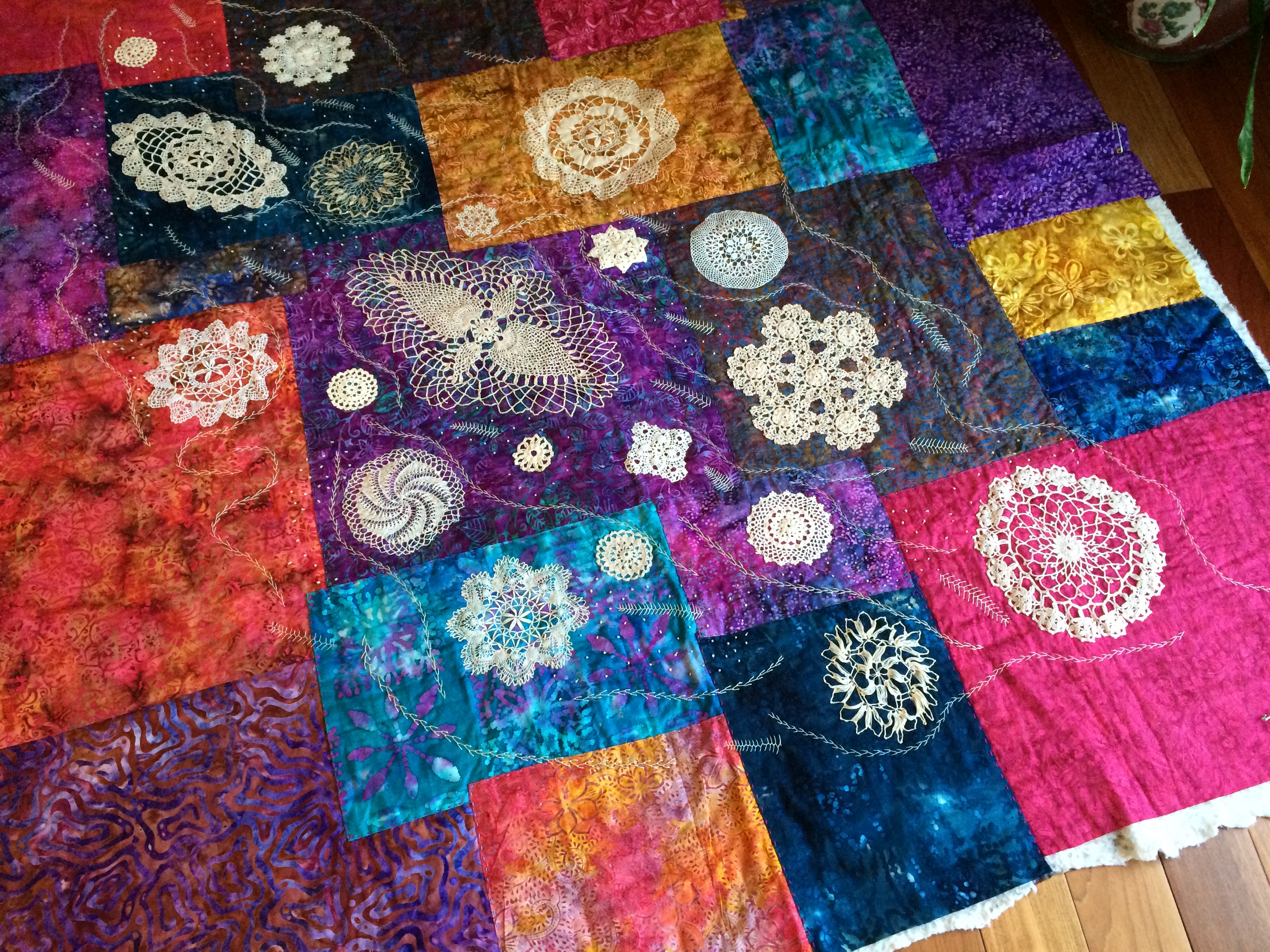
And finally, there is indeed a quilt that is taking shape slowly over the winter months. I have no idea what it will be called. Right now, there is joy in the color and playing with the stitches.

IMG_0385 IMG_0386 IMG_0388


This is another of what I refer to as a “boro-style” quilt. “Boro” means “rag” in Japanese, and traditionally they are stitched together to make quilted blankets. They’re very simple and often breath-takingly beautiful. This particular one is not making use of indigo-dyed, upcycled fabric scraps, it’s made from store-bought commercial batik fabrics. (I’m uncomfortably aware of the cultural appropriation taking place here, and its dissonance when contrasted with white, western privilege, so it’s transparently “boro-style” in this case.)  The process itself is pretty straight-forward: I choose the fabric for the backing, do any measuring and stitching, and then trim the batting and secure it to the back with basting spray, which creates a blank slate. Once the batting is secured to the back of the quilt, it’s possible to begin laying out patches of fabric and stitching them directly to the back of the quilt until it’s all covered.

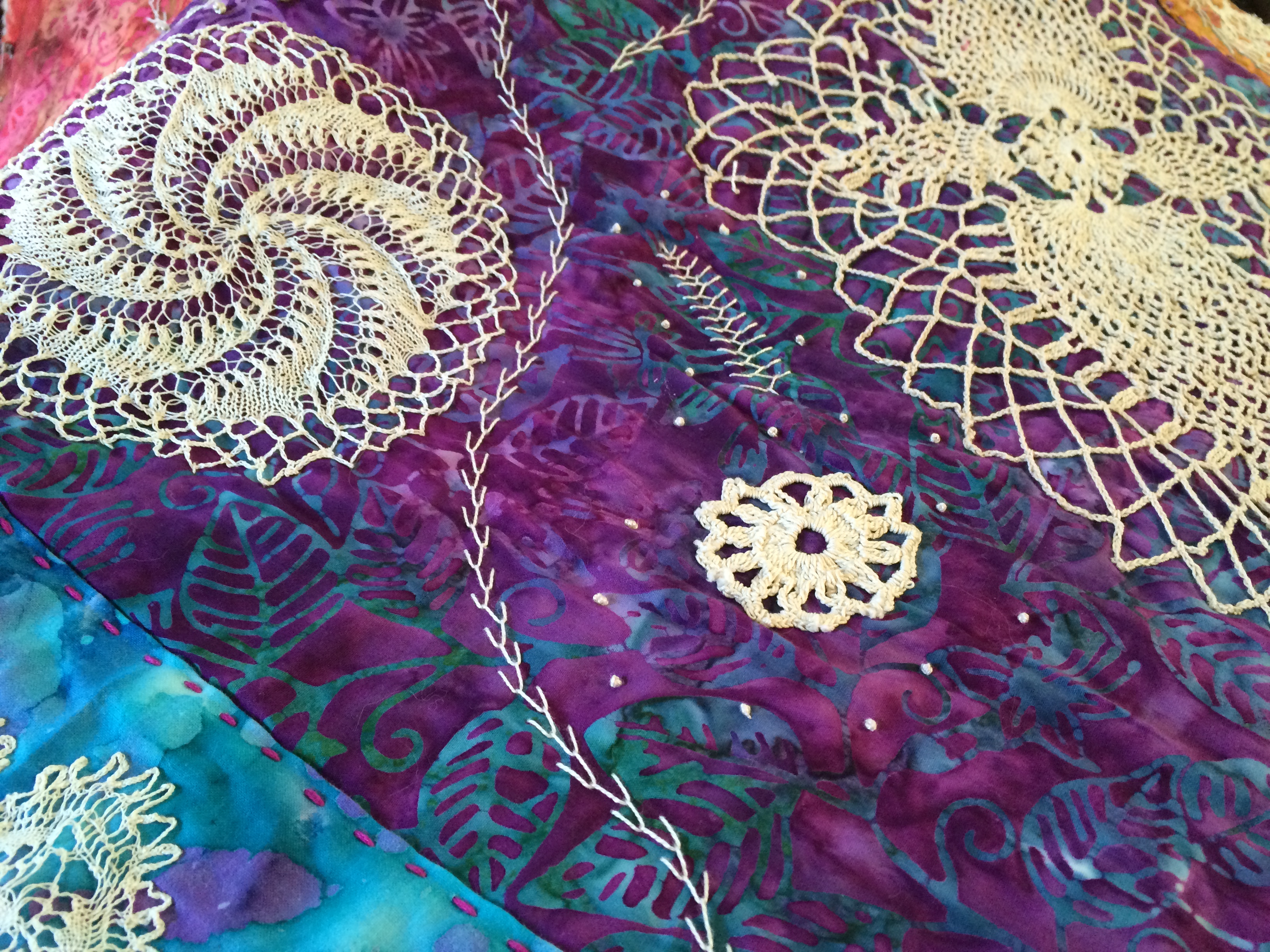
Usually, the covered quilt, too, feels like a blank slate, and more quilting is needed if the patches are as large as these. For this quilt, I decided to use some old hand-made doilies collected from antique shops, estate sales, etc, and stitch them directly onto the quilt. 

IMG_5045 IMG_5033 IMG_5049IMG_5036

The stitches used are feather, cretan, and french knots. I like using embroidery floss and perle cotton for stitching, and I tend to use long, sharp darning needles for the job, although it depends on the weight of the thread. With many layers to stitch through, a heavier, longer needle is often really useful. It cheers me no end to work on this one. Batik fabrics are so pleasingly saturated with color!

None of these projects required stitching on a sewing machine, though some of the others this winter have. This is enough for now, however. More to come another time.


Off the Deep End

The last post was well-received on The Facebook, where many friends offered high praise, support, and comments like, “Wow — that’s so cool it makes me envy you.” Well — it seems likely that if they are the well adjusted, competent individuals I have credited them with being, they may not feel especially envious or terribly generous with praise after this update. . . *gulp*

In my last post, all was peachy keen, if a bit slow-going, and I was preparing to put the skylights in and finish the roof, all whilst listening to the dulcet tones of forest birds, embraced by nature, and charmed by the occasional owl while sitting in my loft at twilight. As my former acting teacher and colleague, Gary, would say, “What could be more fun or more wholesome?” 

That didn’t happen.

Instead, the weather forecast changed, and we were expecting cold temps and falling precipitation, which doesn’t make for a good roof-putting-on kind of weekend, really. (The owls agreed.)  Rather than being brought down by the change of plans and annoyance of yet further delays, however, I triumphantly decided to make another attempt at leveling and stabilizing the trailer. Up to this point, it’s been somewhat level, and somewhat stable. But not terribly. I had also noticed that it had shifted at some point (but clearly hadn’t taken the clue), and the jack that’s welded to the trailer was pushing up against the sheathing at the back, making it impossible to put siding there. It seemed that nothing could really be done “well” until it was fully stable and level, so I went out and bought jacks to stabilize and level the trailer, merrily took them home, and began the process.

I was so merry, in fact, that I thought it would be a great time to take a selfie:

Triumphant selfie in front of the open gable.

Triumphant selfie in front of the open gable.

In short, it failed.

In fact, it was almost a complete disaster.

Just as Dad and I were making a final few adjustments before considering the whole thing something of a success, there was this . . . sound . . . like a groan . . . after which, the trailer suddenly gave way and heaved about 8 inches to the South-East, knocking me out of its way as it headed in the direction of the valley below.

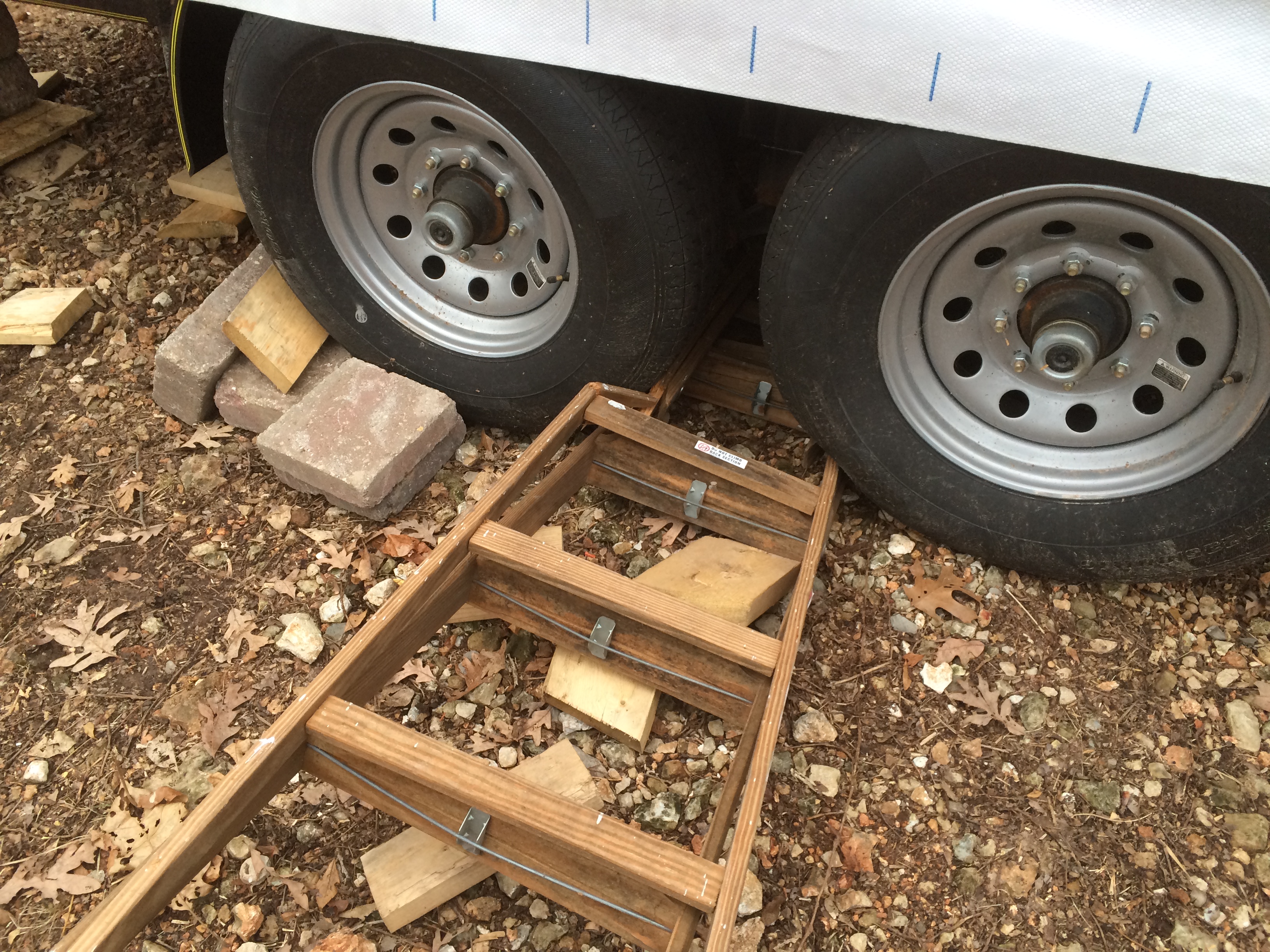
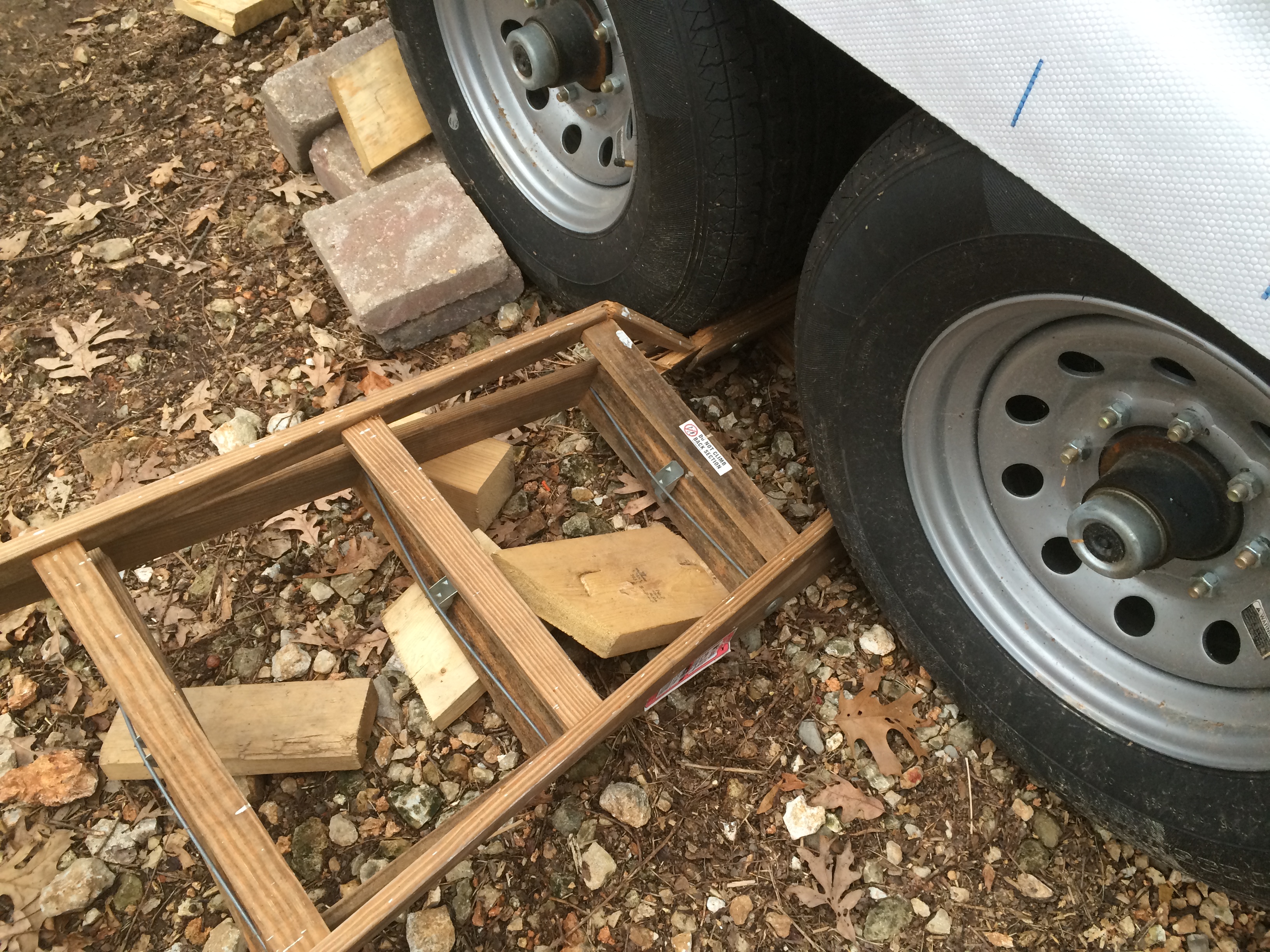
Fortunately, this ladder seems to have helped slow it down:

. . .worth taking a second picture of, right?

The ladder was crushed, but it helped stop the house from rolling into the valley. . .

IMG_4989

. . .worth taking a second picture of it, right?

It was pretty horrifying.

Once Dad established that I was okay (it was really more of a push out of the way) and we were sure it wasn’t going to slip further toward the valley, we started walking around scratching our heads for a bit, trying to decide what to do.  Here’s what we were looking at while we scratched:

IMG_4991


Here’s a longer-range view of the position of the trailer, which you can see is listing to the left (or South-East):

Uncomfortably close to the edge.

Uncomfortably close to the edge.

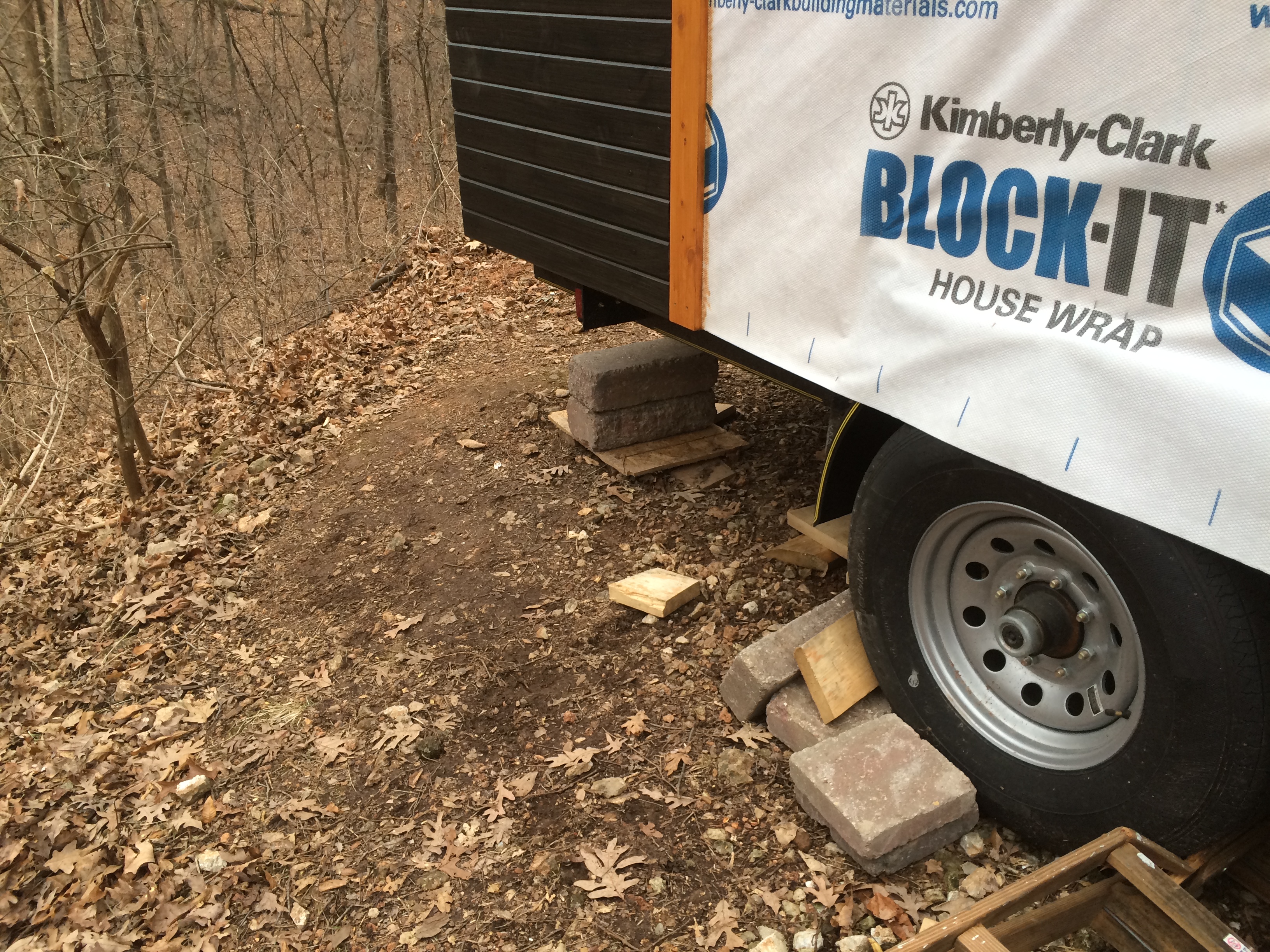
We considered many different options. Initially my dad was ready to get a winch to pull it back over to the right/South-West. I wasn’t too sure about it. I figured if he was serious, it would be wise to consult with my brother-in-law’s brother, Kevin. He owns big trucks, is a trained carpenter, has worked and/or lived on farms his entire life, and likely owns a winch. Turned out he was duck hunting that day, so we stacked blocks around the wheels, reassured ourselves that it was likely to stay put and be fine for a day or two, packed everything up, and went inside to warm up and settle our rattled nervous systems.

Although I was calm for the first few days afterward, the fact that I had nearly watched my house slide off the plateau and into the valley below eventually hit, and it made for a pretty tense week. No matter what your level of meditation practice or relative “Zen”, you’re still faced with the stark reality that the home you’ve spent the last 8 months of your life building was precariously close to being lost, and it’s really upsetting. As my father observed later on, “If that trailer had gotten any closer to the edge and had gone over into the valley, most of that work would probably have been lost, and I really don’t know how we’d go about getting it out of there.”

Here’s the thing: we didn’t have a way to engage the brakes (or ensure that the breaks are engaged) on the trailer, but it had been pretty reliably stable up to this point. There was no real reason to think it was in any danger where it was. When we initially got the dang thing up the hill in the first place (see my first blog post on the entire subject!), it was such a harrowing experience that by the end of it we felt lucky to have gotten it into a workable position at all. No amount of research, reading, consulting, planning, or ruminating will really adequately prepare you for the experience of doing something like this for the first time. We knew we would make plenty of mistakes, and we were prepared to do it anyway.

When I think of the imagery of “The Fool” (I love him) in the tarot, I see more and more often the ways I figuratively — and literally — resemble him:

"The Fool", Rider-Waite Tarot Deck

“The Fool”, Rider-Waite Tarot Deck

The intention, of course, would be to embody the archetype this way:

"The Fool", Rumi Tarot Deck

“The Fool”, Rumi Tarot Deck. “Be foolish, so that your heart may be at peace.”

Or even this way:

I honestly have no idea who to credit this one to.

I honestly have no idea who to credit this one to, but it’s SO COOL.

BUT — when all’s said and done, I think this is likely the most realistic depiction of what was going on:

I could do this even without the high heels, though.

I would be capable of this even in my bare feet some days. . .

All fools aside, though, after a solid 24 hours to think it through, dad had a new plan: call someone who moves and repositions mobile homes, and get them to come and move the tiny house. Seemed like a good plan, right?  Why not trust the experts? Probably much safer than winching the tiny house back up to a safer position, and far less likely to damage the axles in the process. After making several phone calls over a few days, we found someone willing to take it on: Jeffrey Day.

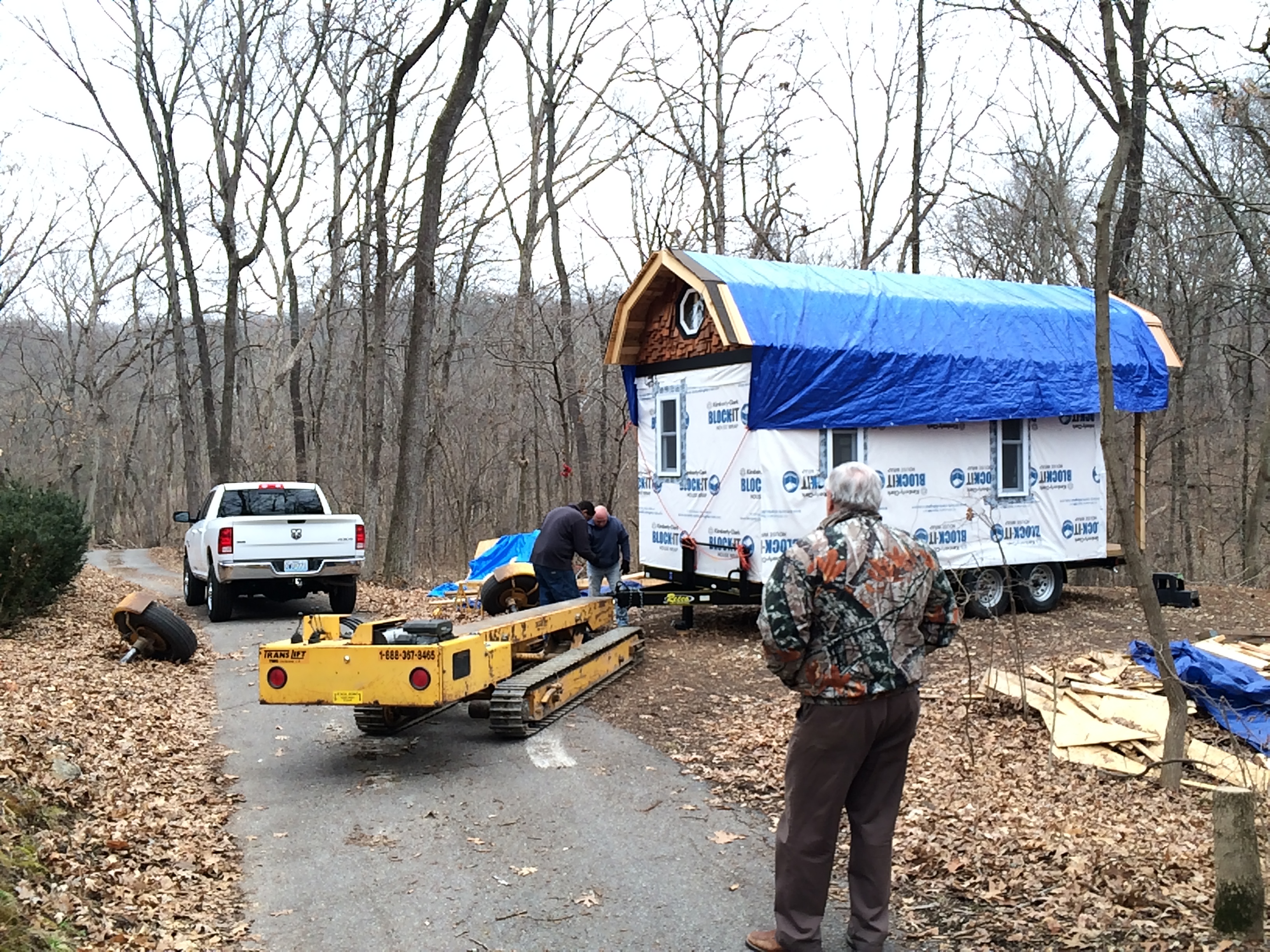
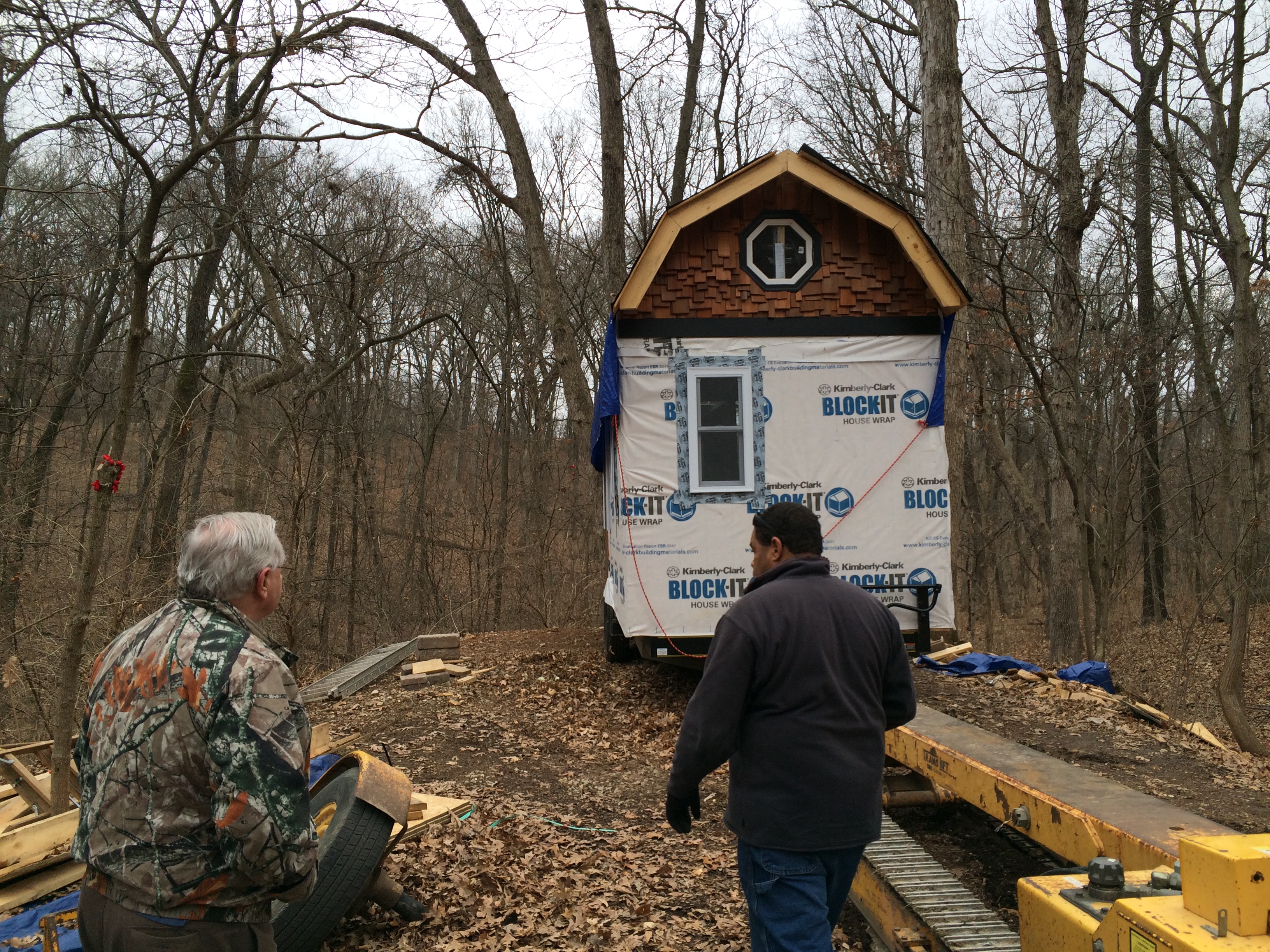
Jeffrey was unbelievably competent, and came armed with a piece of machinery that enabled him to reposition the tiny house as though it were a tinker toy. Check it out:

Jeffrey Day, his assistant, David, and the "Trans Lift".

Jeffrey Day, his assistant, David, and the “Trans Lift”. Dad is there in the foreground, observing.

I videoed the entire move, which took 2 minutes and 56 seconds, including moving the crushed ladder out of the way. (I hope to get it uploaded to YouTube in the near future. . .) Once it was re-positioned, mostly what they had to do was rock it back and forth to get the tires off the ground and stabilized at the right level, and put the TransLift back in its “on the road” mode. Then it was putting blocks under the corners of the trailer to ensure its level-ness and overall stability, which has been greatly improved, not to mention how much safer it will be to work on the left side of the house. So, while I’m confident that there will be plenty more mistakes made before it’s finished and ready to move into, the good news is that I will also be all the more likely to live to tell about it!

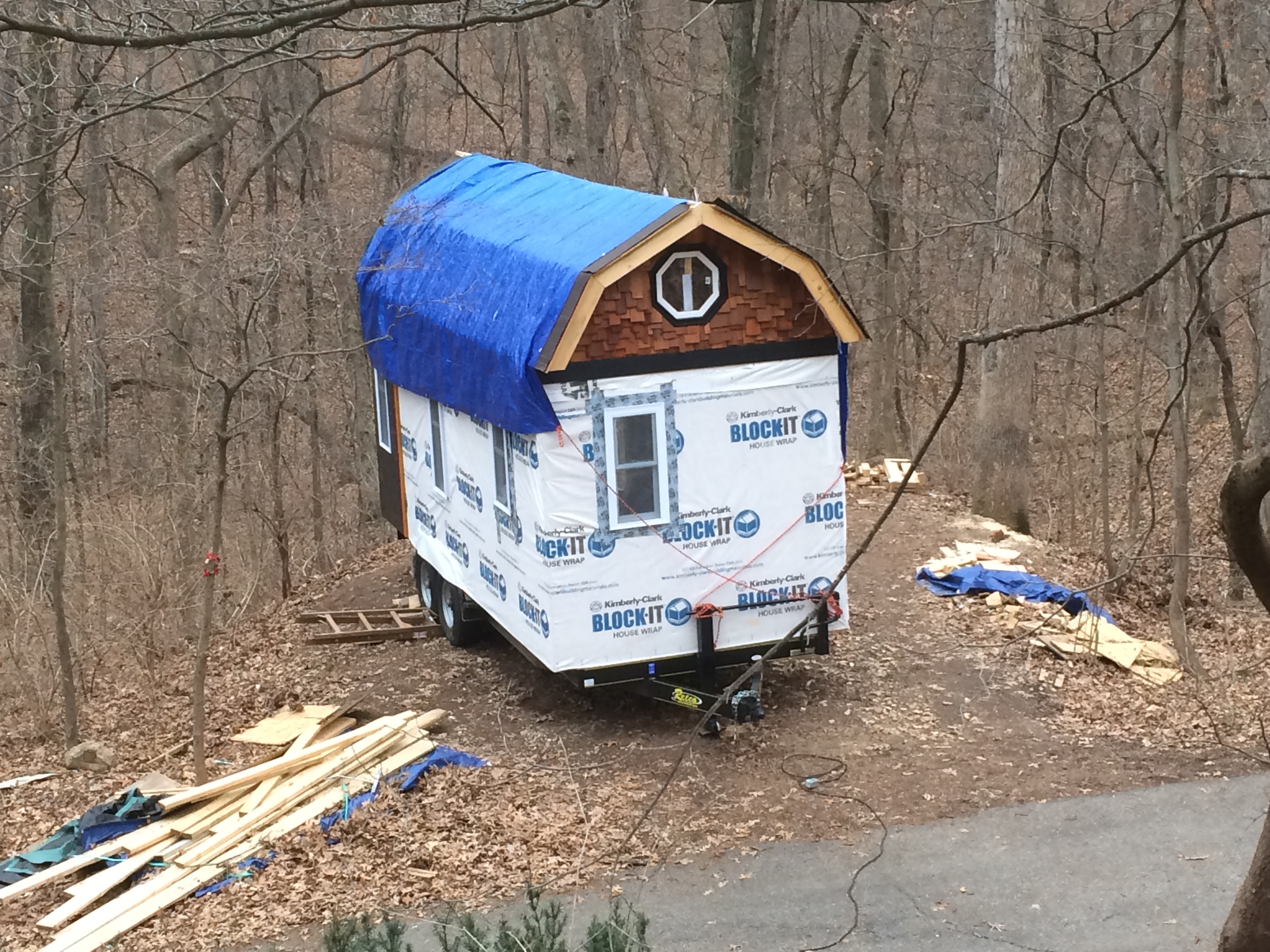
The trailer in its more stable position on the plateau overlooking the valley.

The trailer in its more stable position on the plateau overlooking the valley.

To give you some idea of the difference in position, as you look to the left in the above picture, where you see the aluminum ladder and stack of blocks is right about where it was sitting after it slipped.

And that’s pretty much it for the moment.

. . .never a dull moment, though, is there?


A Practice in Patience

It’s coming along. . .slowly.  (The house and the patience. . . )

Last fall, I began to feel desperate about getting certain aspects “done”, and lost the mindful approach and spacious feel to the entire project, which can quickly turn the entire thing into an arduous form of torture. Accepting that I cannot change the weather, work faster or harder, push myself beyond a certain point, or stop other necessary parts of my life from happening has helped.  I’ve had to step back from anything that is unnecessary, however, and have fallen behind on other things I’d never intended to let go of. It’s challenging to remember that the point of this is to create more space in my whole life, because right now it feels like the building process has taken it over entirely.  In the mean time, I’m doing my best to slow down, breathe, and continually re-assess what needs to happen next in every area of life. The practice now is to be patient and accepting of present conditions.

That can be difficult sometimes when people ask “Hey — how’s the house coming? Moved in yet?” It’s hard not to feel a crushing pressure in my solar plexus. Their intentions are good (and they should still keep asking!) — they just cannot know how long it takes to build a house as a complete beginner while working full-time. Having never built anything before in my life, each new step is a massive uphill learning curve requiring all of the usual steps involved in learning to do something new — including failure, starting over, making mistakes and eventual success. Even moderate competence in a particular area is pretty sweet. It’s tremendously humbling. Not a day goes by when I don’t encounter with my own humanity and limitations.

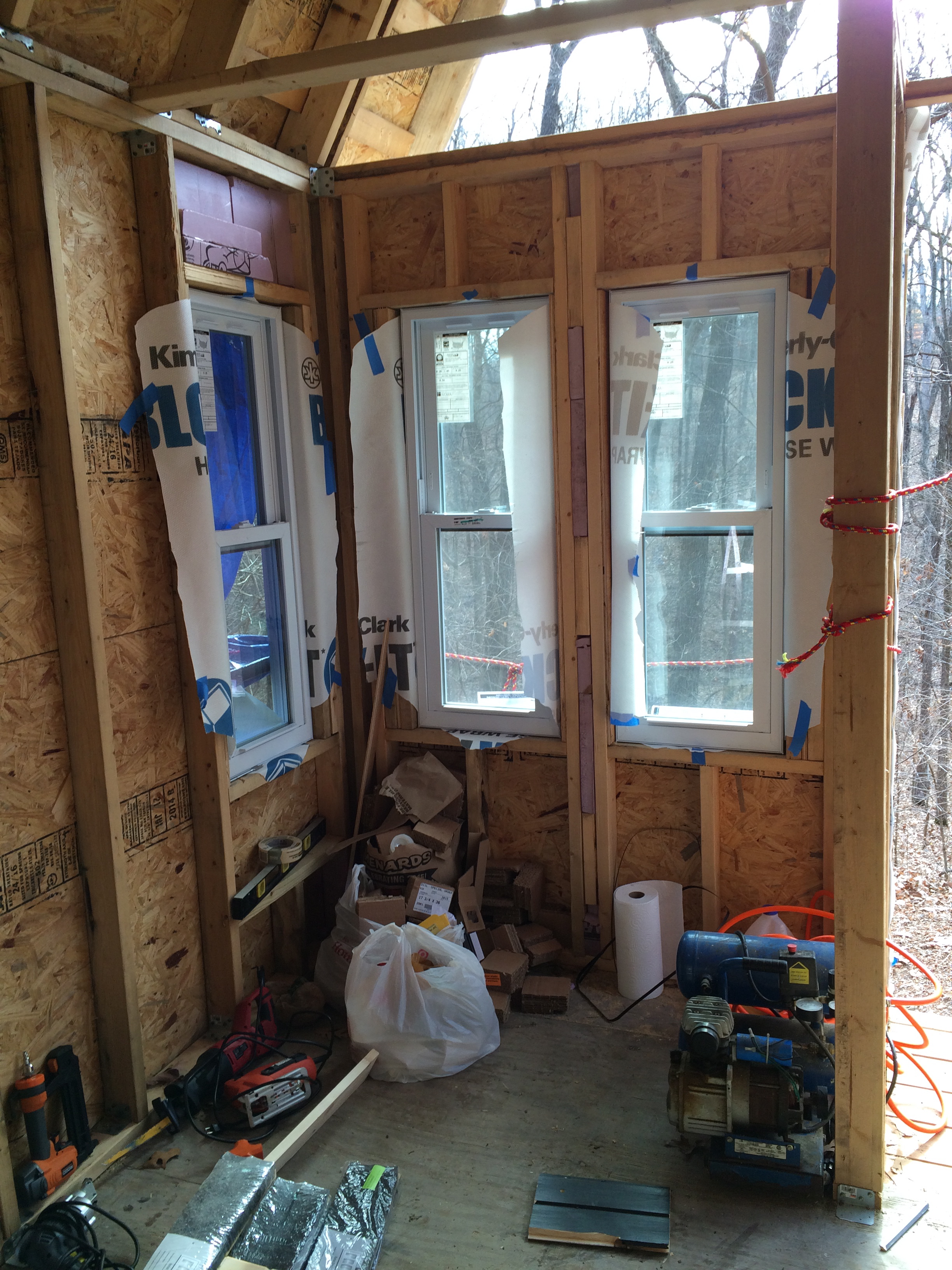
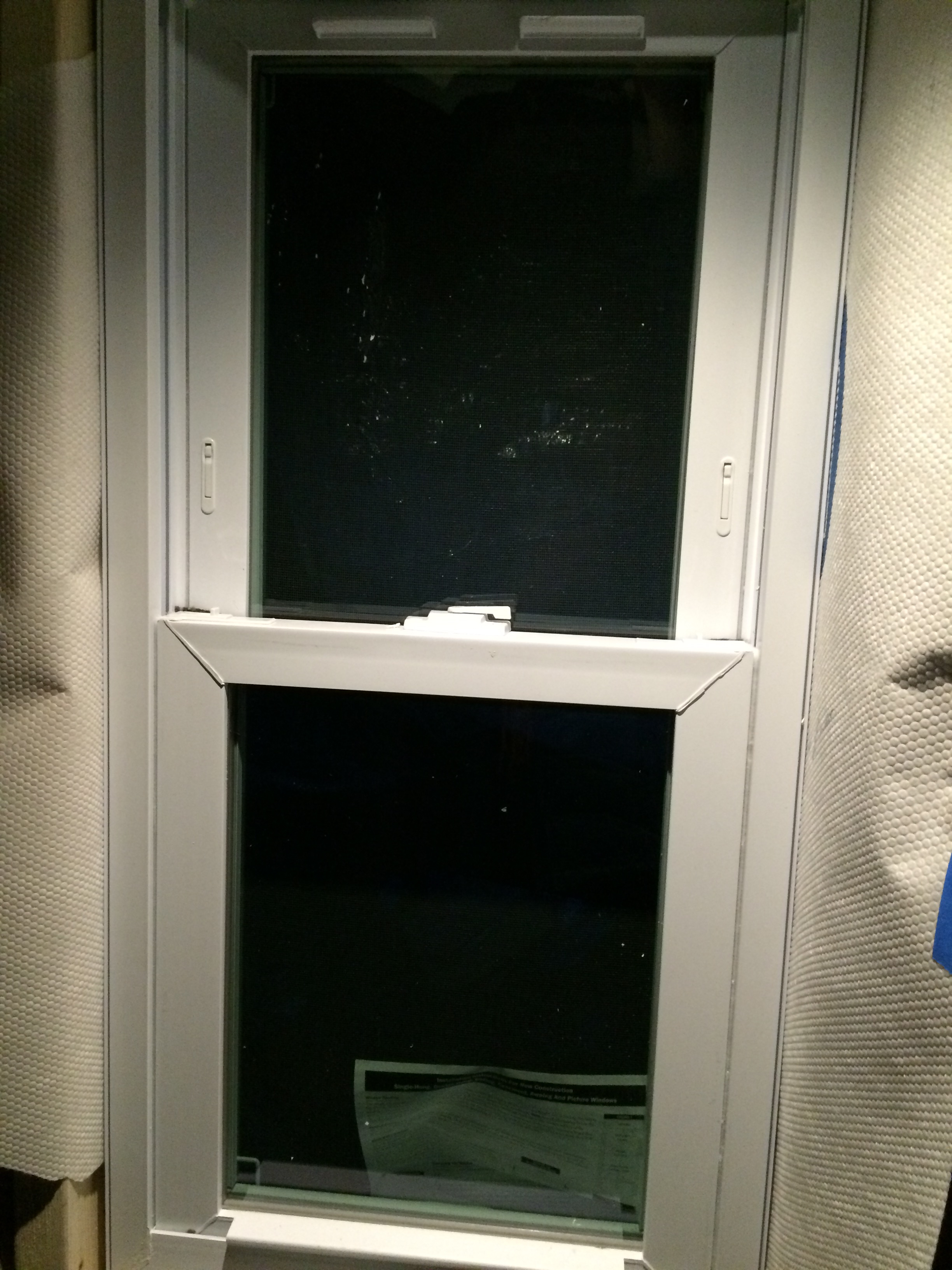
So, sometime between the last post and this one, the windows arrived and we installed them. That was a very happy moment.

IMG_4832_2

We also put on the roofing felt and began putting on the roof. . .only to discover that we had exactly half the amount of roofing material needed. UGH. Apparently, when we showed a sketch of the roof to the guy at Menards, he thought we were building half of it. He also interpreted the gambrel break as an inside break rather than an outside one, so that had to be re-ordered, too. It’s been an exercise in patience and acceptance in order to continue moving forward peacefully. And peace is a practice, not a state.  That can be hard to remember — especially when it’s hard to accept limitations. Again — this is all brand new. I don’t know how to install a metal roof on a house because it’s my first time. As I started working on it, all I knew to do is to research the subject, watch videos, and seek the help or advice of those who theoretically know about it. Often I’ll start working on something, believing I have everything needed to proceed and complete the project. . .only to find out that I’m missing something crucial. Everything stops while the necessary item is ordered, purchased, researched, etc. The only thing to do in those moments is to accept it, feel the frustration as a physical sensation in the body, create space around the issue at hand, breathe in and out, and wait for the body to calm and the mind to clear. Once that is taken care of, the next “step” is usually pretty obvious and I’m in the right place to proceed.

Usually. As with all of this, it’s work in progress, right?

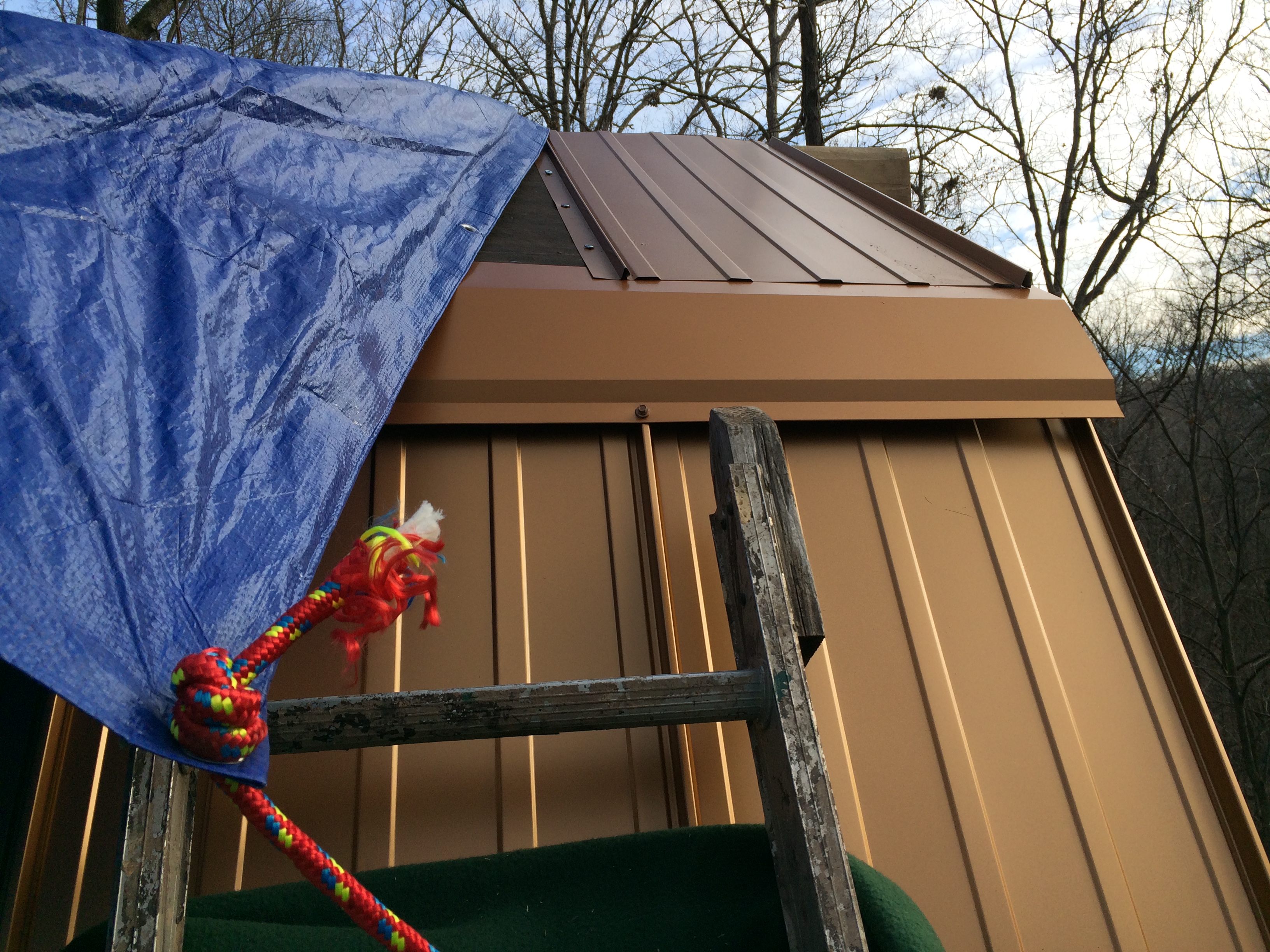
That said, here is what’s been done with the roof so far:

IMG_4837_2 IMG_4836_2

Given all of the delays, I cannot say enough about how relieved and grateful I’ve been that the weather has been so temperate this winter! We put on the felt, the lower level of panels, one section of outside gambrel break trim, and one upper panel. The rest of the panels have now arrived at Menards, so I’ll get them picked up tomorrow and the roof will go on this weekend — that’s the plan, at least. This much of the roof didn’t take more than two hours to get put into place, and I’m going to gather a few people to help with it in the hopes that it can be completed over the course of a day. We’ll see! I’m optimistic.

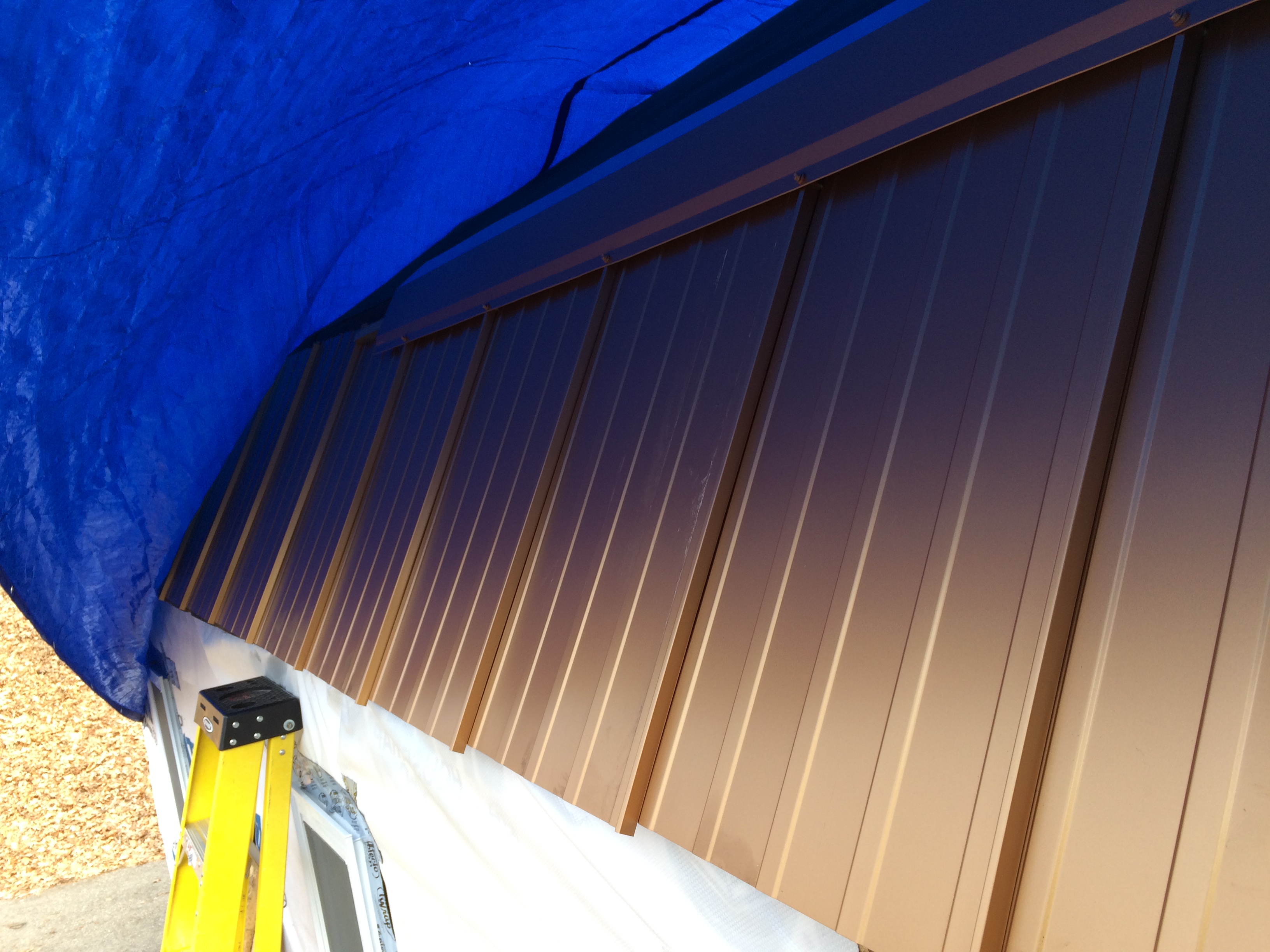
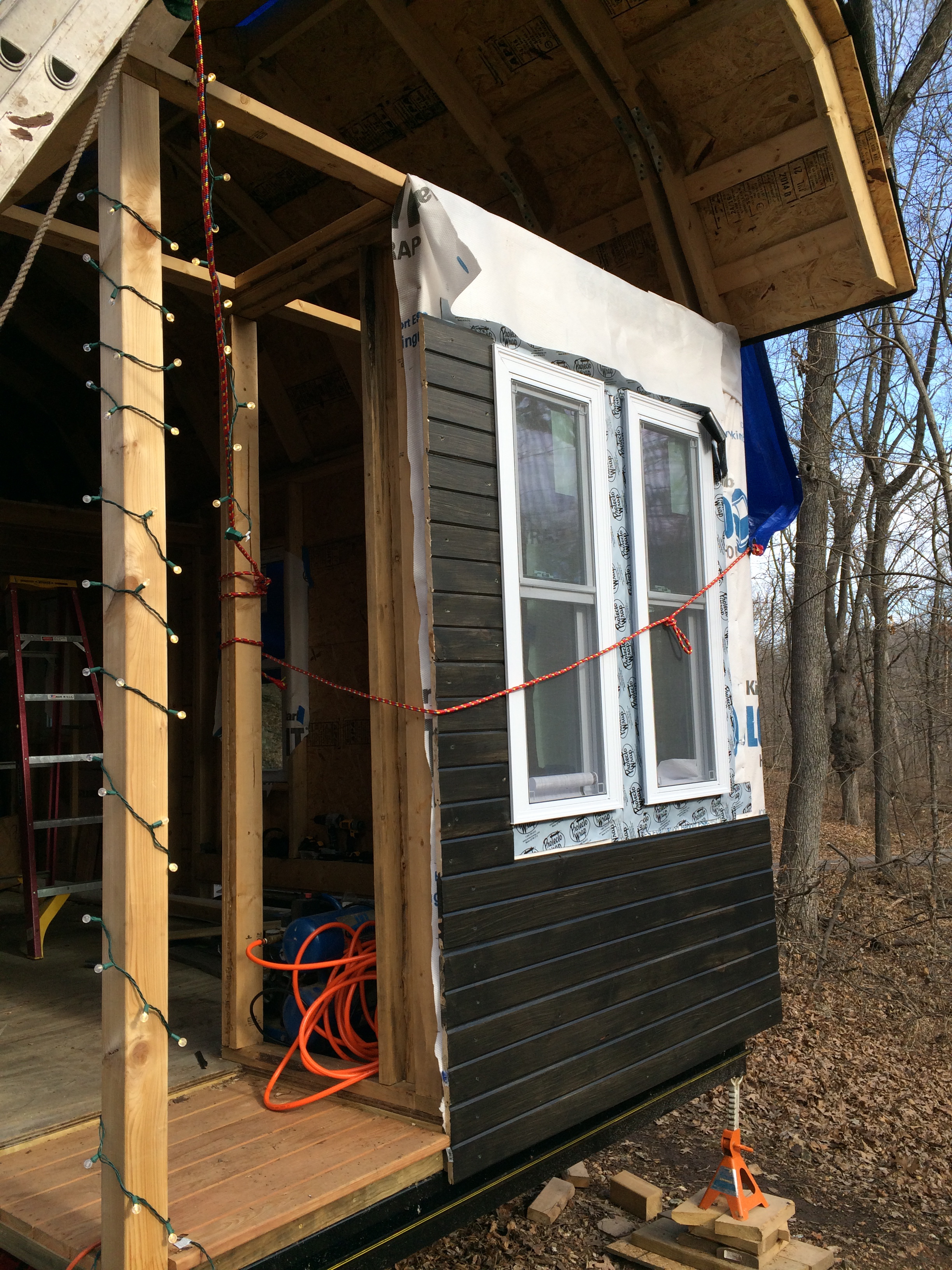
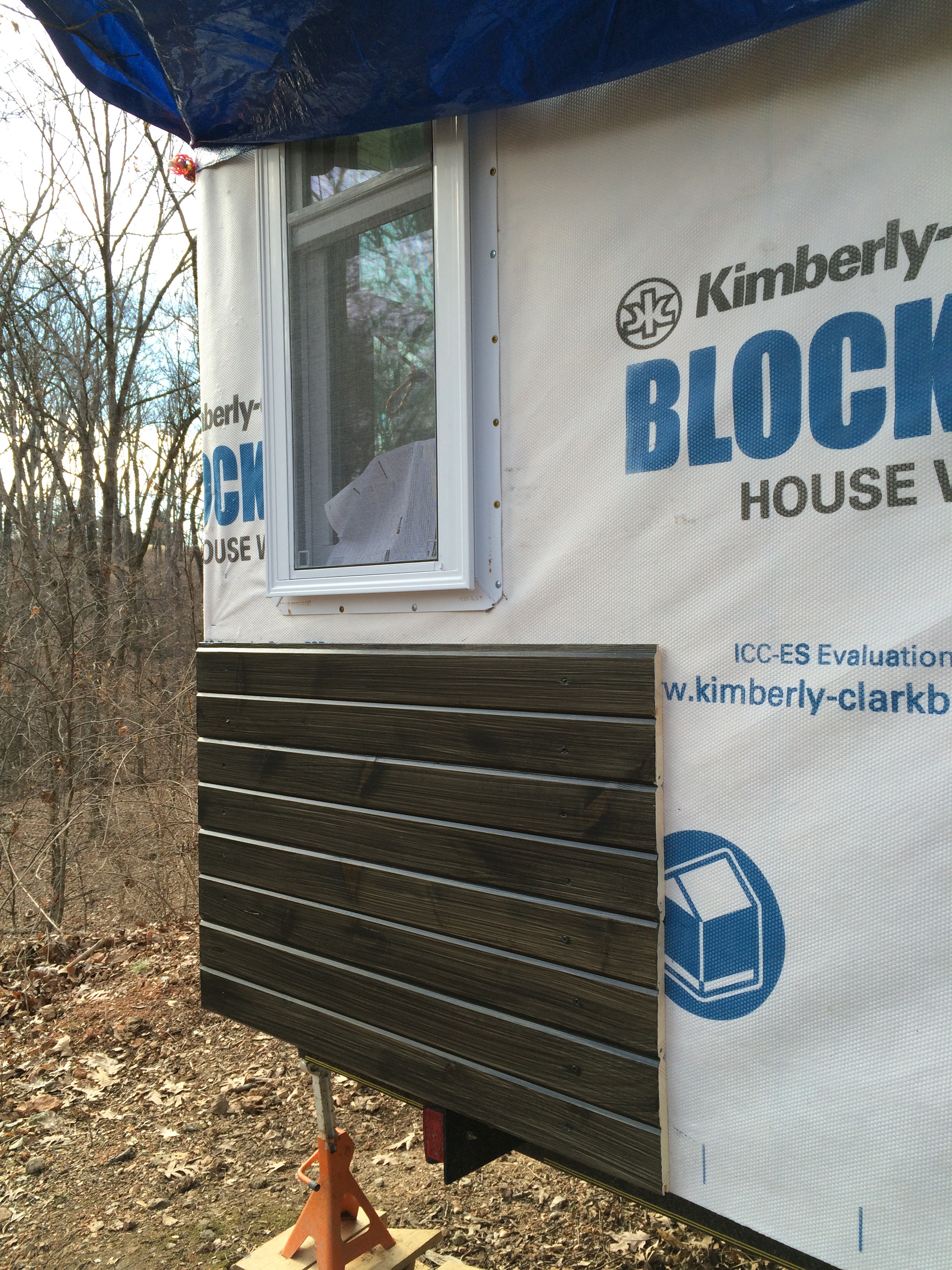
While waiting for the roofing to arrive, I purchased and then stained siding and cedar shakes indoors, and started putting them up once they were dry:

IMG_4820 IMG_4822_2

IMG_2281 IMG_2282

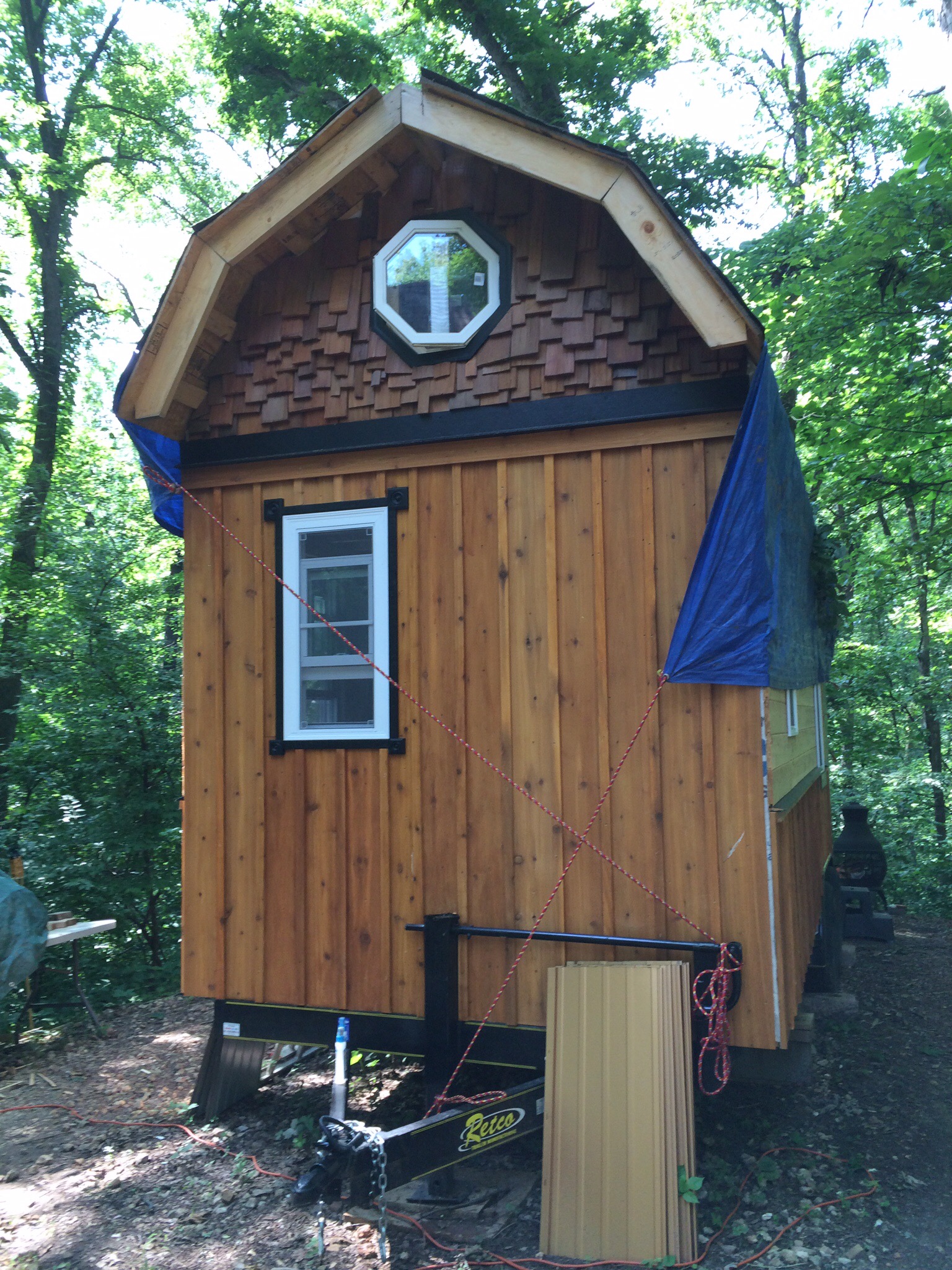
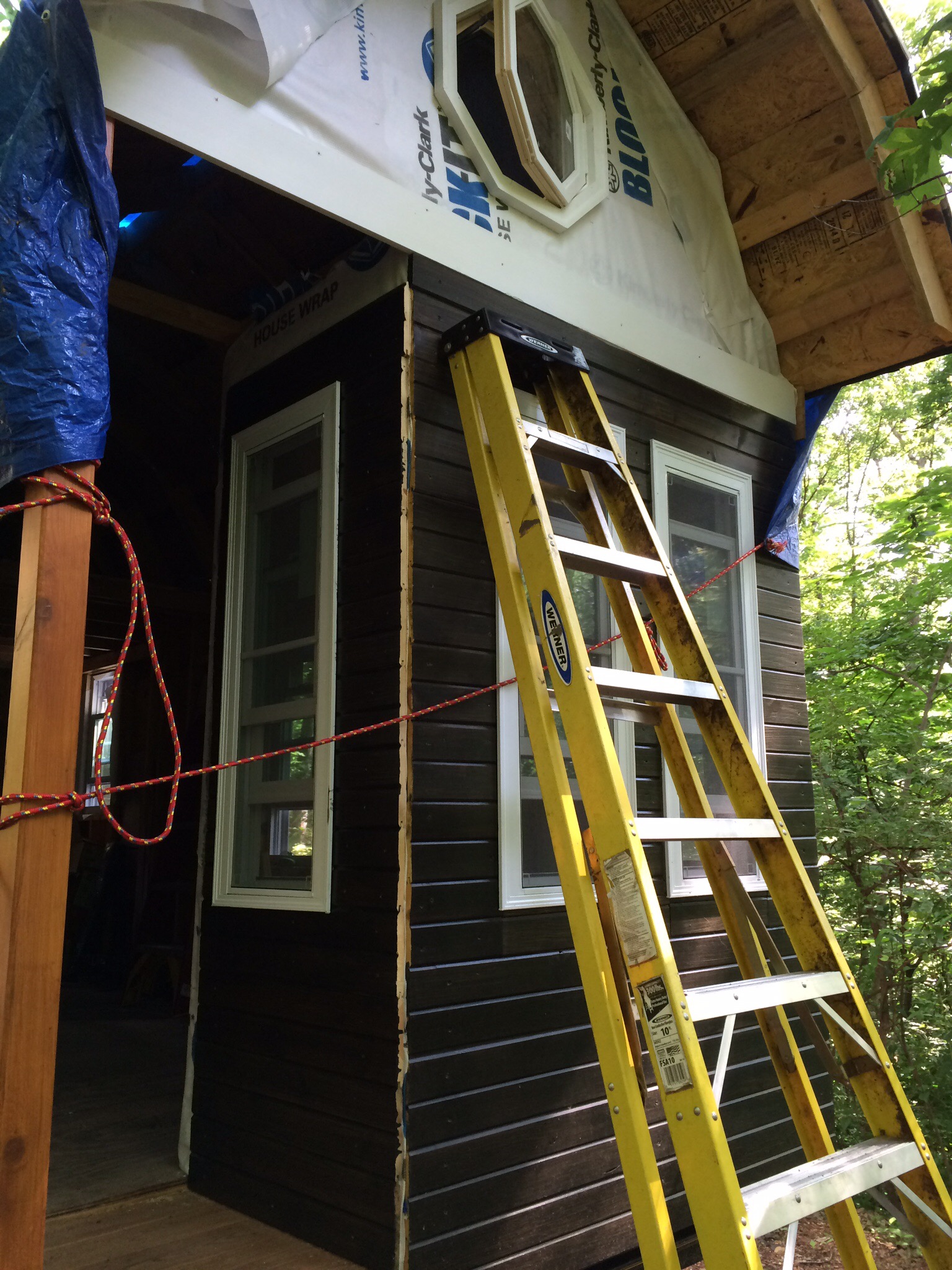
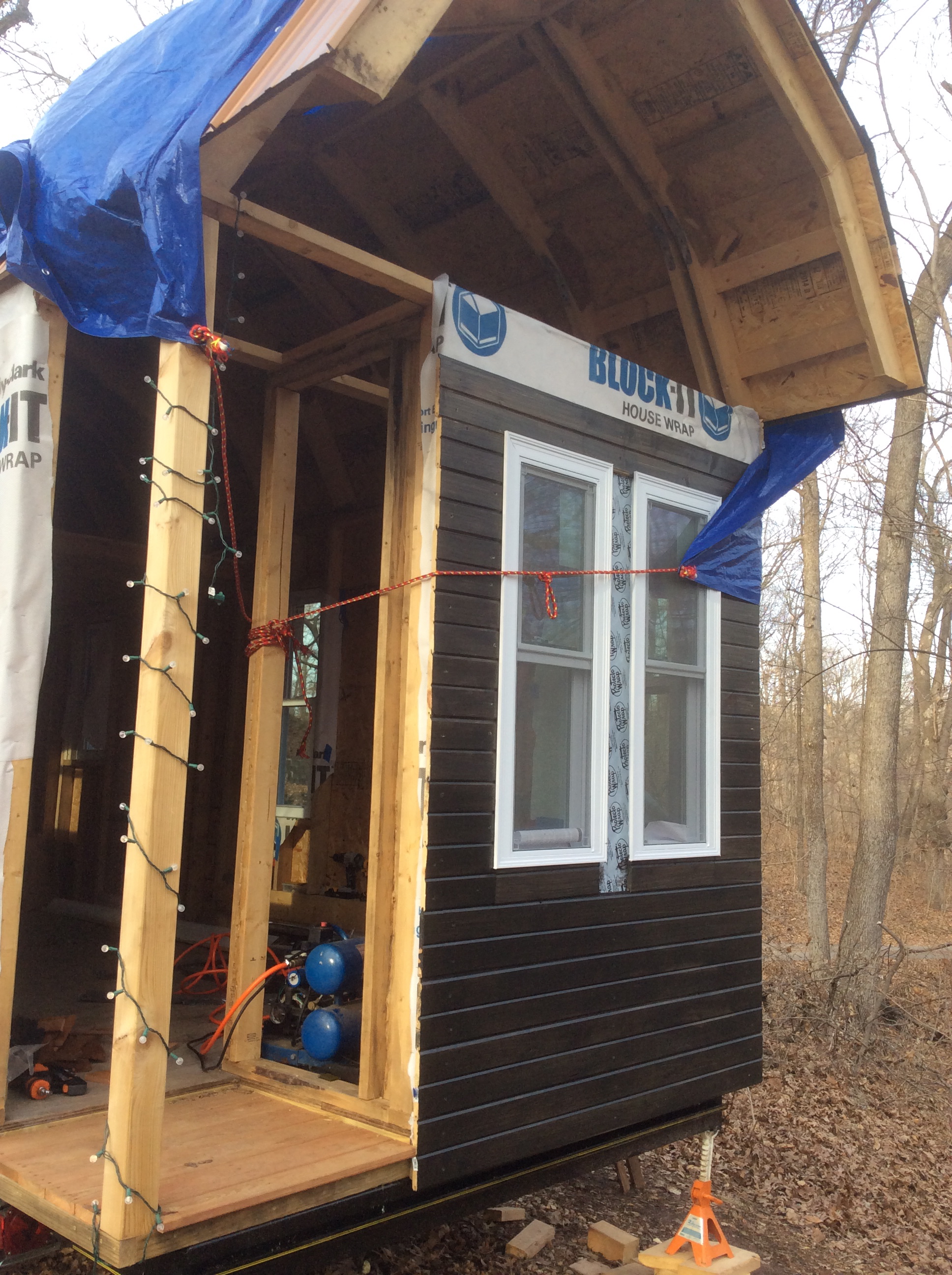
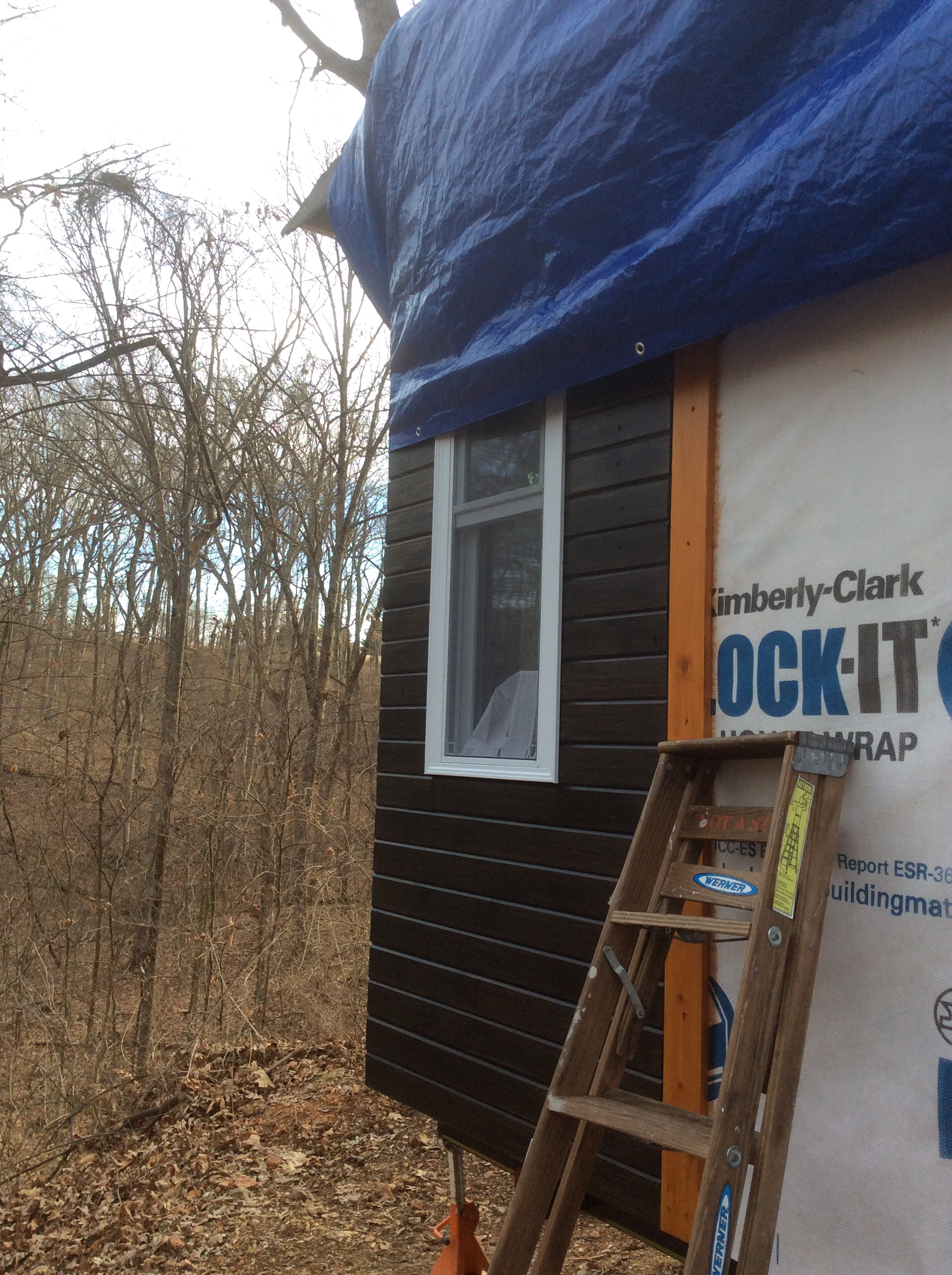
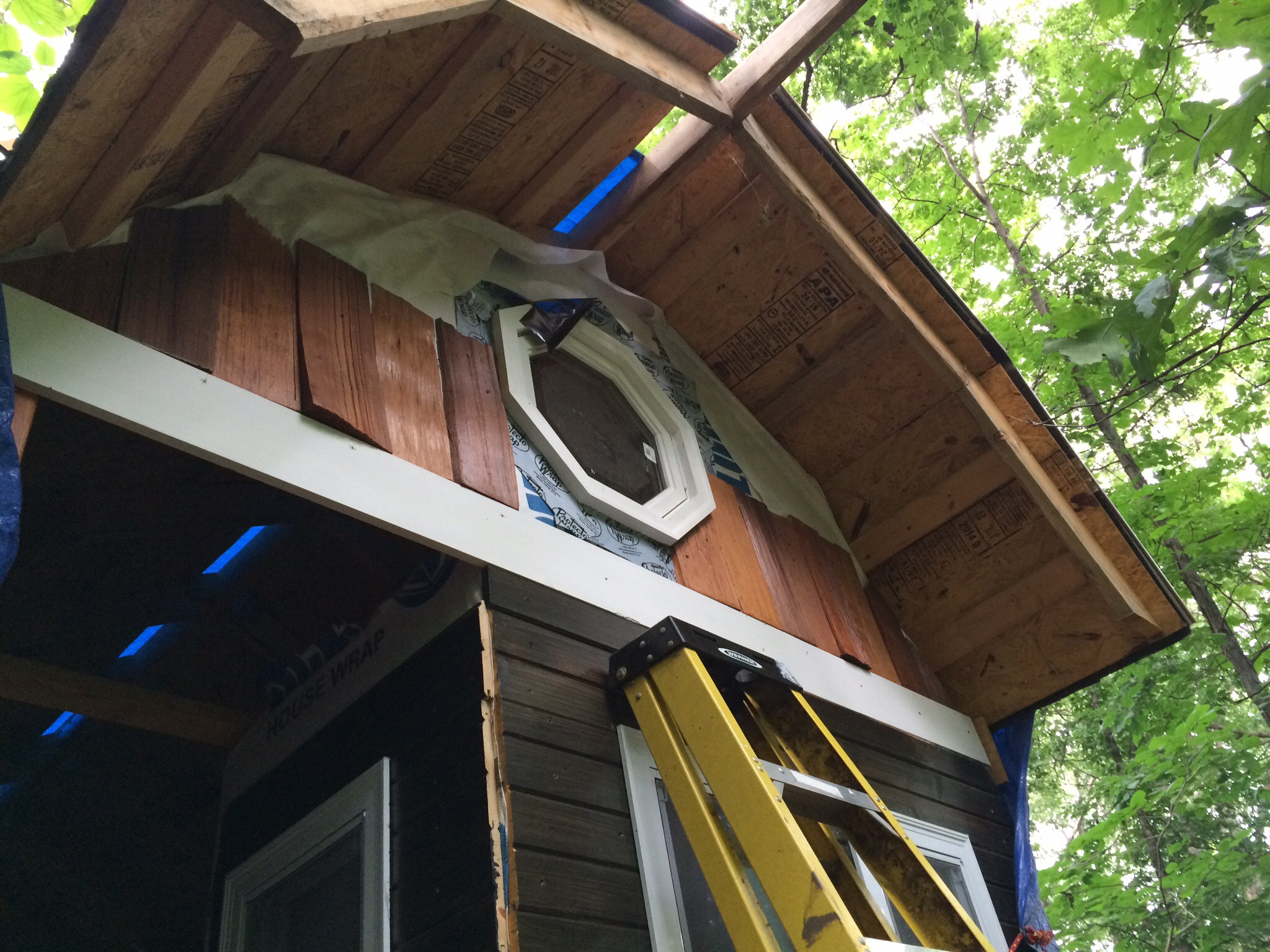
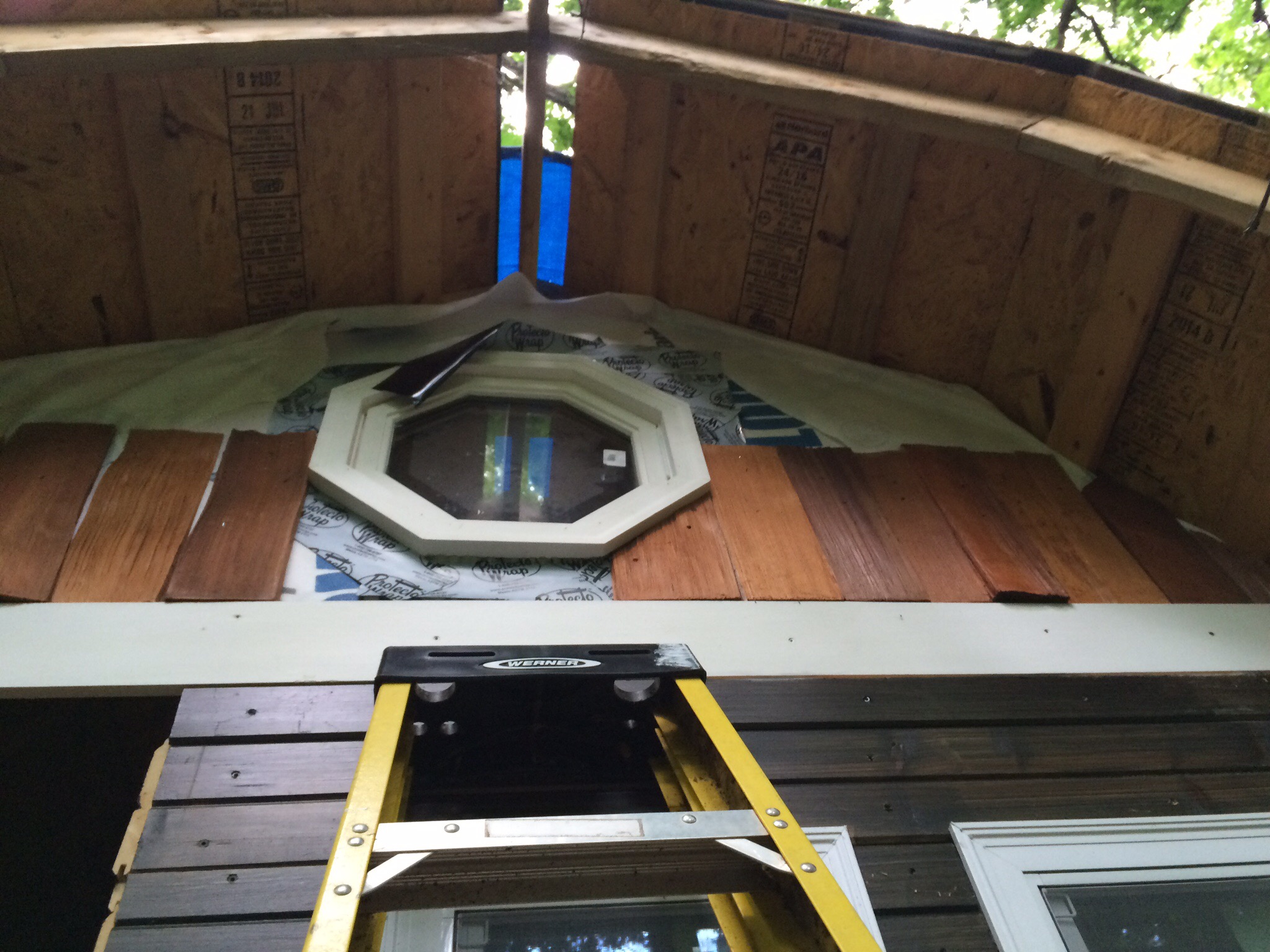
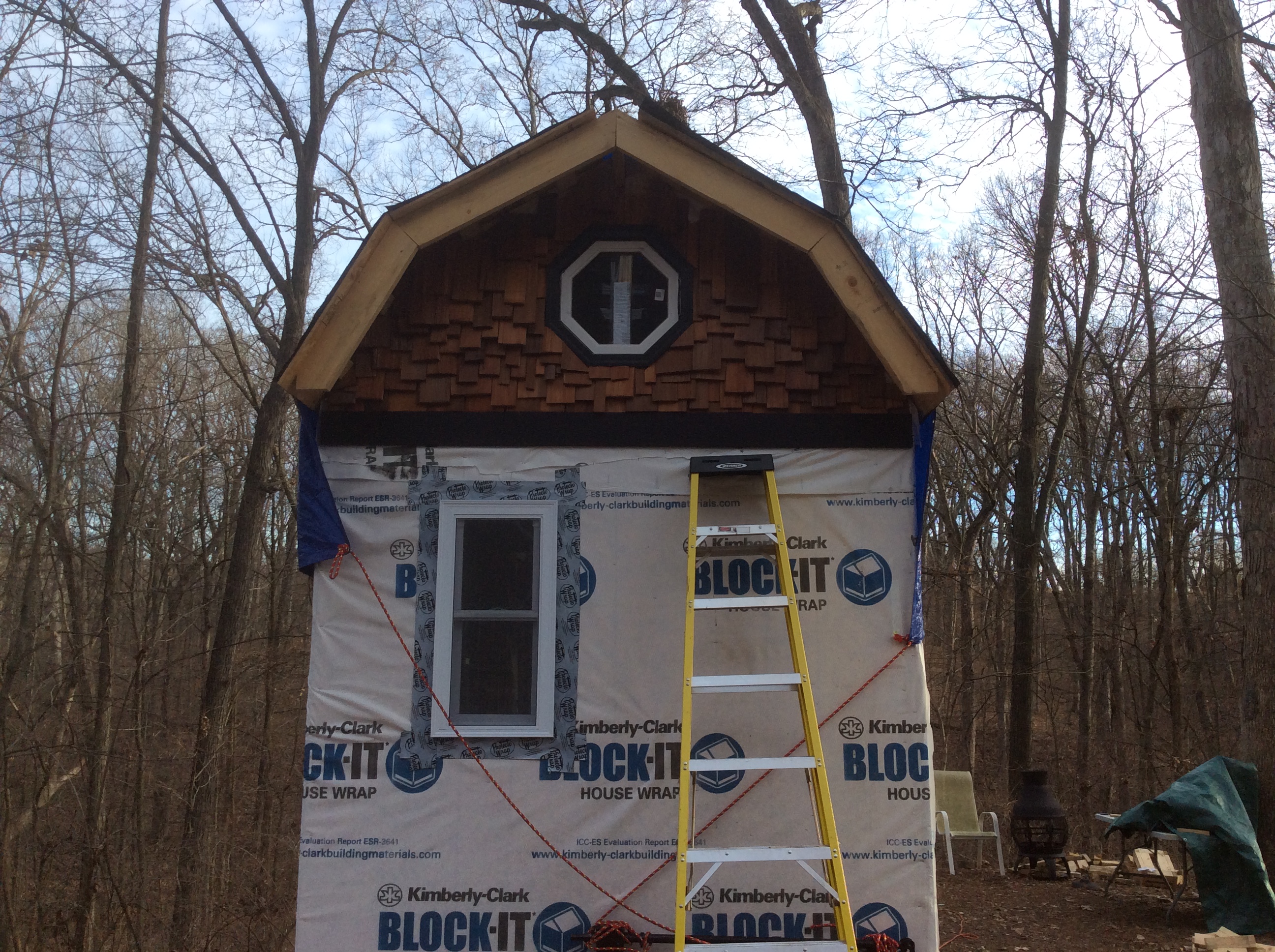
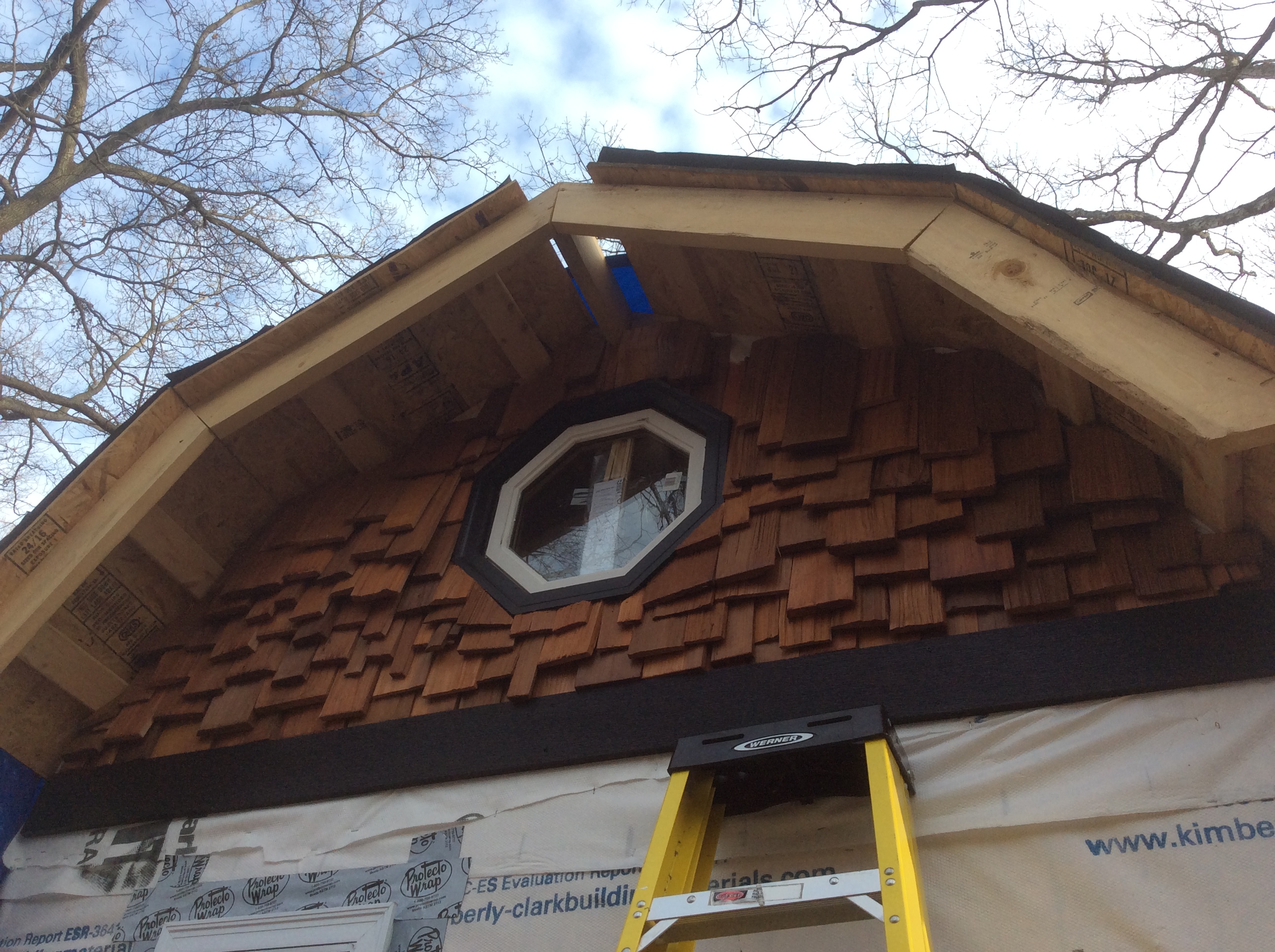
The second set of pics was taken this afternoon. The front of the house is going to be the dark slate/black stained tongue and groove with white trim; the gable (once it goes in) will be cedar shakes and another octagonal window painted white. The sides will be cedar lap siding and black trim around the white windows. The back will be cedar board and batten with black trim, and more cedar shakes in the gable.

Here’s how the shakes are coming along at the back of the house:

IMG_4856 IMG_4855_2

IMG_2290 IMG_2285

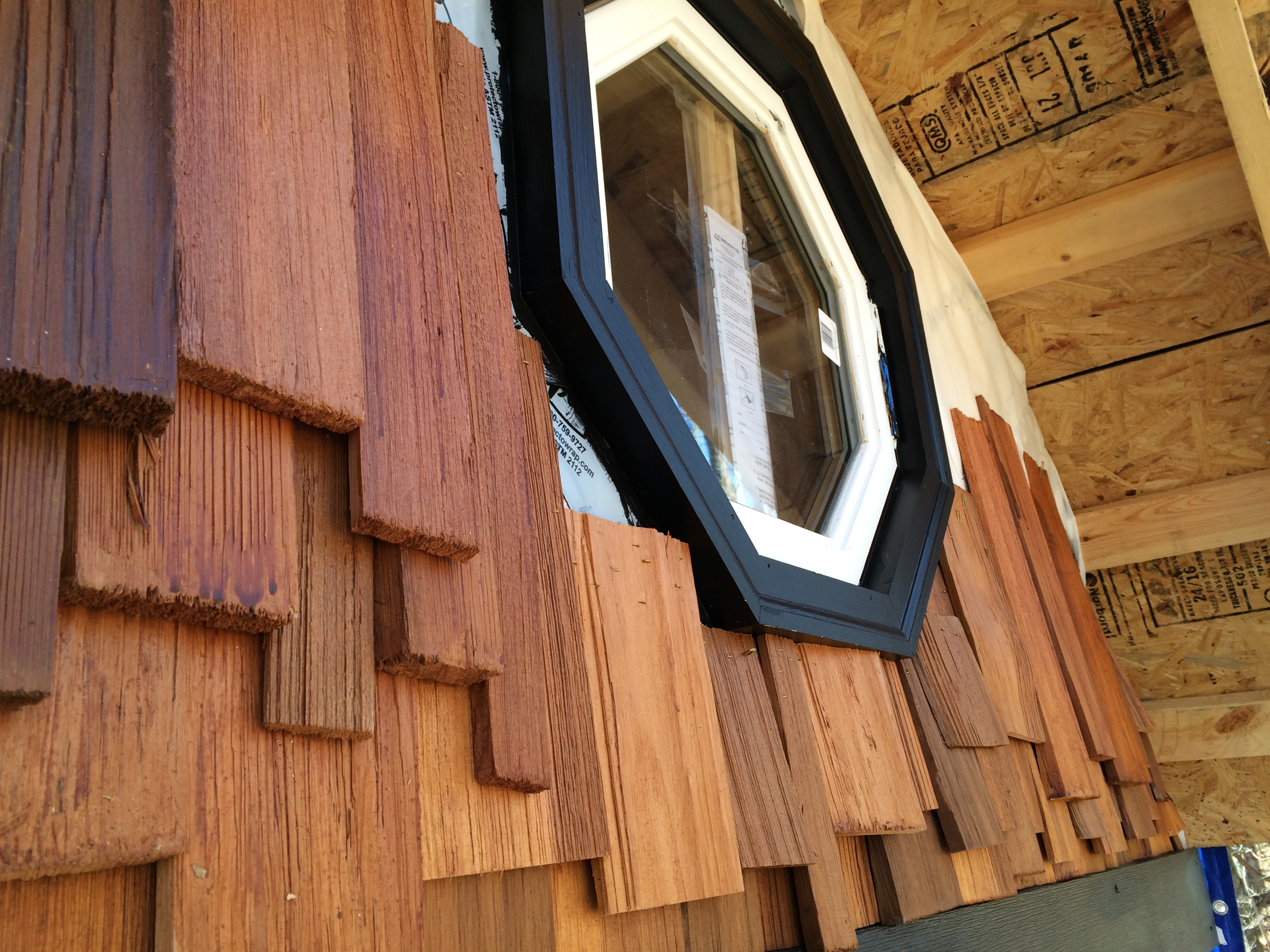
Once again, the two bottom photos are the ones I took this afternoon. The shingles are almost finished — a couple of spots where more need to be put in. This is a fairly tedious job; hours of work staining, climbing up and down the ladder to trim individual shakes, or “go fish” to find the right fit, etc. Doing the second gable should theoretically be easier, but it will still be tedious due to the nature of the material and the way I’m installing it. In truth, I’ve enjoyed this part a lot. It appeals to my artistic side and the tasks involved aren’t as new, making it much easier. I love the gingerbread effect of the shingles! They make me so happy!

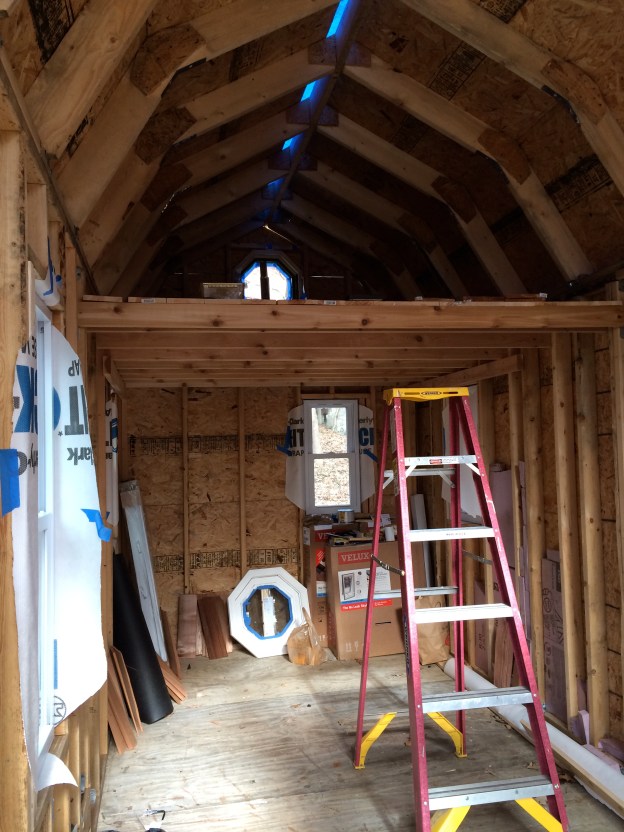
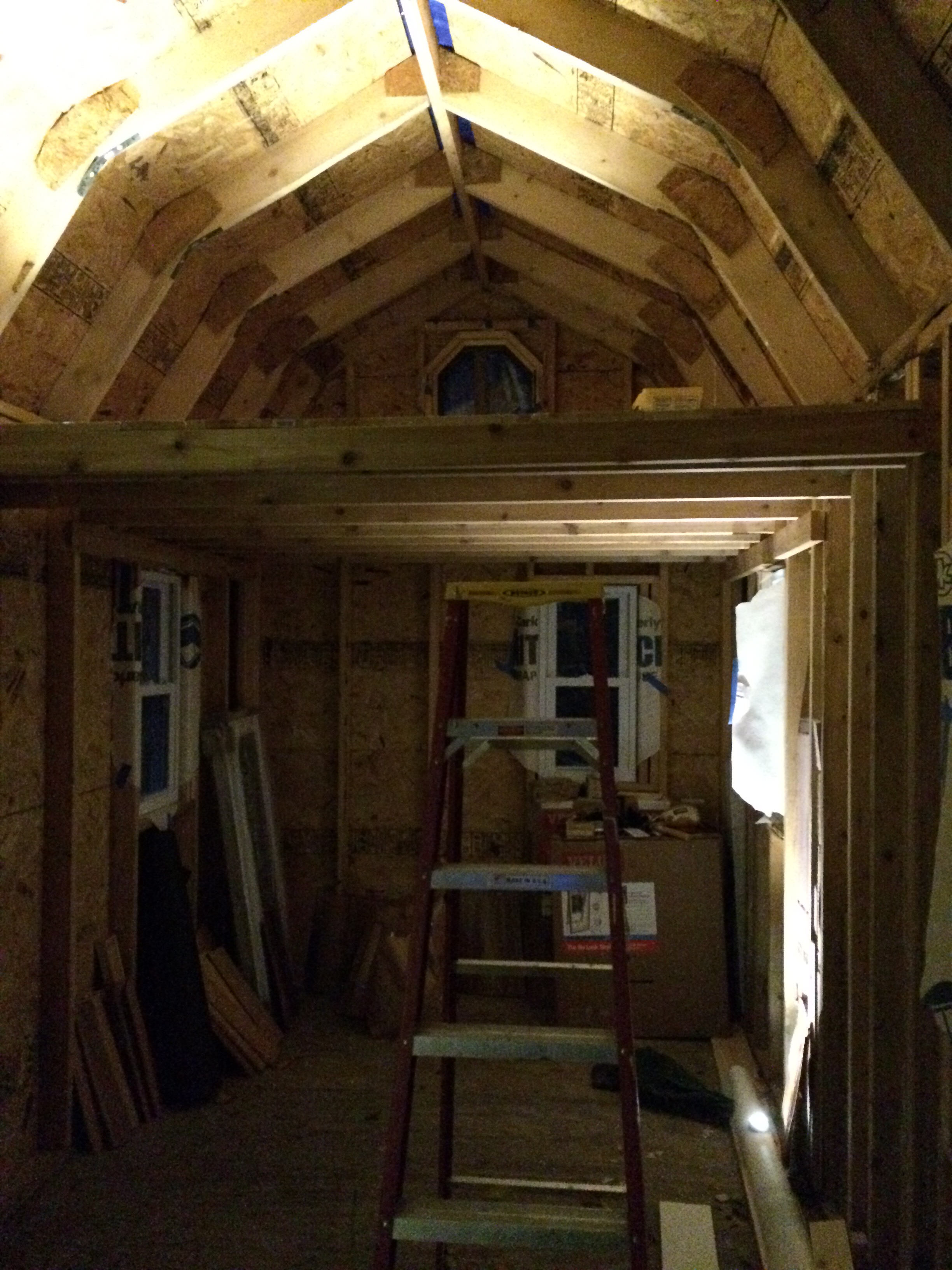
The other new development is the larger sleeping loft, which is now built inside:

IMG_4825_2 IMG_4812

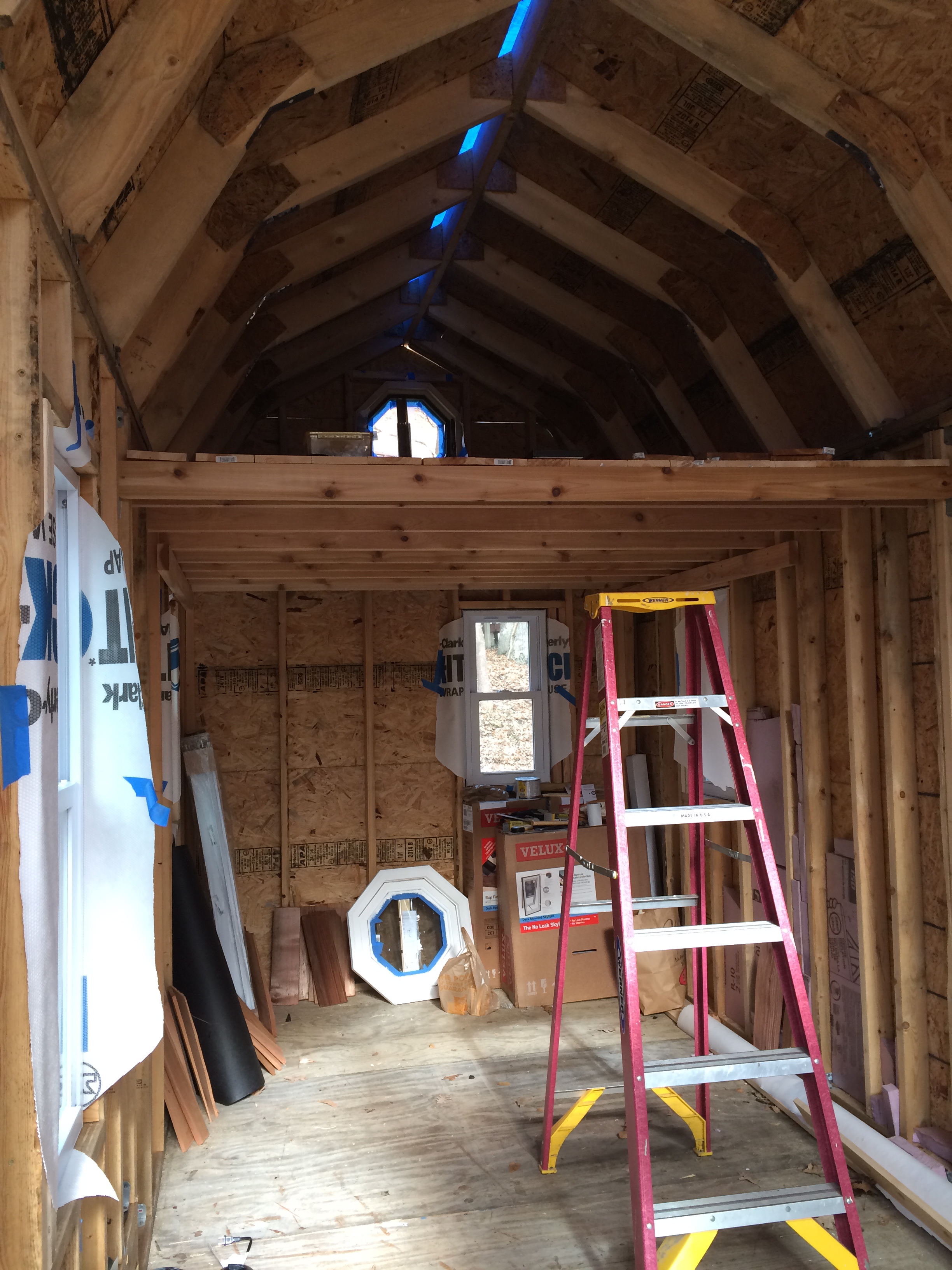
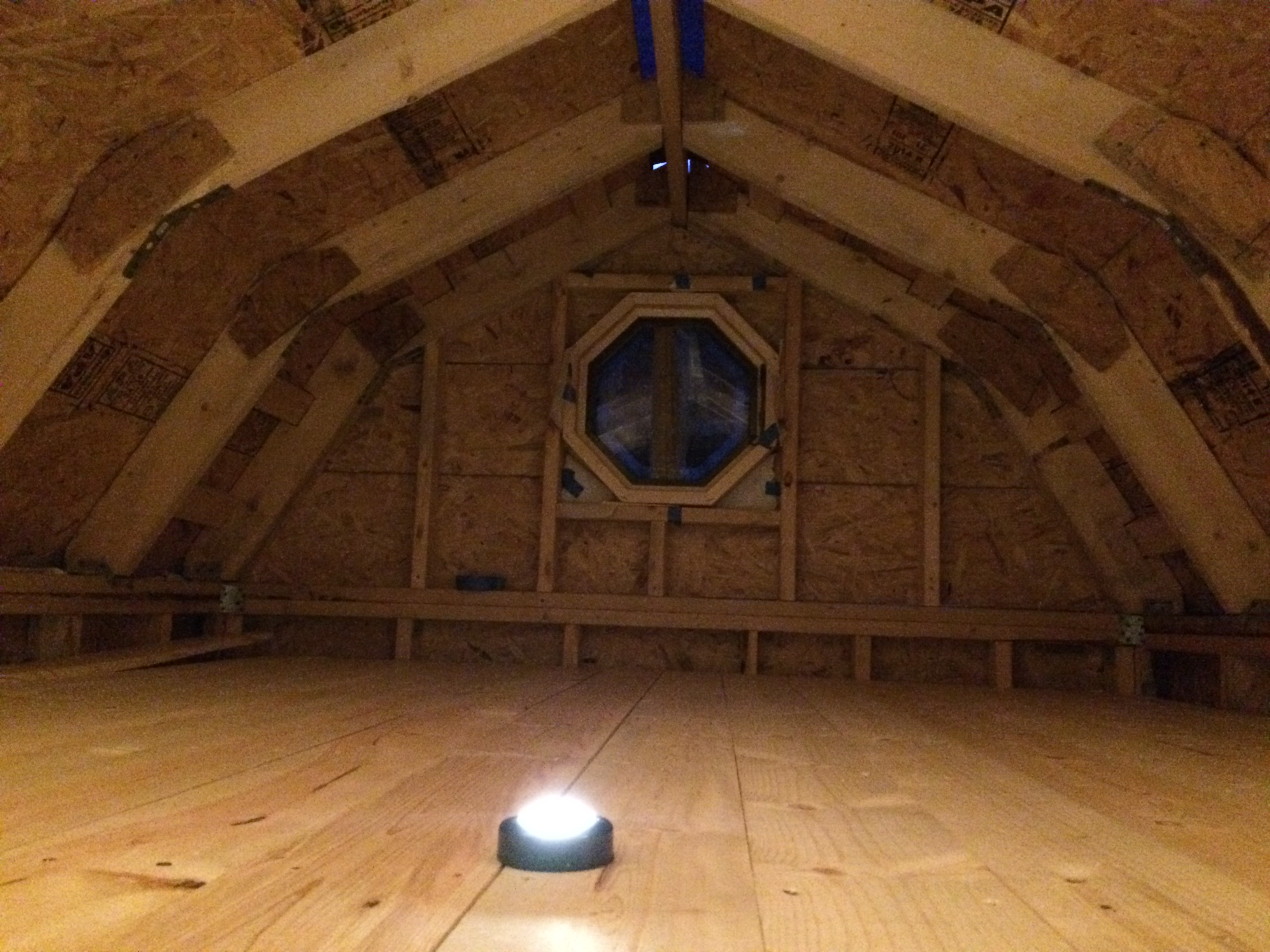
It brings me a lot of happiness to say that the sleeping loft was “sponsored” by “The Kiddos” from A Christmas Carol, who gave me a Lowe’s gift card as a thank you present on closing night. (If any of you are reading this — thank you so much!!! I miss you all and will be reminded of you for a very long time!)  The beams are cedar, the floor is pine. I’ll leave the beams and floor exposed underneath as my “ceiling”, so I chose the wood carefully. Eventually I’ll probably put down flooring in the loft, but there’s no need to do that yet. The loft is pretty spacious; 89″x108″. Plenty of space for a queen mattress to go either vertically or horizontally with space all around. There will also be a skylight that opens for ventilation. I can sit comfortably up there now, and the view out of the front gable is of the wooded valley the house overlooks. I’m probably going to wait as long as I can before I frame it so that the view remains a little longer. It’s really stunning. (No good pics of it, however, which needs remedying soon!)

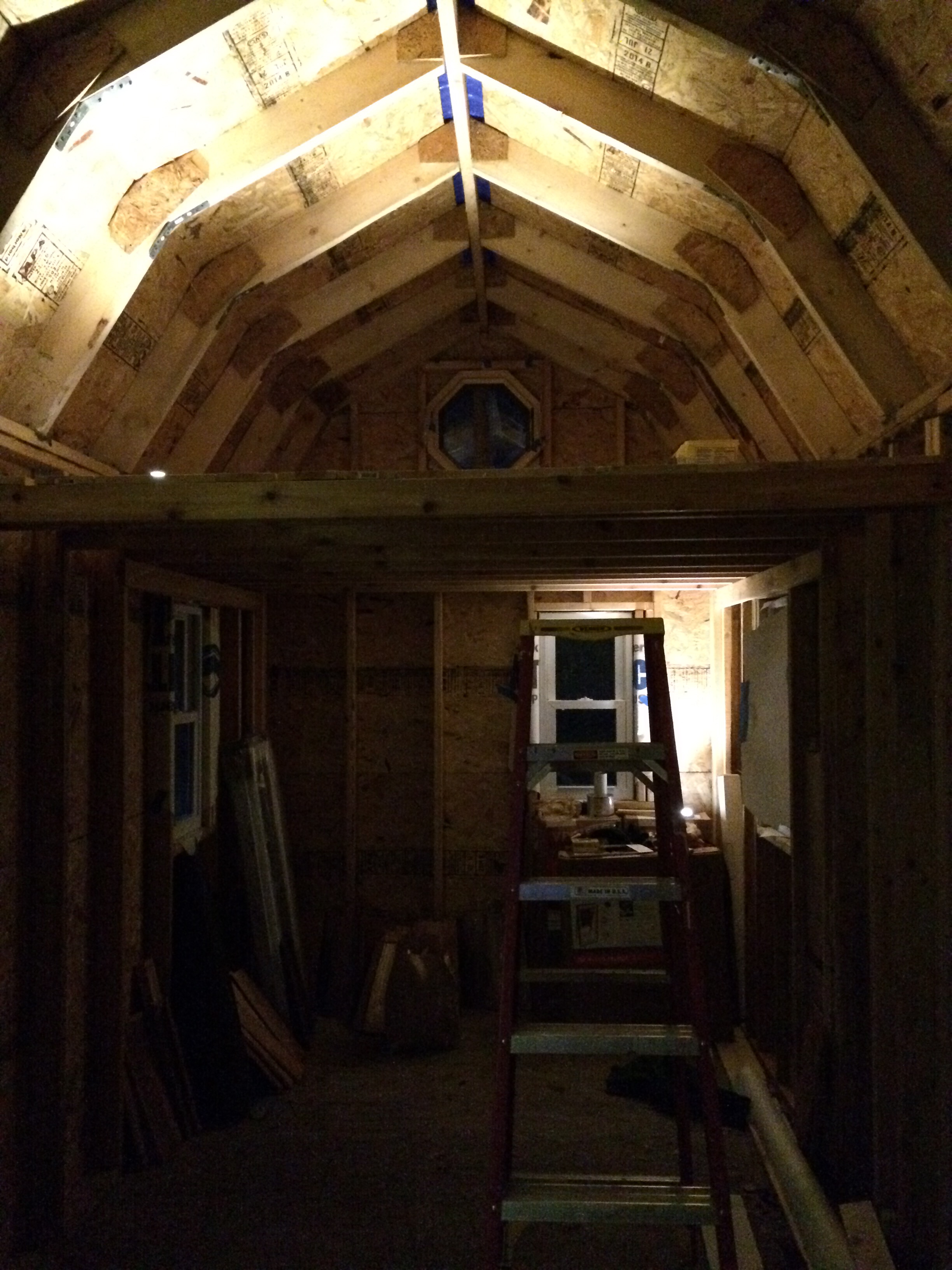
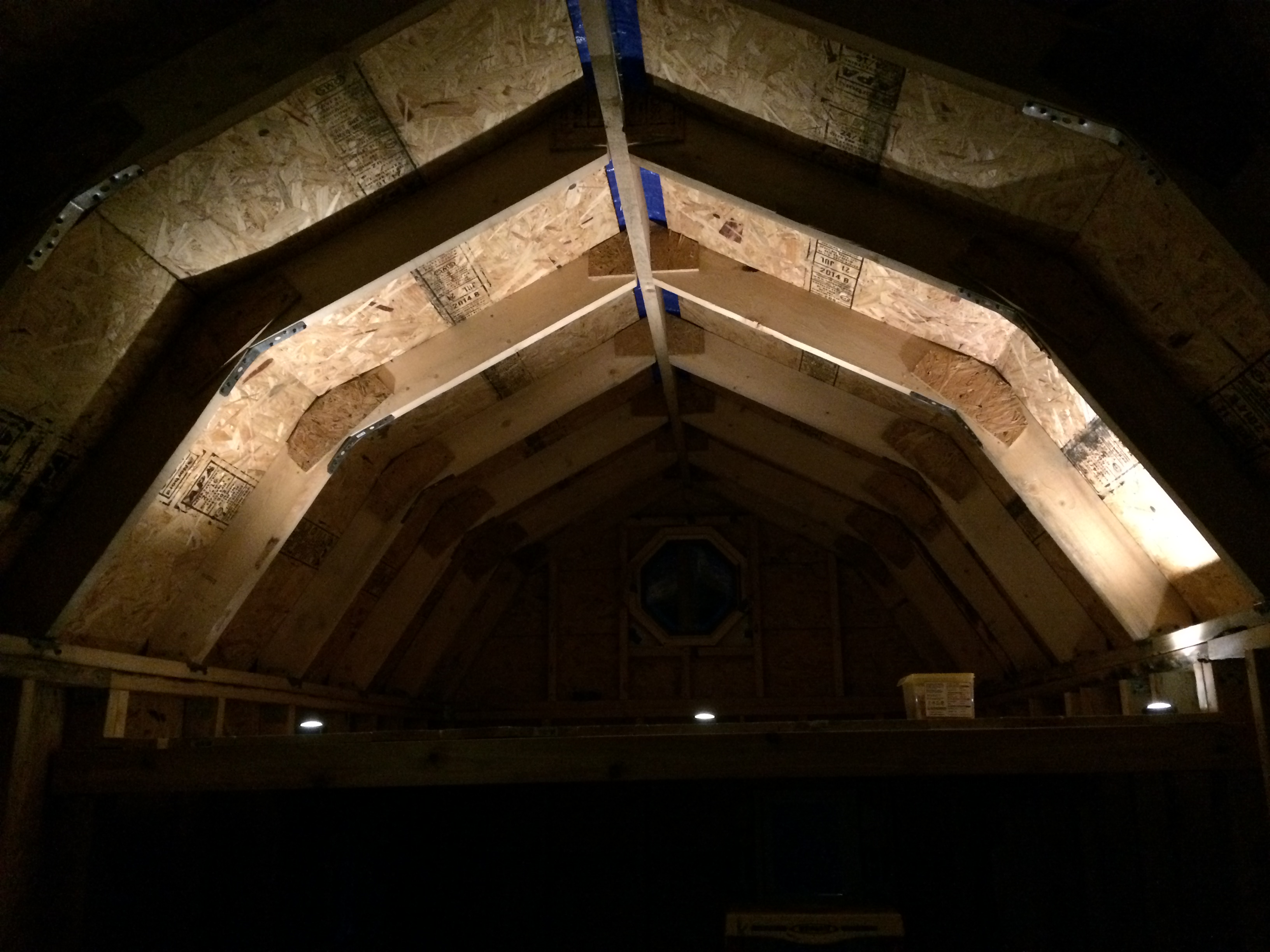
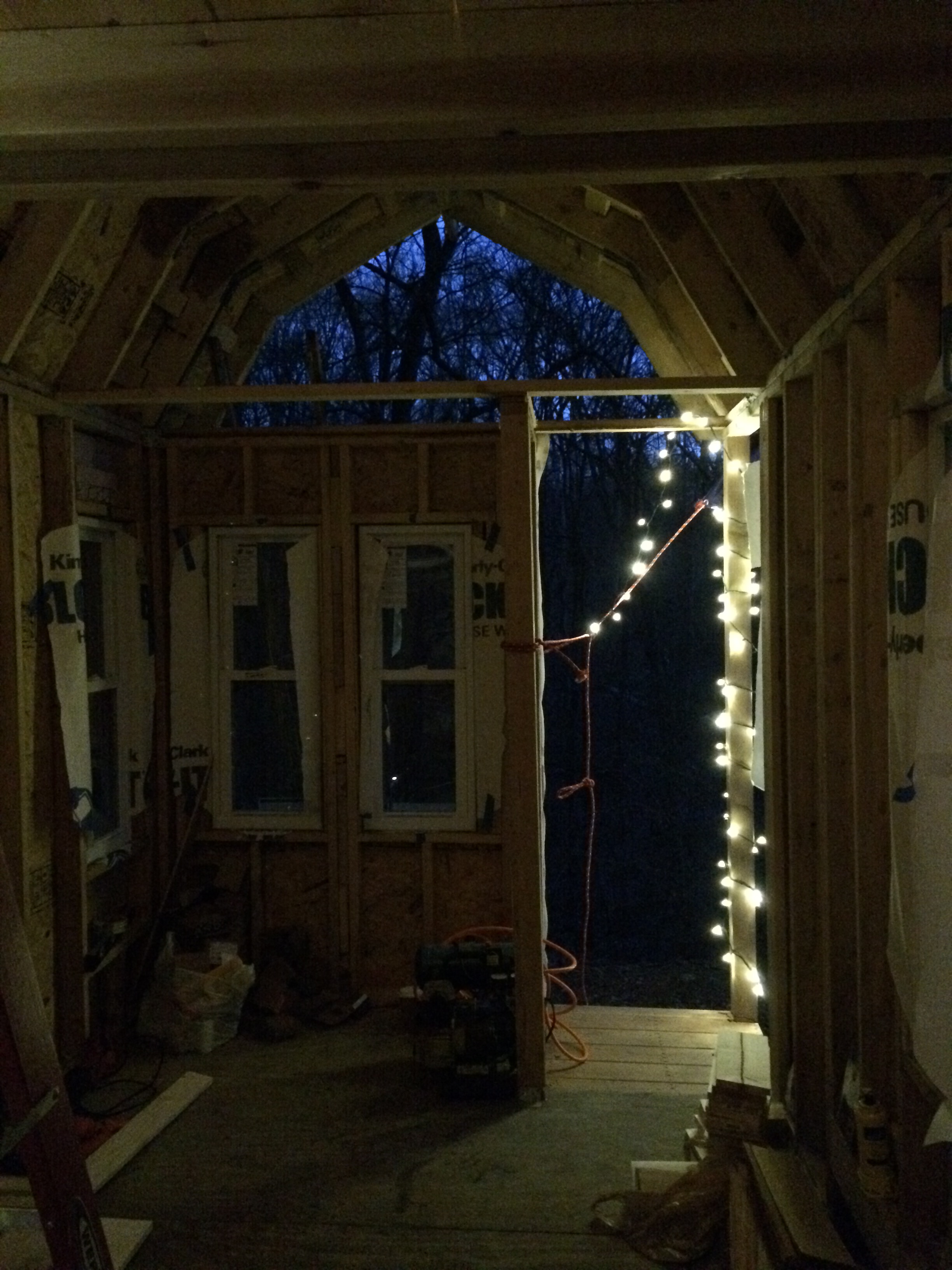
Finally, a few more pics of the house at night while playing with some battery operated puck lights. I wanted to see how much light they put out in a house that size to get a better sense of how to wire, what kind of lighting, what size solar panel to get, etc. It was pretty amazing to see just how much light these three little guys could put out:

IMG_4816_2 IMG_4809

The effect of uplighting is pretty stunning. I may use a fair bit of it, actually.

IMG_4817_2

Changing the position of the pucks changes the lighting a lot, too, as you can see in the above pic.

They’ll be very handy in the kitchen, as the pic below was the effect of just one puck light over the kitchen window:

IMG_4814


Even though it isn’t Christmas anymore, I left the string of LED’s up outside the house around the post for the simple fact that they make me smile and remember why I’m doing this. IMG_4818_2

Being in the woods is magical at night. There are several owls that hang out in the trees all around my house, and they chat happily once the sun starts going down. The sunrises and sunsets are glorious through the bare trees. In the daytime, the red-tailed hawks that live to the south can be seen and heard several times a day and are no longer shy around me when I’m working. All in all, a pretty sweet experience.

A “Tiny” Bit of a Challenge . . .

Who would think that building something so “tiny” could possibly be so challenging?

I know, I know. This update on the progress of the house is LONG overdue. Suffice it to say — I took on WAY too many responsibilities over the summer and into the autumn this year. On the other hand — a person’s gotta live, don’t they? As a freelance artist and teacher, if I don’t take the work that’s available, devote mindful presence and energy to it (and ultimately feel gratitude for it), I’m in a lot of trouble.

That said, onto the details about the house and its construction.

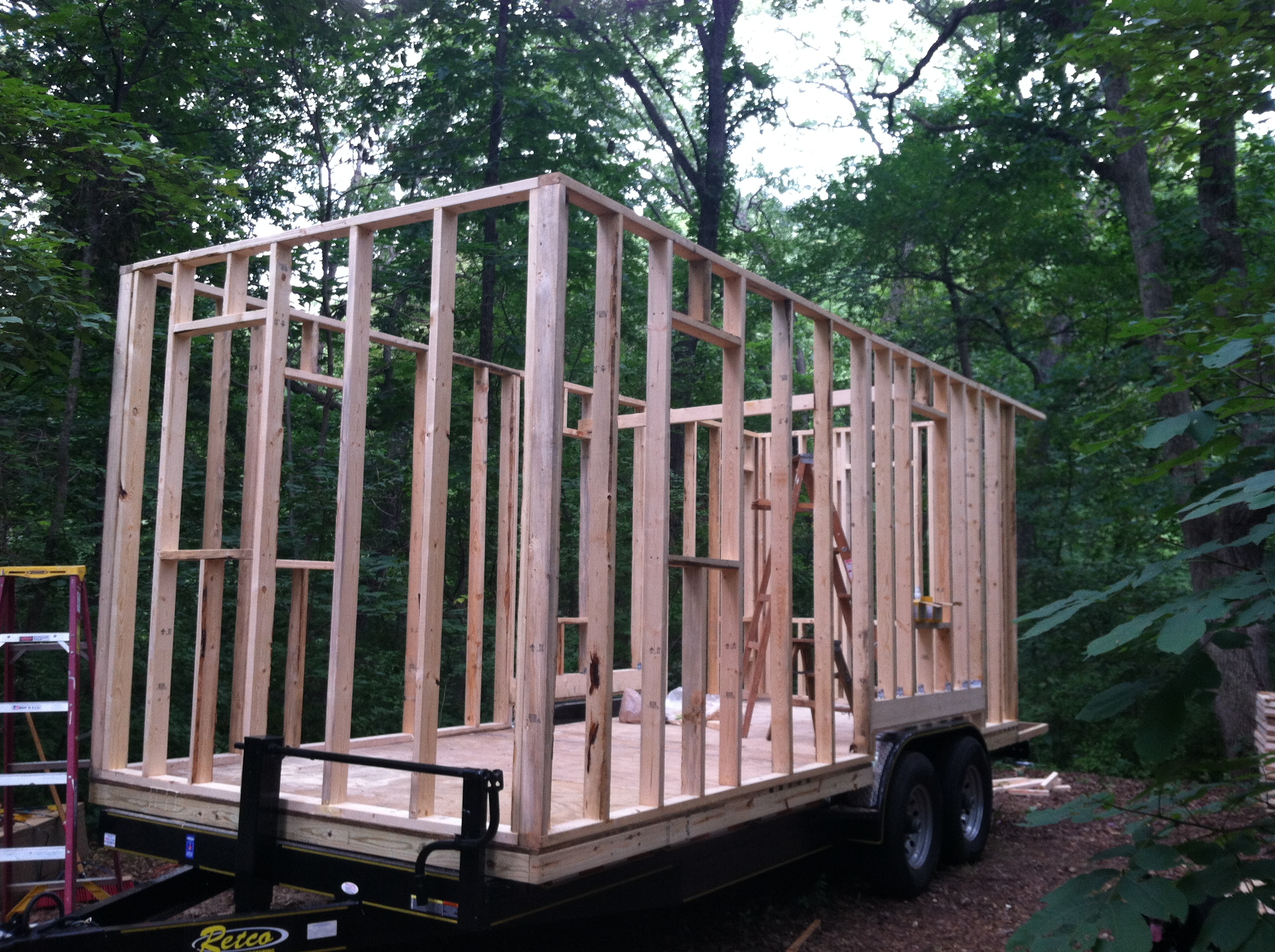
The frame went up with minimal difficulty.

IMG_5129

See?

Then there was the roof.

Ohhh… the roof.

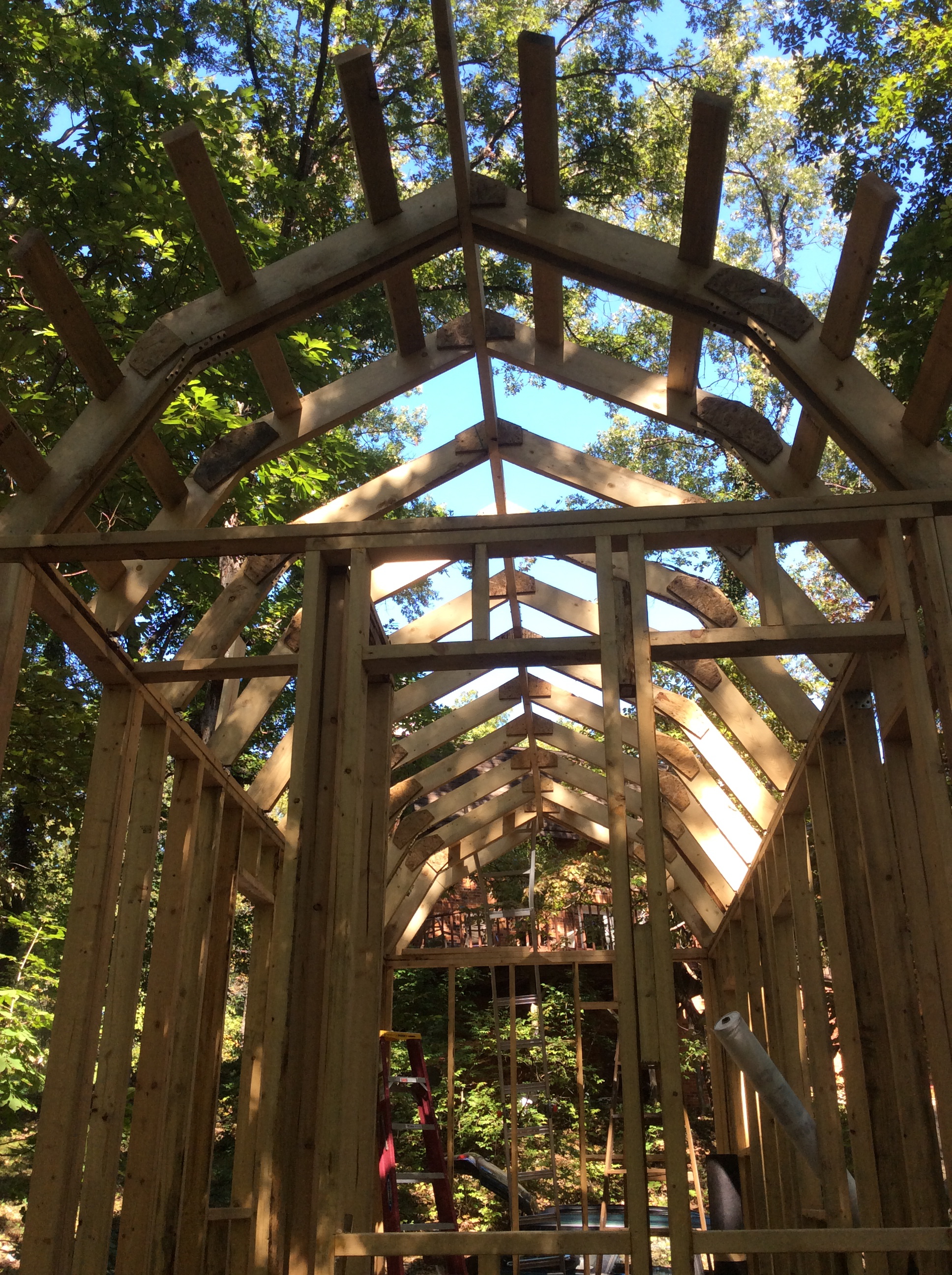
There are a lot of details I could offer about the roof and why we chose to change its pitch, but it’s confusing so I won’t. We altered the style of the roof to a gambrel or ‘hip’ roof. My father has built at least two buildings with gambrel roofs on them, and they do offer quite a bit more space in the loft, so we chose to go ahead and do it.

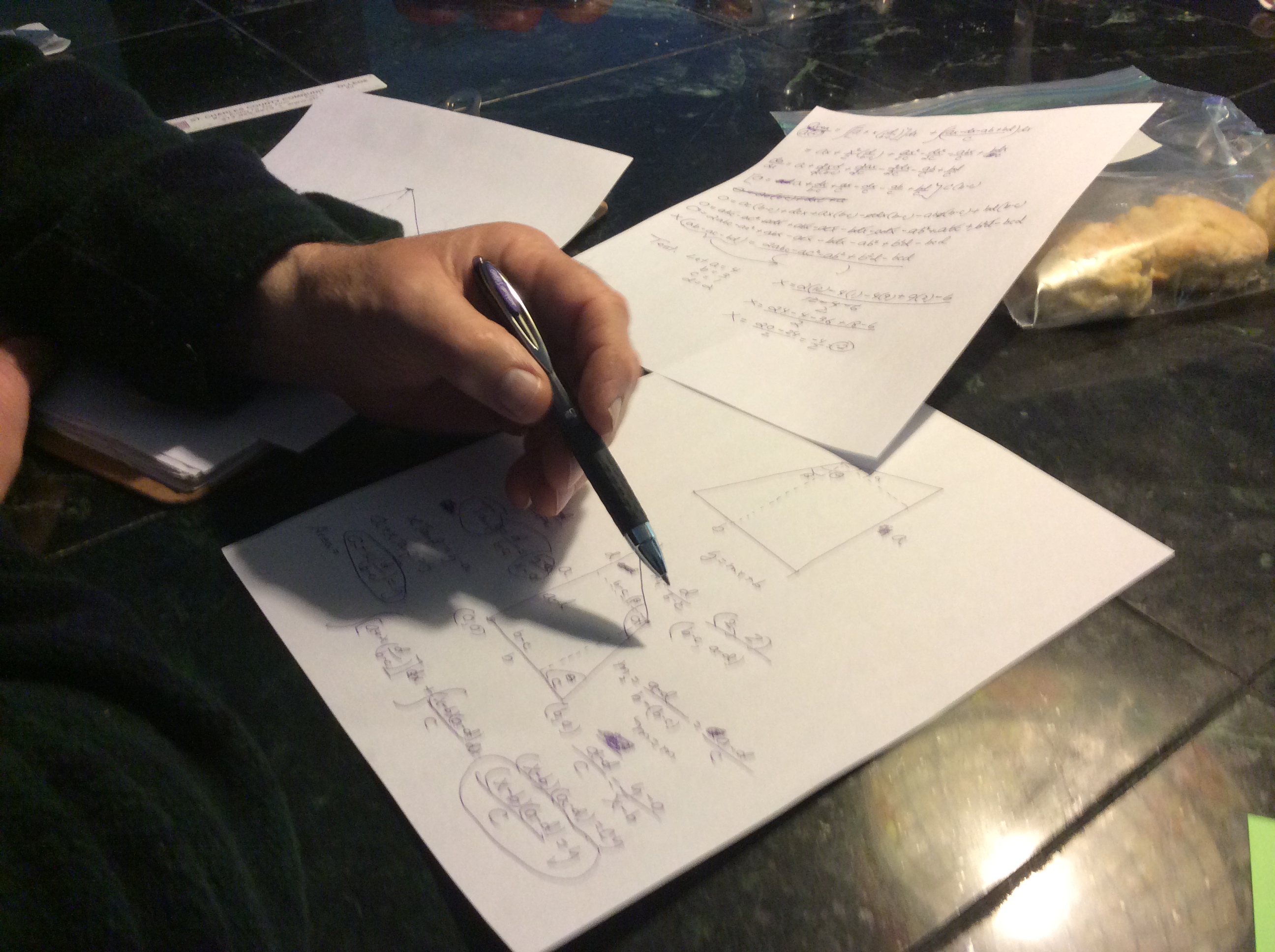
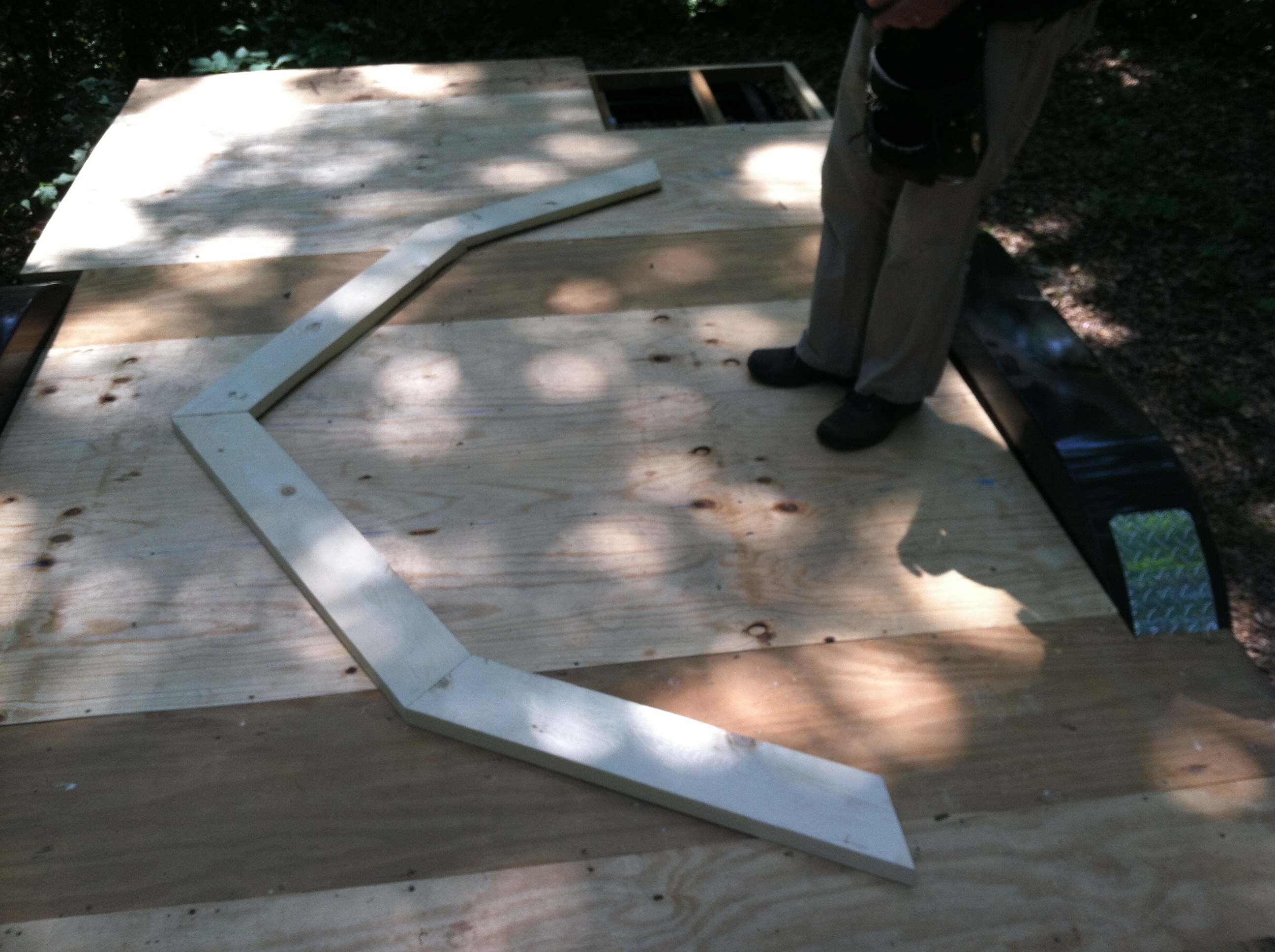
Dad did all the calculations, and we started building trusses.

IMG_1107 IMG_5004

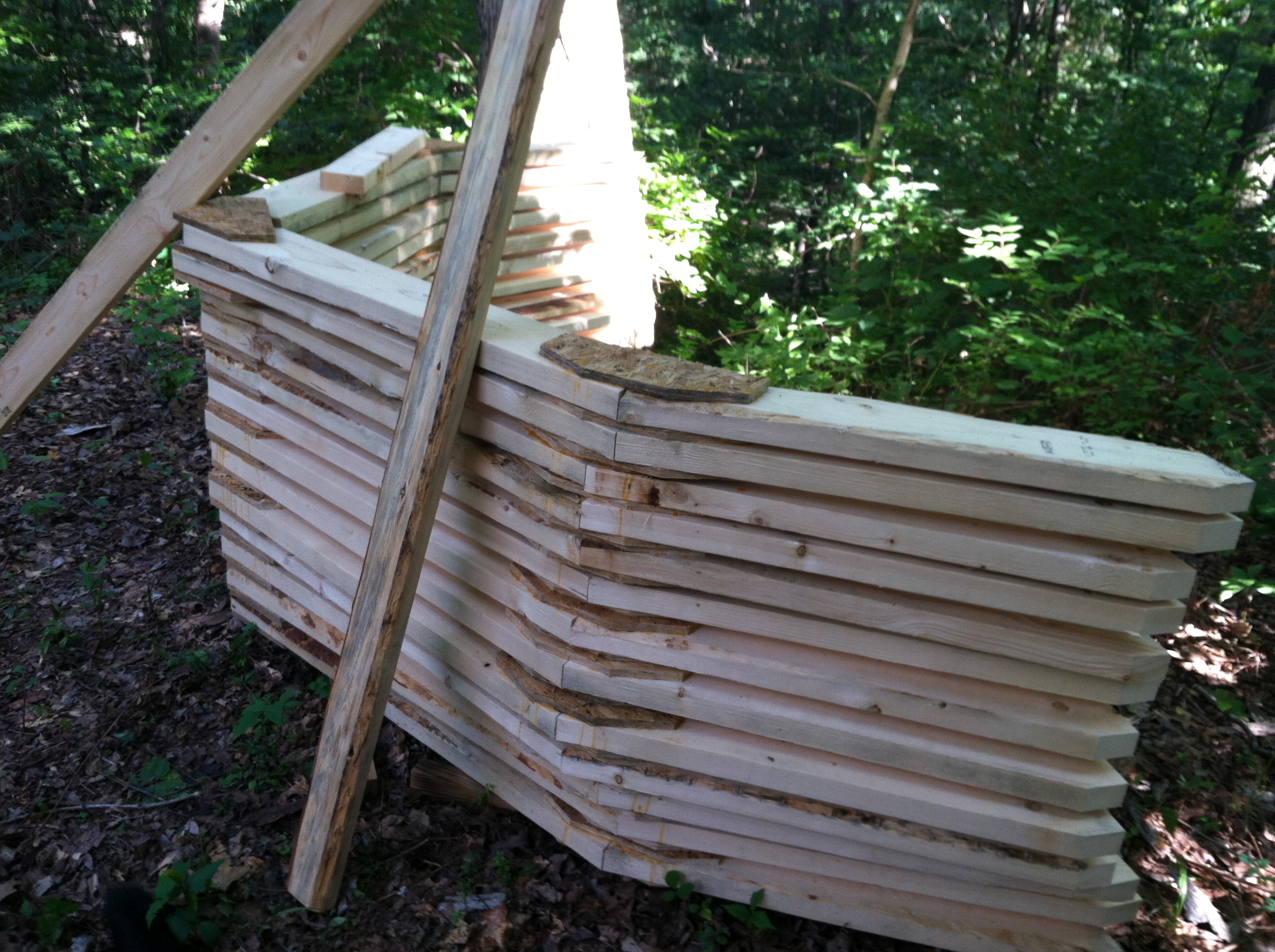
We built all these trusses so that we could put up the frame and have the trusses ready to put up. It all seemed so simple.

Great big stack 'o' trusses.

Great big stack ‘o’ trusses.

At first, it was. We got some anchors for the trusses, measured them out, screwed them in, and put up the trusses. It took shockingly little time to do. Once they were up for a few days, however, we realized that we’d built a few of them incorrectly. No big deal, we thought. We’ll take the faulty ones down and re-build a few trusses. When we took them down, however, we realized that the structure wasn’t going to be nearly stable enough without a rafter board. Even with the sheathing and roofing to stabilize the structure, the use of trusses isn’t nearly as stable as rafters and a rafter board when you subject the structure to torsion. If you put a stick building on a trailer and tow it, there’ll be torsion. Oh, yes. Torsion-tastic.

I love and admire my father deeply, and am eternally grateful for his assistance, problem-solving abilities, experience, and brilliance. I have also since learned that it is unwise to back off when he tells me that the additional reinforcements I add to the structure are “overkill”, and I no longer defer automatically to his opinions about building. If I were building a structure that wasn’t intended to move on a trailer, they would be entirely valid. NO question. When it comes to building a tiny house, however, he hasn’t done a quarter of the homework or research that I have, and since I’m the one taking the risk and hoping to live in it, I’m going to default to the research provided by those in the know on this particular area. Luckily, between us we’re a pretty solid team. We rarely argue, we work smoothly together with a great deal of mutual support and encouragement, and when one of us screws up, we (eventually) laugh and move forward with ease.

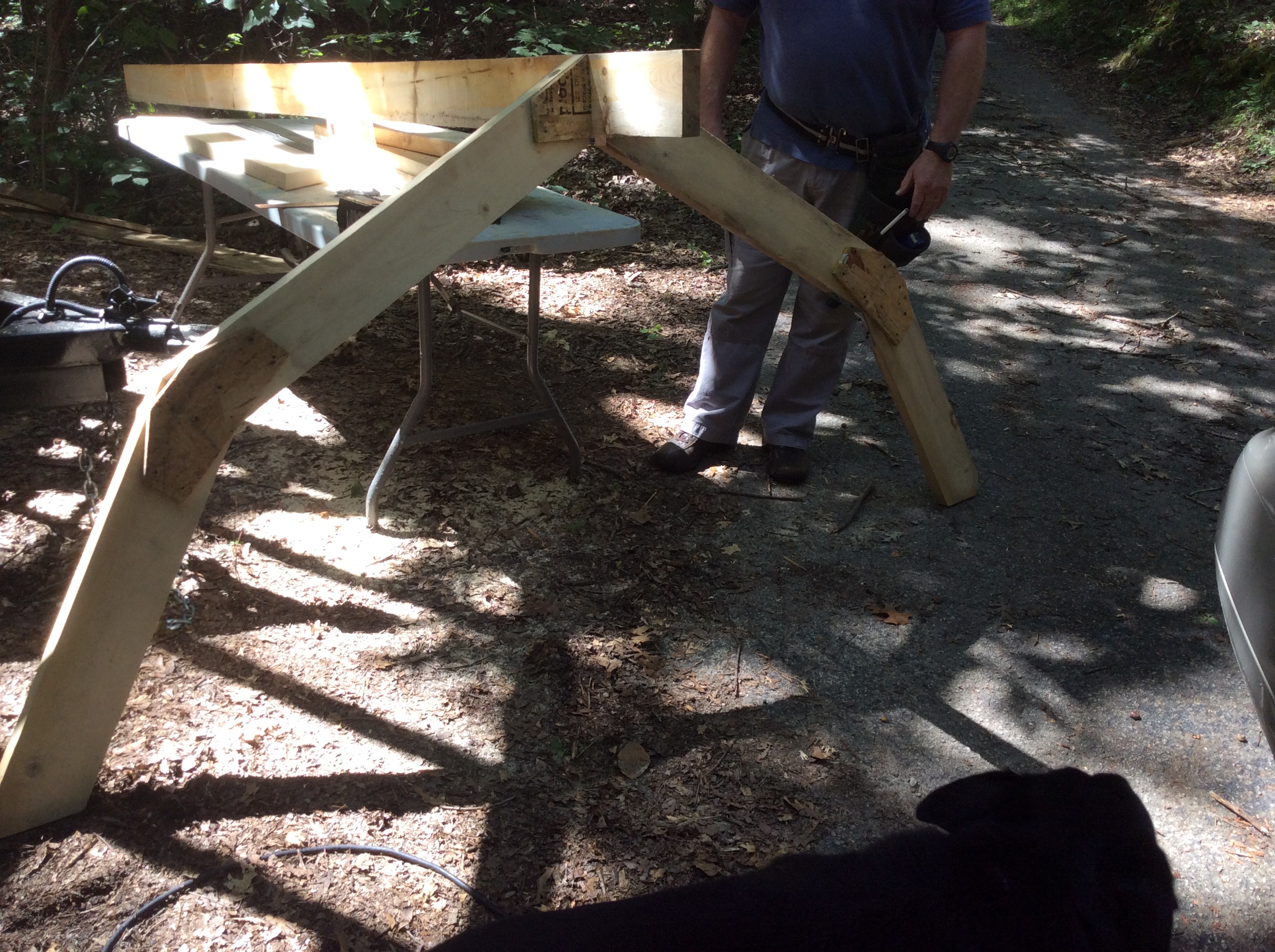
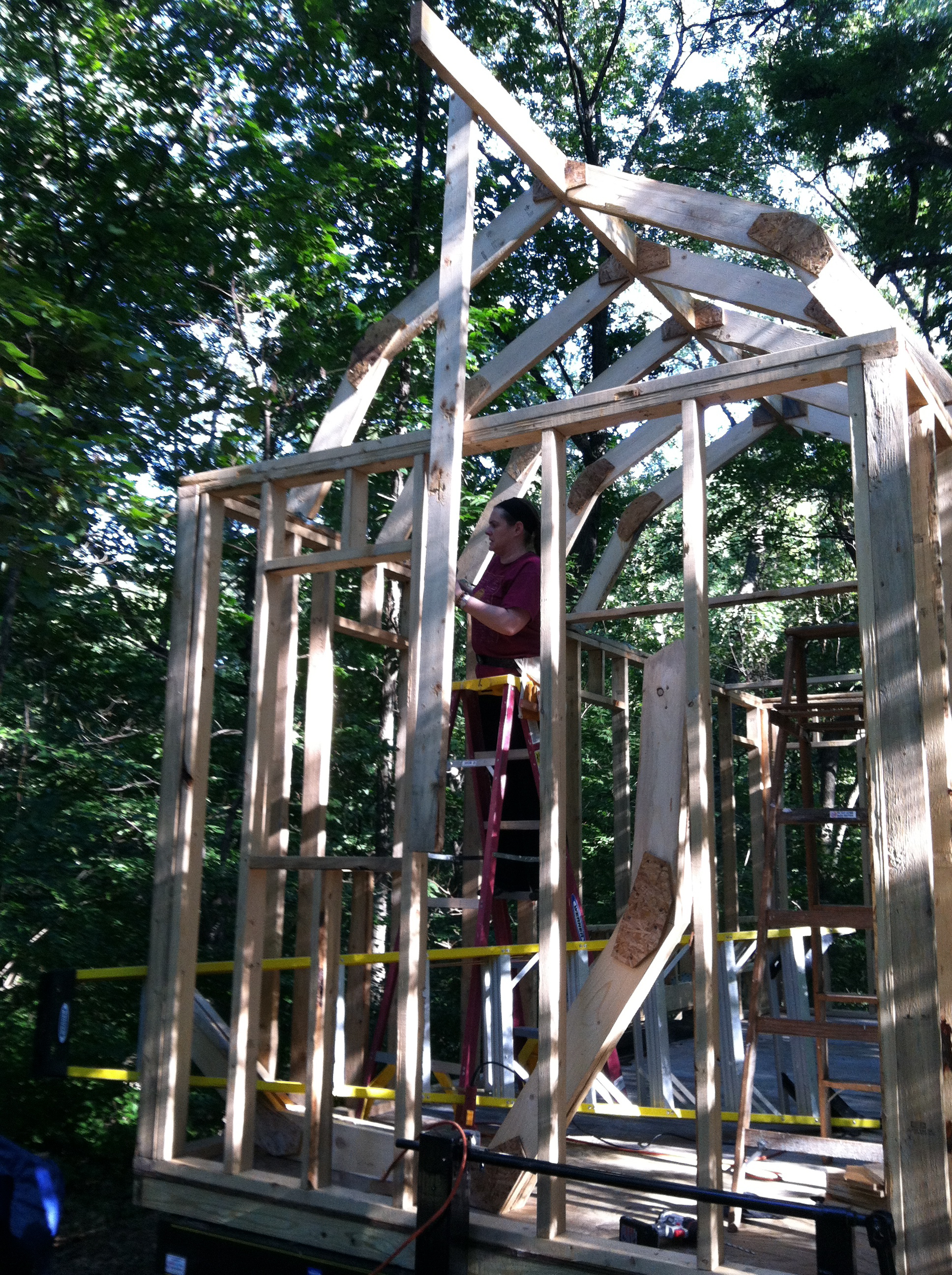
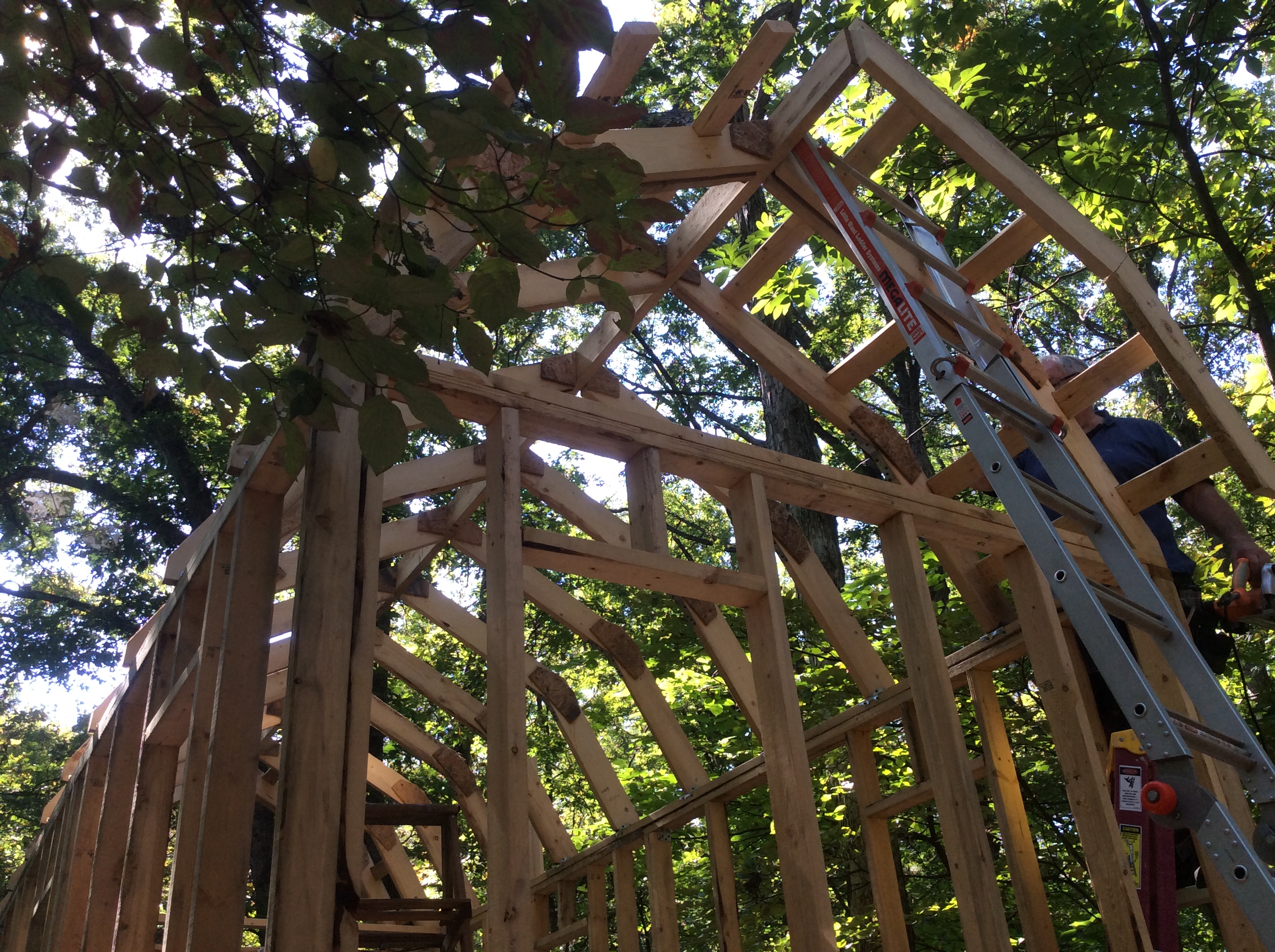
We took the trusses and split them in the middle to turn them into rafters, and attached them to the rafter board.

Trusses turned into rafters and attached to the rafter board.

Trusses turned into rafters and attached to the rafter board.

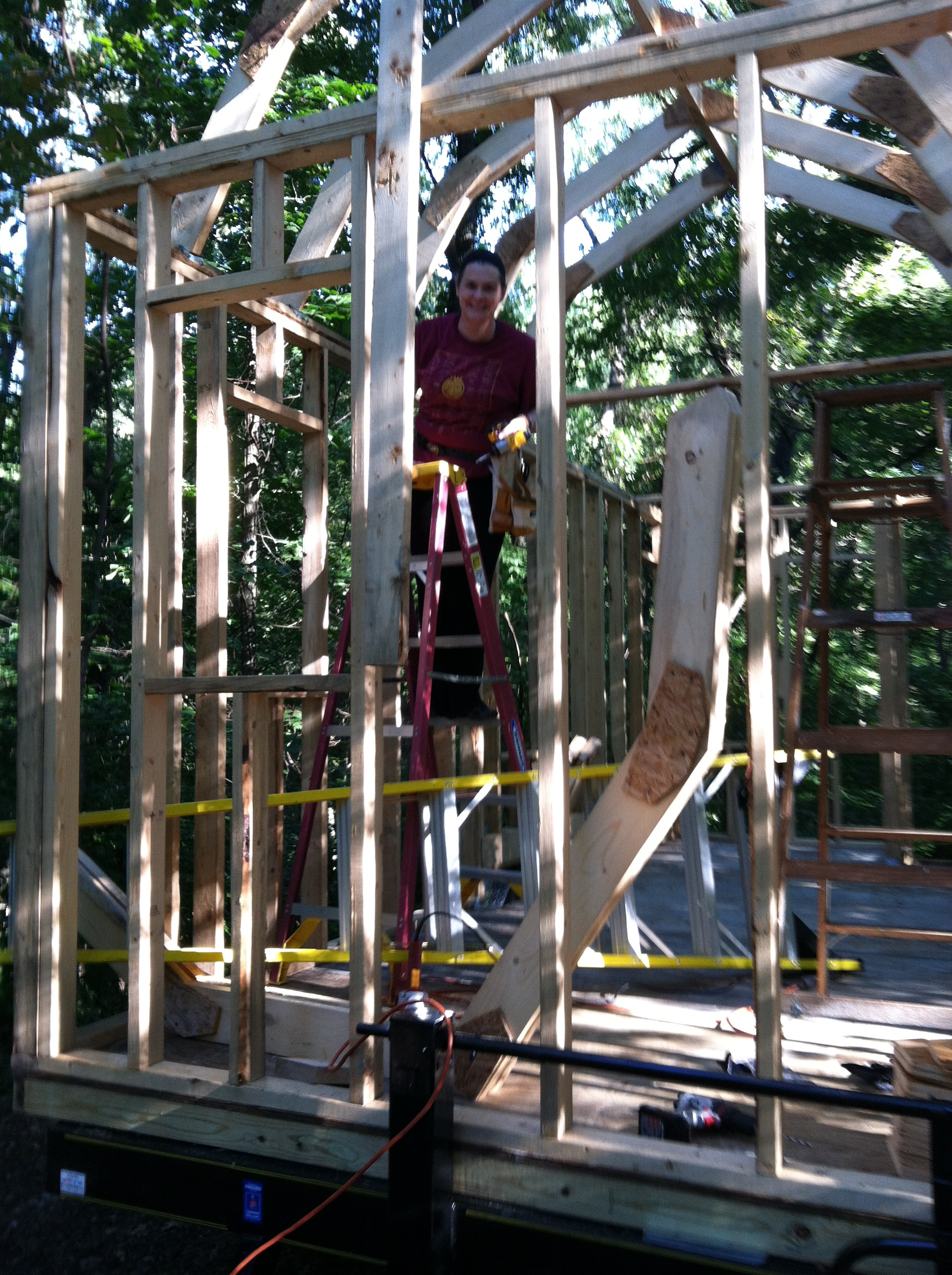
I wish someone had videotaped or taken photos of us trying to get that rafter board into place; I couldn’t describe it to you anymore because I remember very little of the process. It was kind of traumatic and we were lucky to have survived it. But once it was in place and we could attach the rafters to it, as you can see from the photos below (taken by my mother as she was passing by on her way home from work), all was well in the world of tiny house construction.

Hard at work fastening rafters into place.

Hard at work fastening rafters into place.

Happy Nat holding her handy impact driver.

Happy Nat holding her handy impact driver.

You can clearly see that the season has moved on from when these photos were taken, however. Once school started, time for building was cut right down to only 2-3 mornings or afternoons a week (max), and once rehearsals for A Christmas Carol started, it was cut down to one day a week. At the end of October, a disc in my lumbar region started to bulge and was decidedly unhappy, so things have ground to a halt until yesterday to allow for recovery. A few years back I had a disc in my neck that decided to bulge and healed very nicely despite the extent of the injury, so this is familiar (if extremely unpleasant) territory.

Before the disc kicked up, however, we managed to get this done:

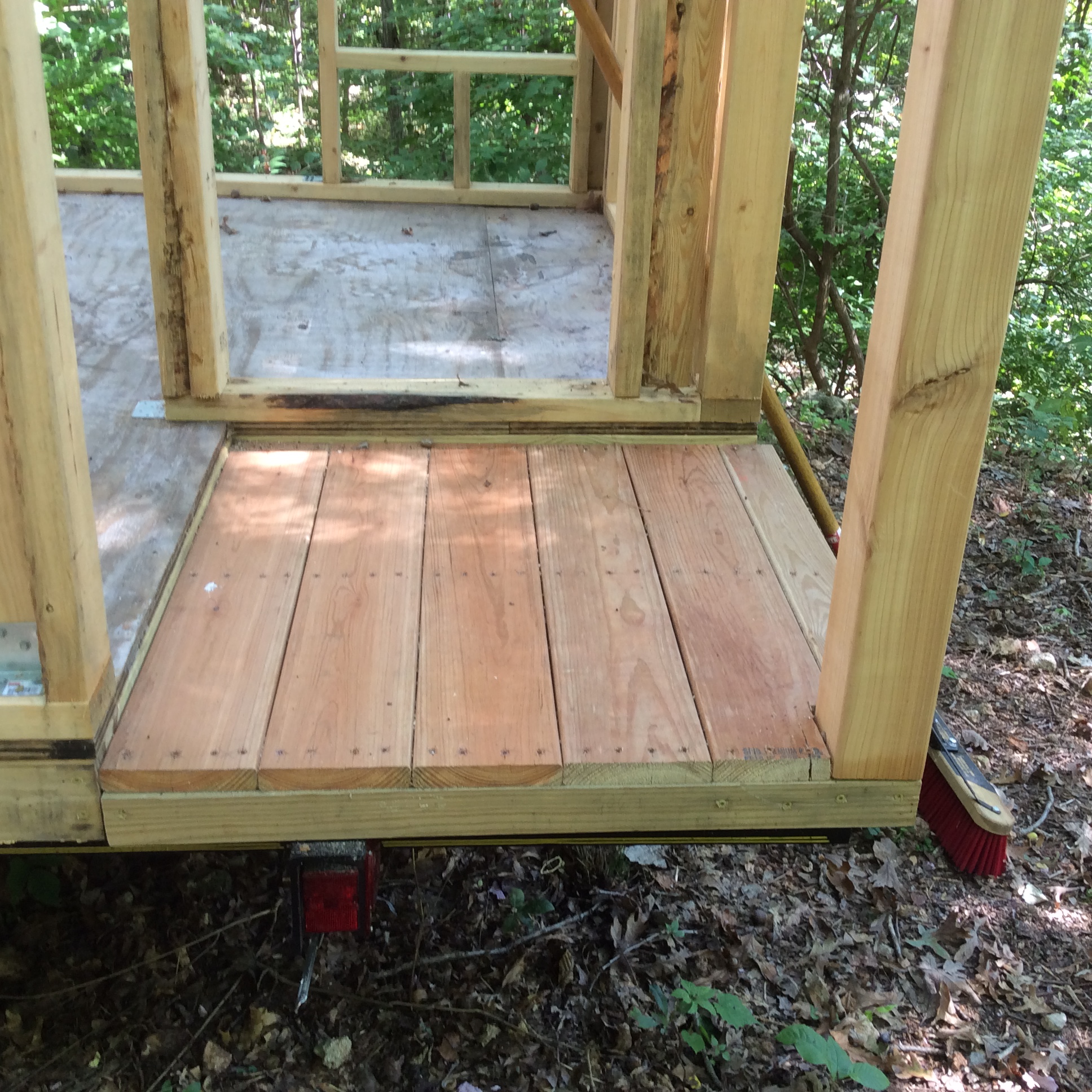
Front porch, which is located at the back of the actual trailer.

Front porch, which is located at the back of the actual trailer.

Looking at the front of the house, which is at the back of the trailer itself. Framing that area of the roof wouldn't have happened without our friend, Bob, who "climbs like a squirrel".

Looking at the front of the house, which is at the back of the trailer itself. Framing that area of the roof wouldn’t have happened without our friend, Bob, who “climbs like a squirrel”.

Looking at the back of the house, which is also the front of the trailer.

Looking at the back of the house, which is also the front of the trailer.

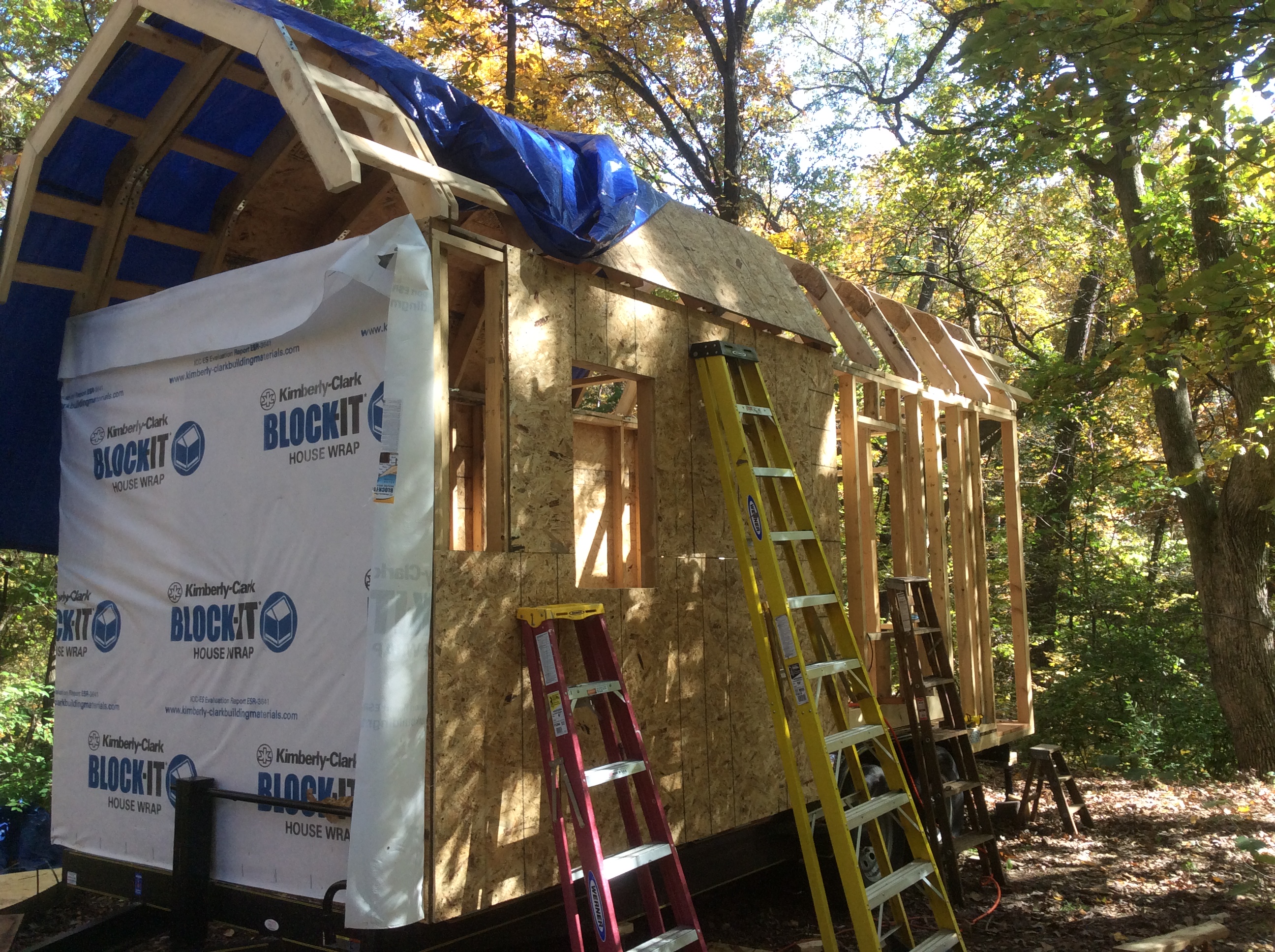
Halfway sheathed and wrapped, and with about 2/5ths of the roof sheathing in place.

Halfway sheathed and wrapped, and with about 2/5ths of the roof sheathing in place.

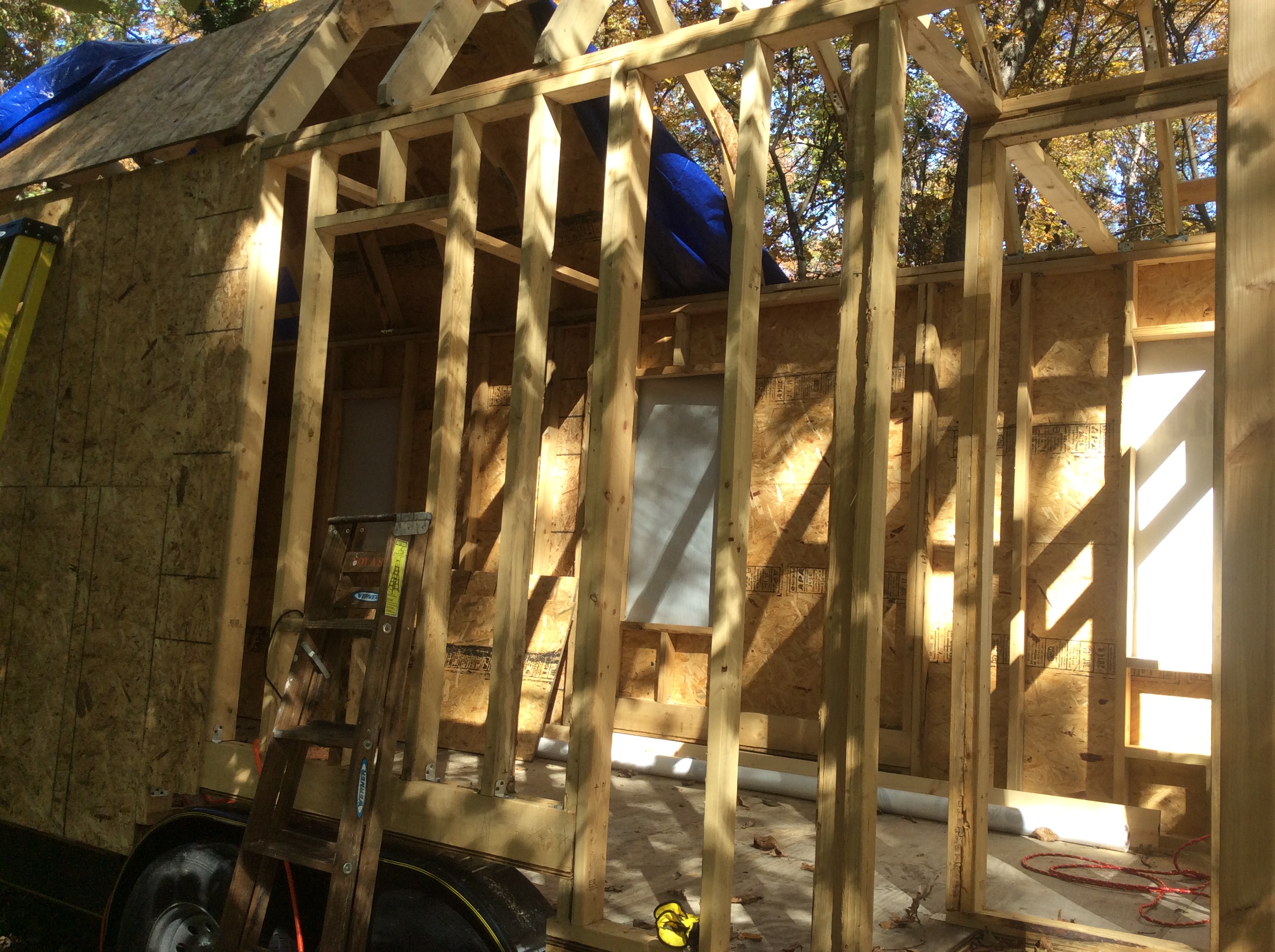
Almost a "cutaway" view of the frame, sheathing, and house wrap process.

Almost a “cutaway” view of the frame, sheathing, and house wrap process.

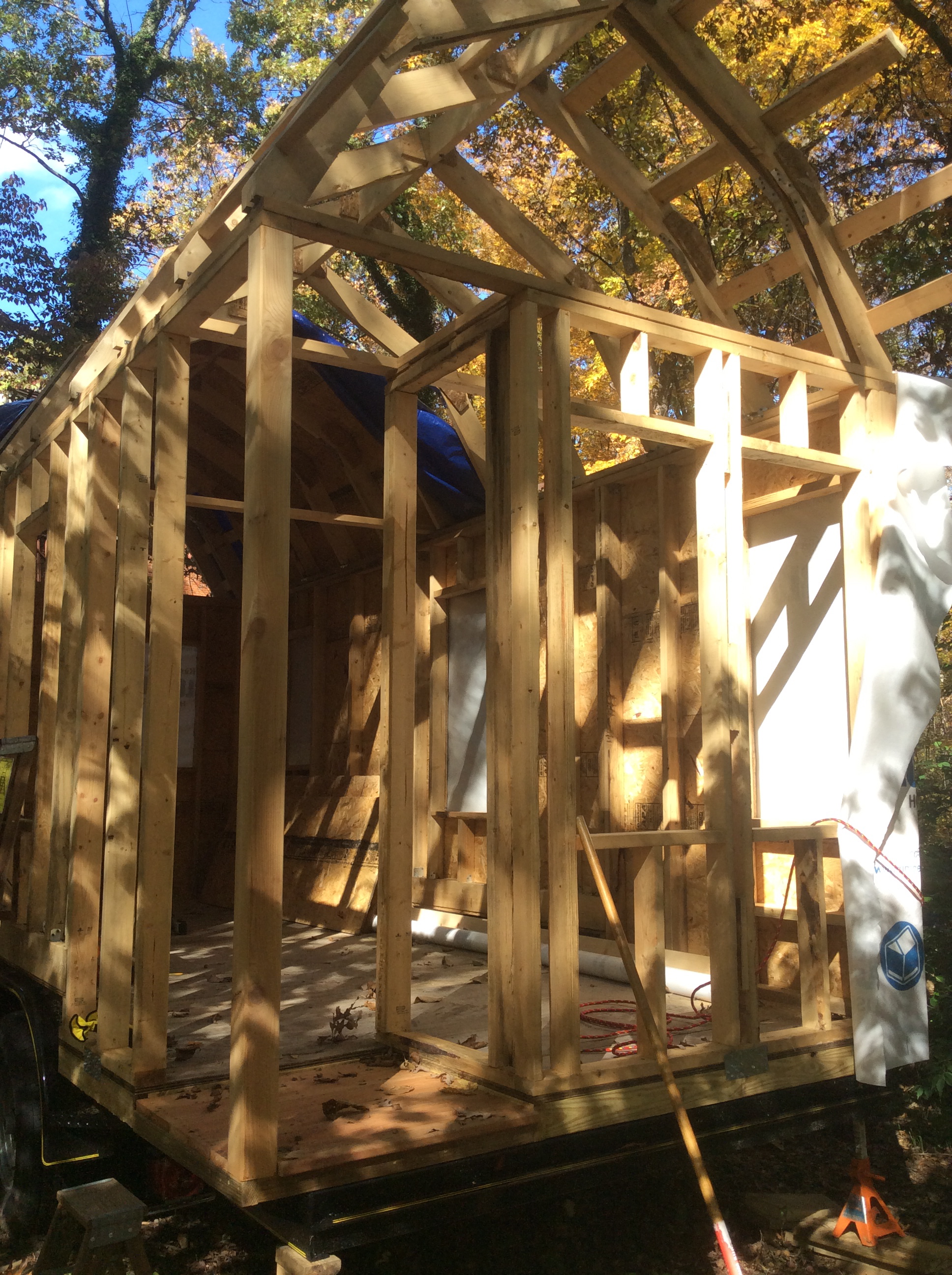
Another cutaway taken from the front of the house.

Another cutaway taken from the front of the house.

Presently, we’ve gotten all of the sheathing put up on the sides and roof, and the house is wrapped. One gable end is finished, the other one isn’t. We have the roofing all ready to go. . .and we’re slightly terrified of doing it. Before attempting it, we’ll be calling our friend, Bob, to come over and assist, and probably a few others as well. This job is the one I fear most, aside from installing the skylights. (!) The windows have been ordered, but between foul weather, riots, and holidays, I’m not sure how much longer it will take for them to arrive.

I’ll take my iPad down with me tomorrow to take a few more photos for a shorter update tomorrow. I need to do that before the end of the semester hits full whammy, or you won’t hear from me again until afterward.

Wow. What a ride.