Monthly Archives: February 2015

Cloth, Stitches, and Simplicity = Breath and Space

Since winter has finally decided to settle in, and doing any building in this weather is no longer possible until it lets up, it’s a perfect time to share something else that is very near and dear to my heart:  stitching cloth by hand.

While the tiny house building takes a break, it’s a perfect time to share some of the stitch work that has been taking shape over the winter. It isn’t that I had given it up while working on the house — far from it. 

When I started this blog up originally, it was to write about and share textile projects, theatre and movement projects, writing, subversive ideas, and anything Zen or Buddhist-related. The tiny house started becoming the primary focus of the blog somewhere along the way, and everything else — despite its continuation as part of normal, everyday life — has taken a back seat on the blog.  

In all honesty — it’s a relief to have a break from the building work and to settle into greater space, quiet, and other aspects of life. During the winter, few things can beat sitting in the warmth and stitching on something in the evening. It quiets the mind and creates space to breathe and contemplate; not just the piece being worked on, but with anything that arises. When the urge to stitch arose a few years ago, seemingly out of nowhere, it began with simplicity and organic process. After taking a few years to play and explore in a wide variety of directions, the simplicity of cloth, a needle, and thread continues to be a tremendous source of joy, creativity, and provides a space for contemplative insight.  

The instant that an outcome or result enters the picture, the joy, space, and creativity dissolve, and I may as well be designing a spreadsheet in Excel. This is the one place in my life where things can be 100% organic, fluid, relaxed, and entirely free from expectation. A sanctuary.

During the tech process for A Christmas Carol last November, I knew that it would be wise to keep my nervous system grounded and slowed down with a piece of stitching at hand. Recognizing that it would need to be something that I could drop at a moment’s notice and play with in poorly lit conditions, I started with assembling scraps into tiny collages.

This was the piece I started with first:
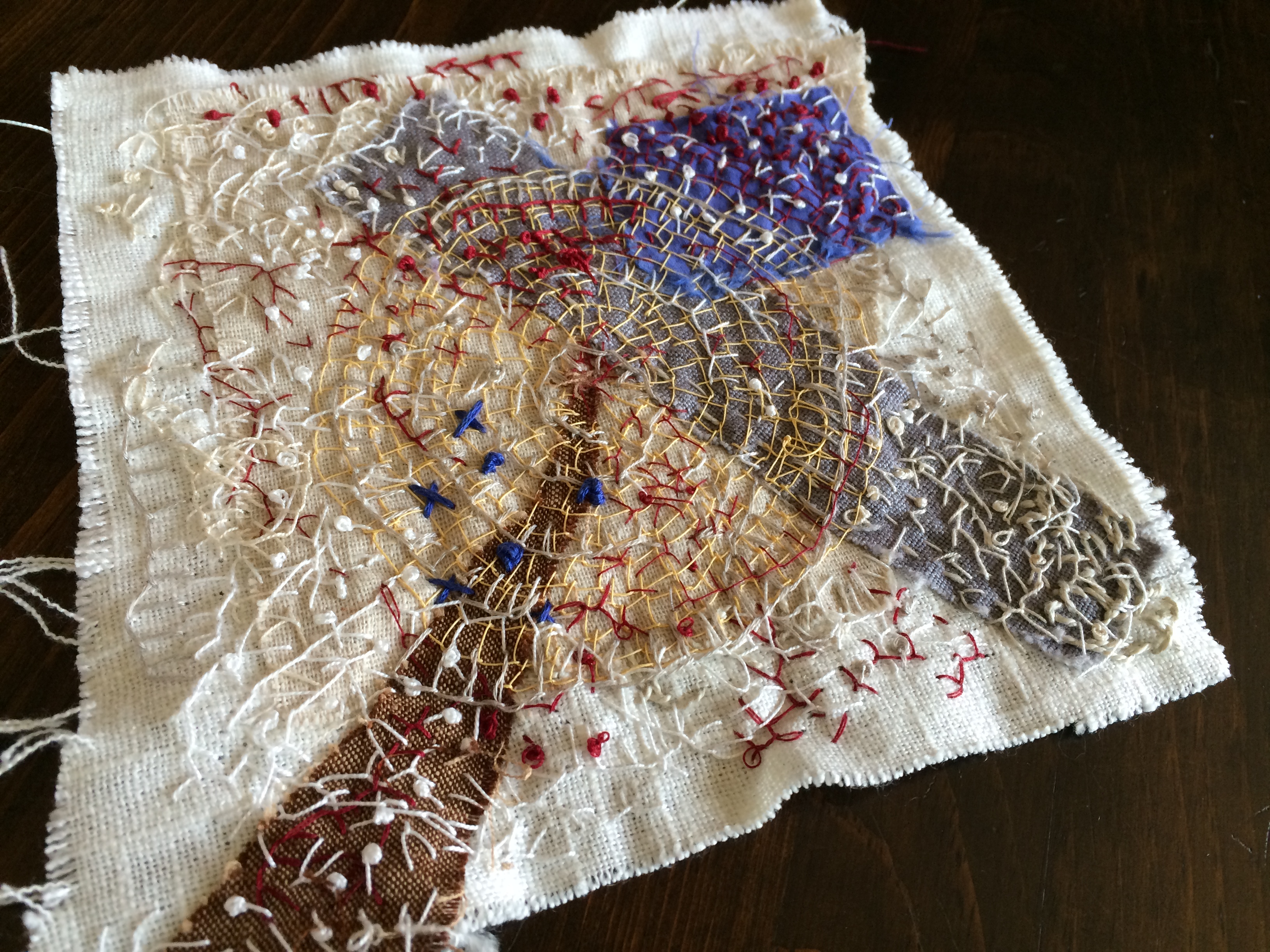
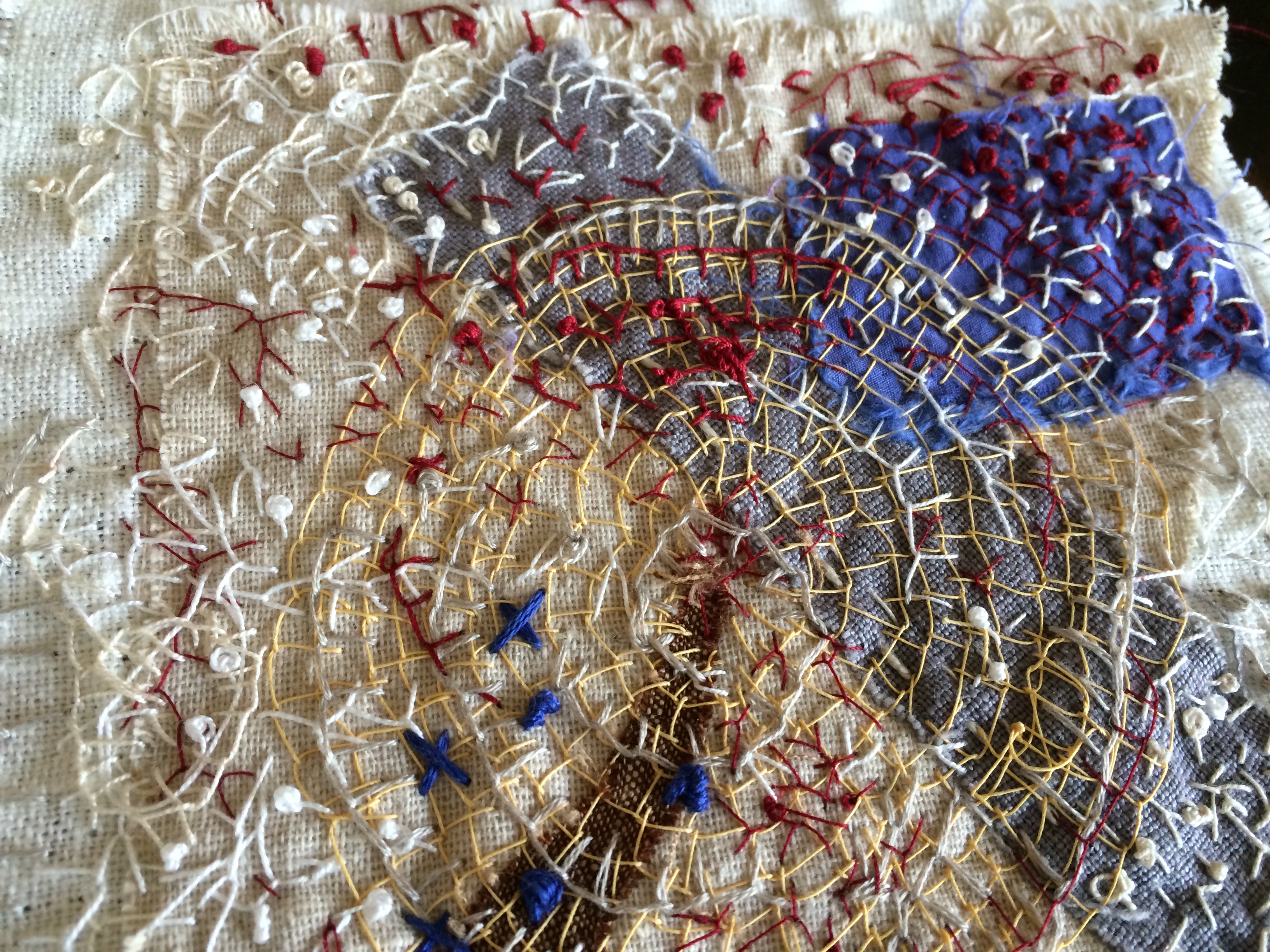
"The Missing Piece"

“The Missing Piece”

"The Missing Piece" Detail close-up

“The Missing Piece” Detail close-up

I call it “The Missing Piece” because it reminds me of the shapes from the story book by Shel Silverstein. It’s also because as soon as I started working on it, I realized how much I had missed the tactile simplicity of stitching something. The impact of it is instantly beneficial and calming.  Working in a circular fashion is also very soothing, as is the pleasure of changing the stitch at a moment’s notice, breaking every known rule imaginable, and just playing until that particular thread runs out. The inspiration to work that way comes from the fiber artist Junko Oki, and her trademark technique, “Woky Shoten”, which means “unbroken stitch”. It’s incredibly fun and freeing. (There are several more to come in another post!)

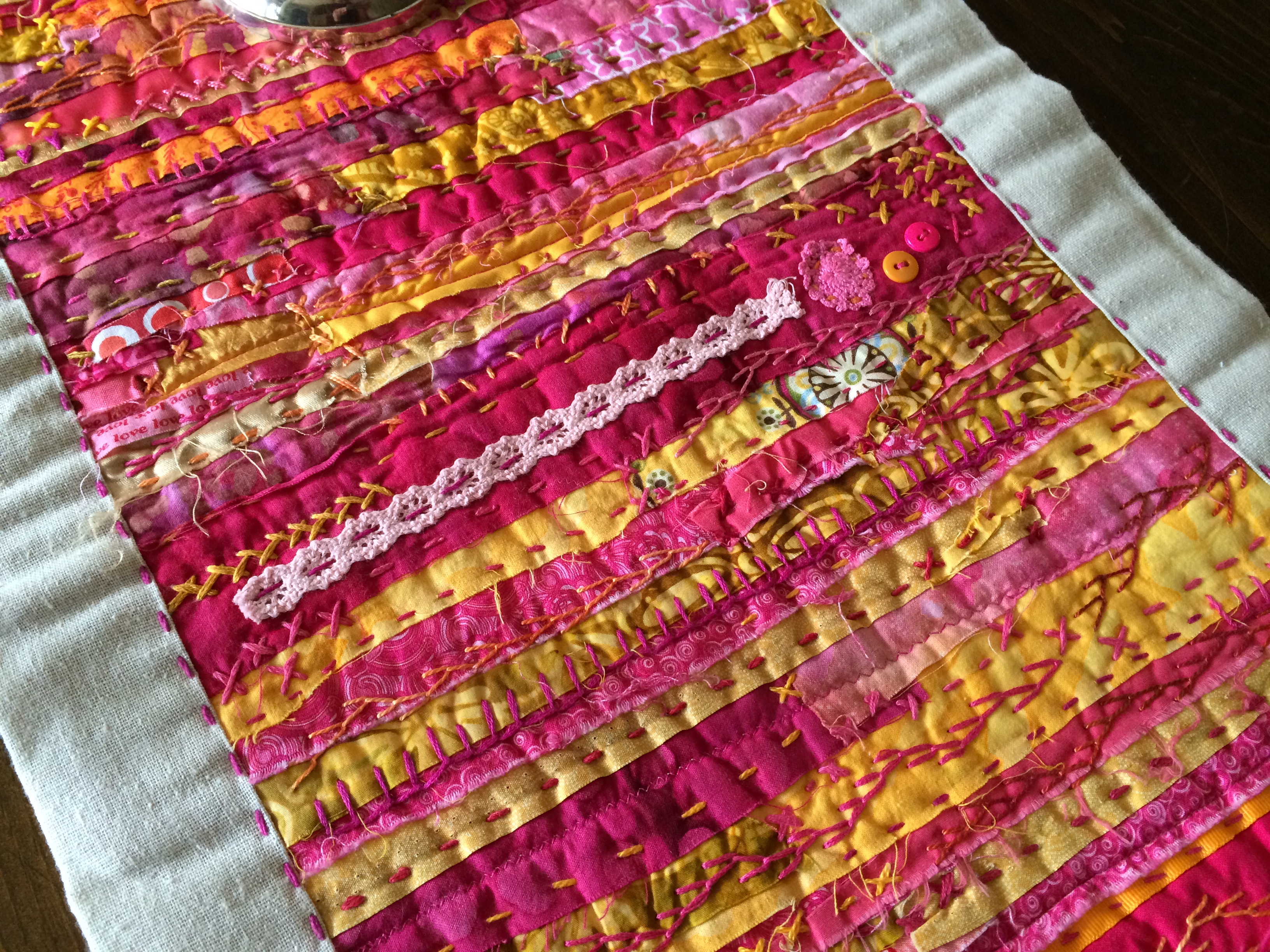
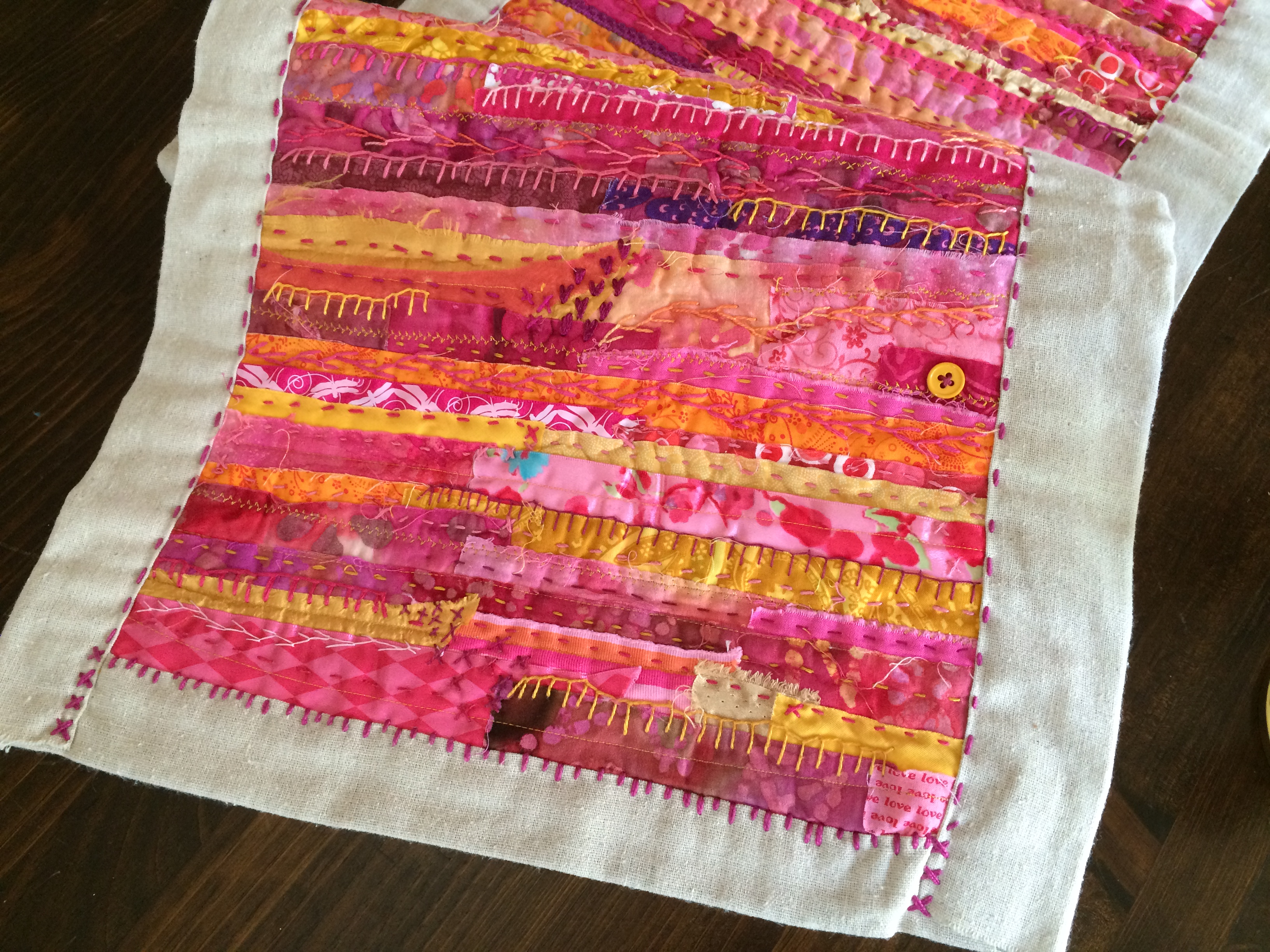
As Christmas began approaching very quickly, however, I remembered a table runner I’d started for my mother back in 2012, but had never finished. At the time, it felt like too much stitching (you’ll see why in a minute!), so I put it away for a while. It was another perfect piece to work on during tech rehearsals, and turned out beautifully. I love it; and I’ll probably never make one like this again:
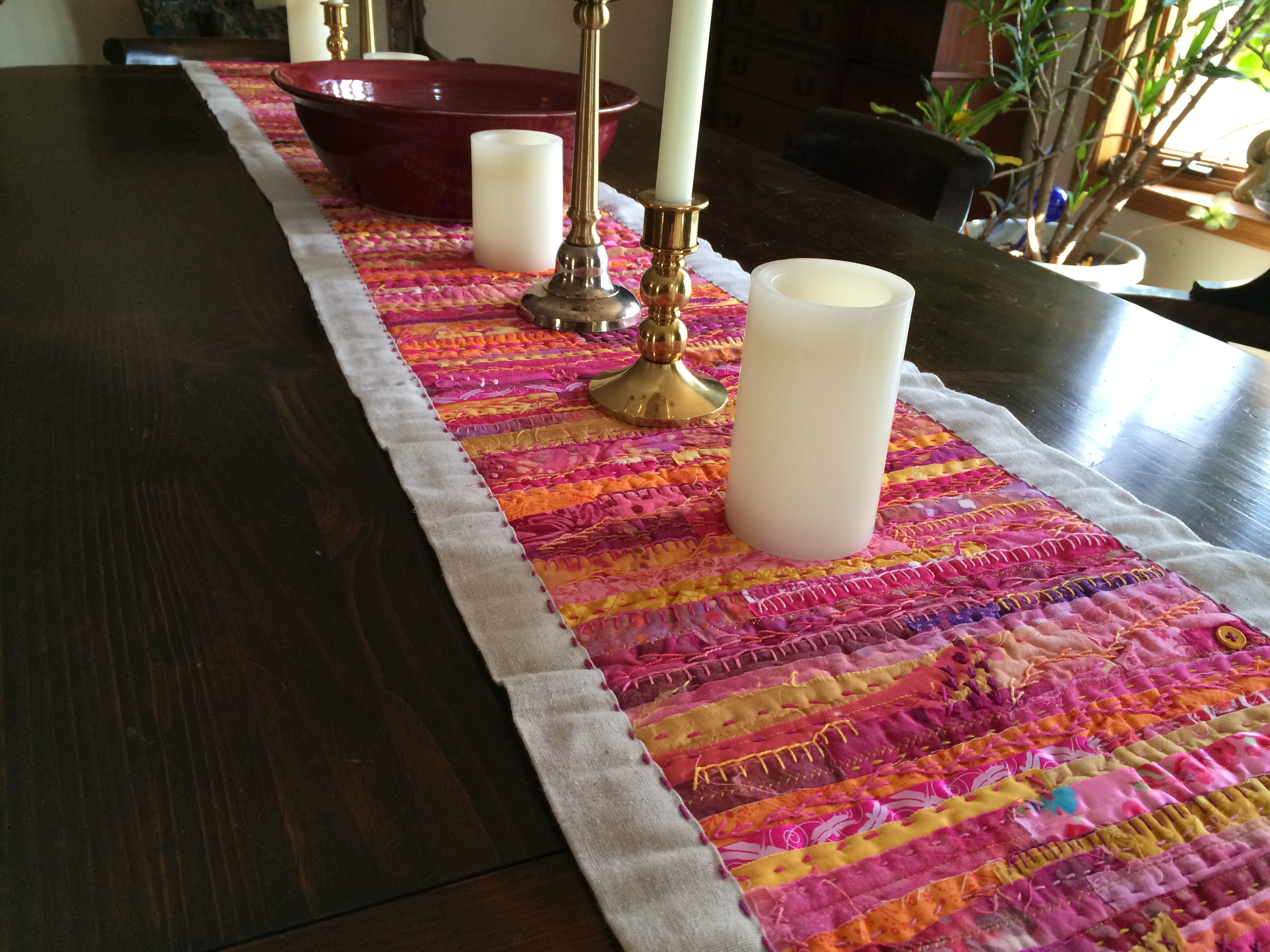
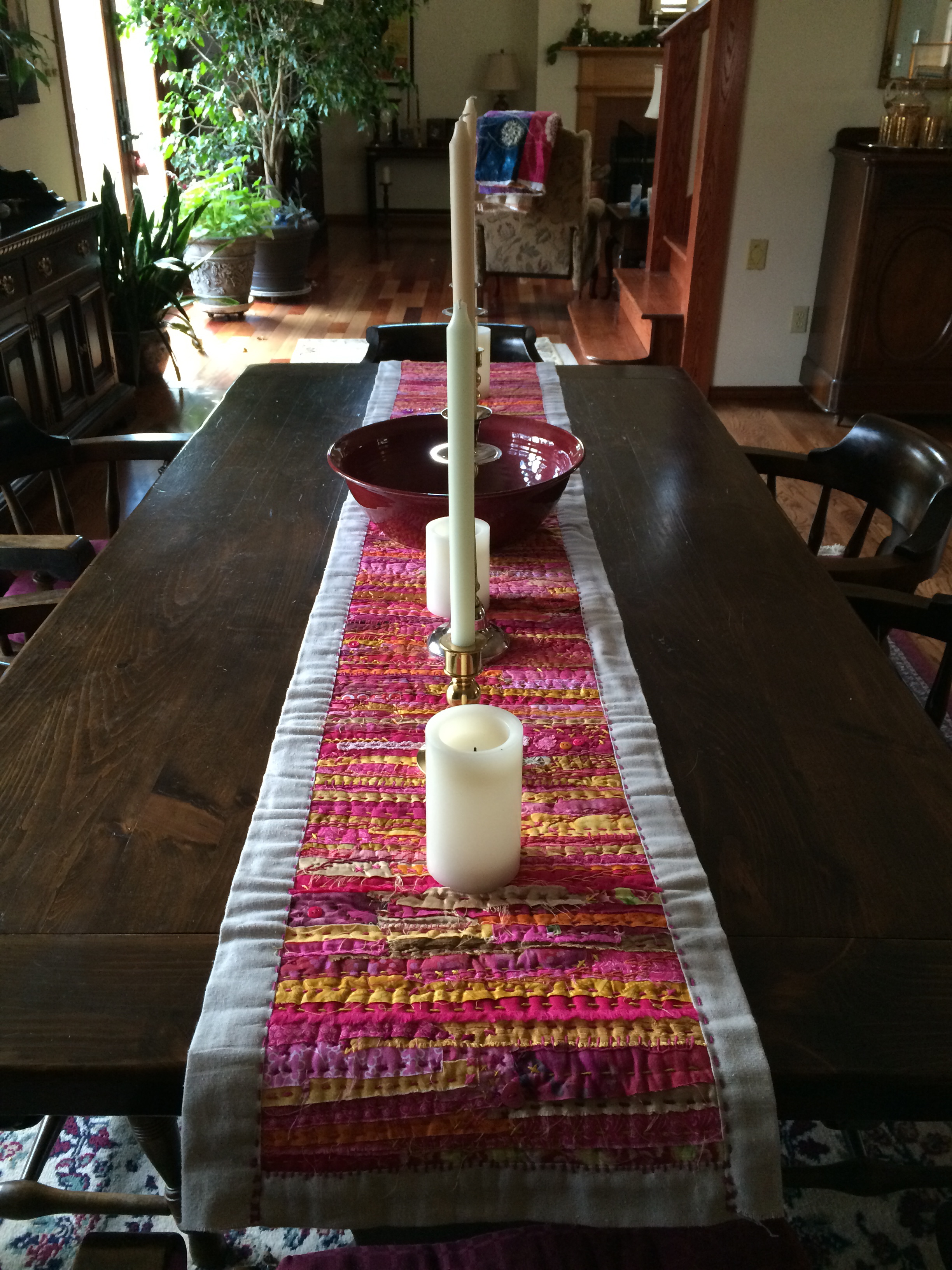
Sunset Table RunnerIMG_4951 IMG_4924 IMG_4939

The table runner matches some of her hand-thrown ceramic bowls, so she was thrilled. It’s covered in kantha stitching, blanket stitches, feather stitches, french knots, and heart stitches (which I made up). The strips of ribbon, selvages, and other scraps are fused to the batting. . .making for very stiff stitching and sticky needles. Now that I have a greater familiarity with different ways to fuse fabrics for collaging and stitching, doing something similar in future could be a much more pleasurable experience.

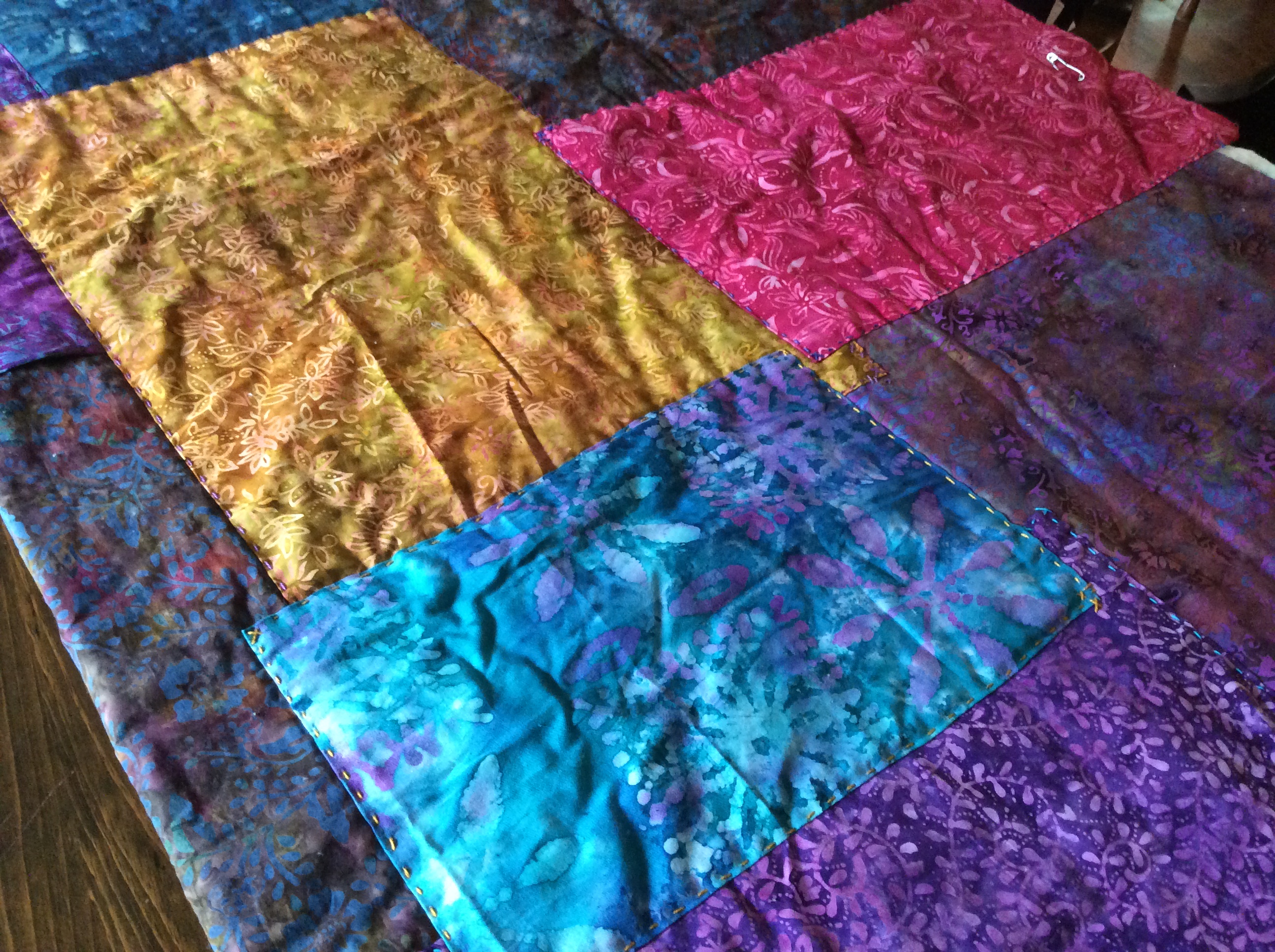
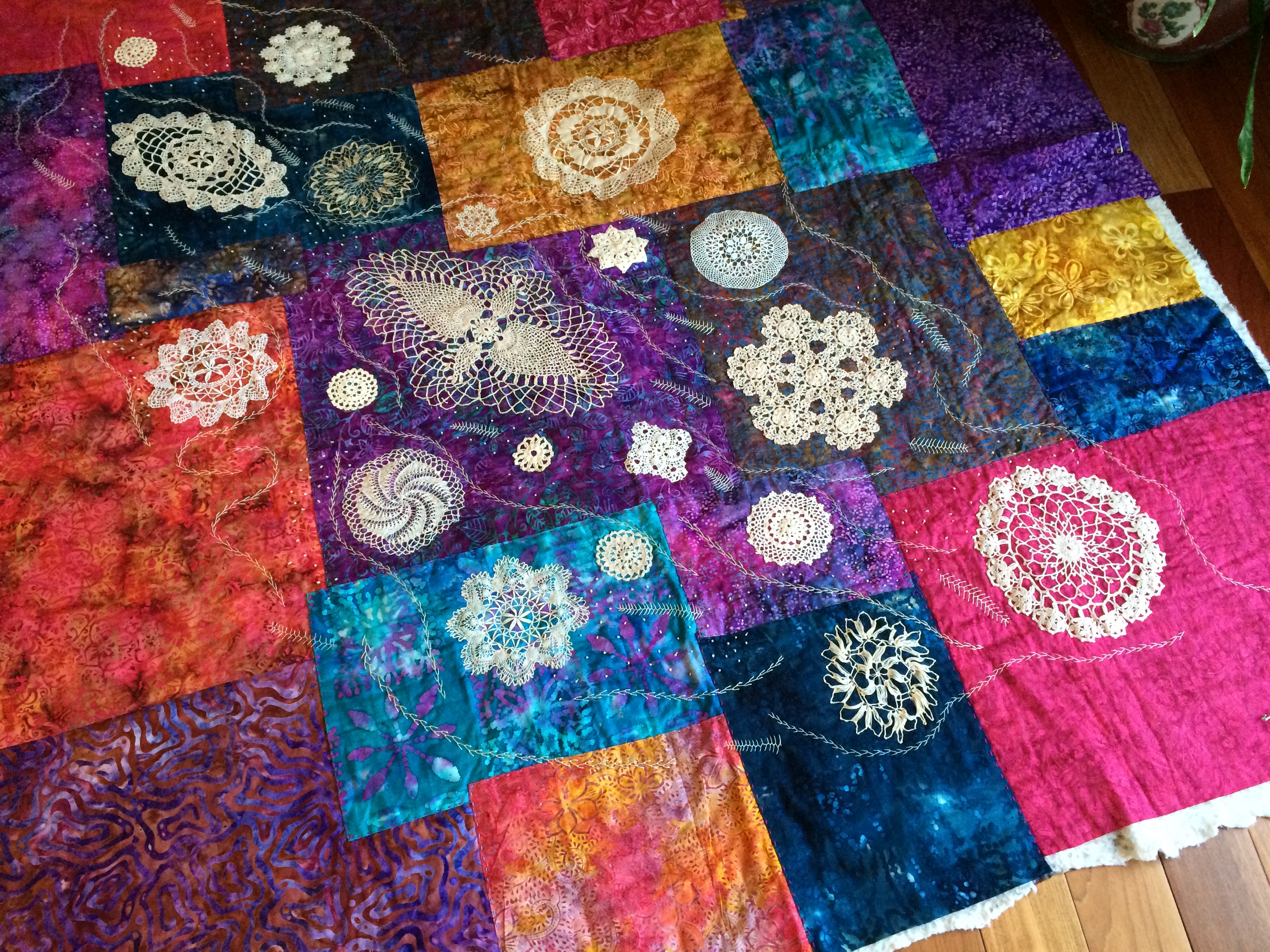
And finally, there is indeed a quilt that is taking shape slowly over the winter months. I have no idea what it will be called. Right now, there is joy in the color and playing with the stitches.
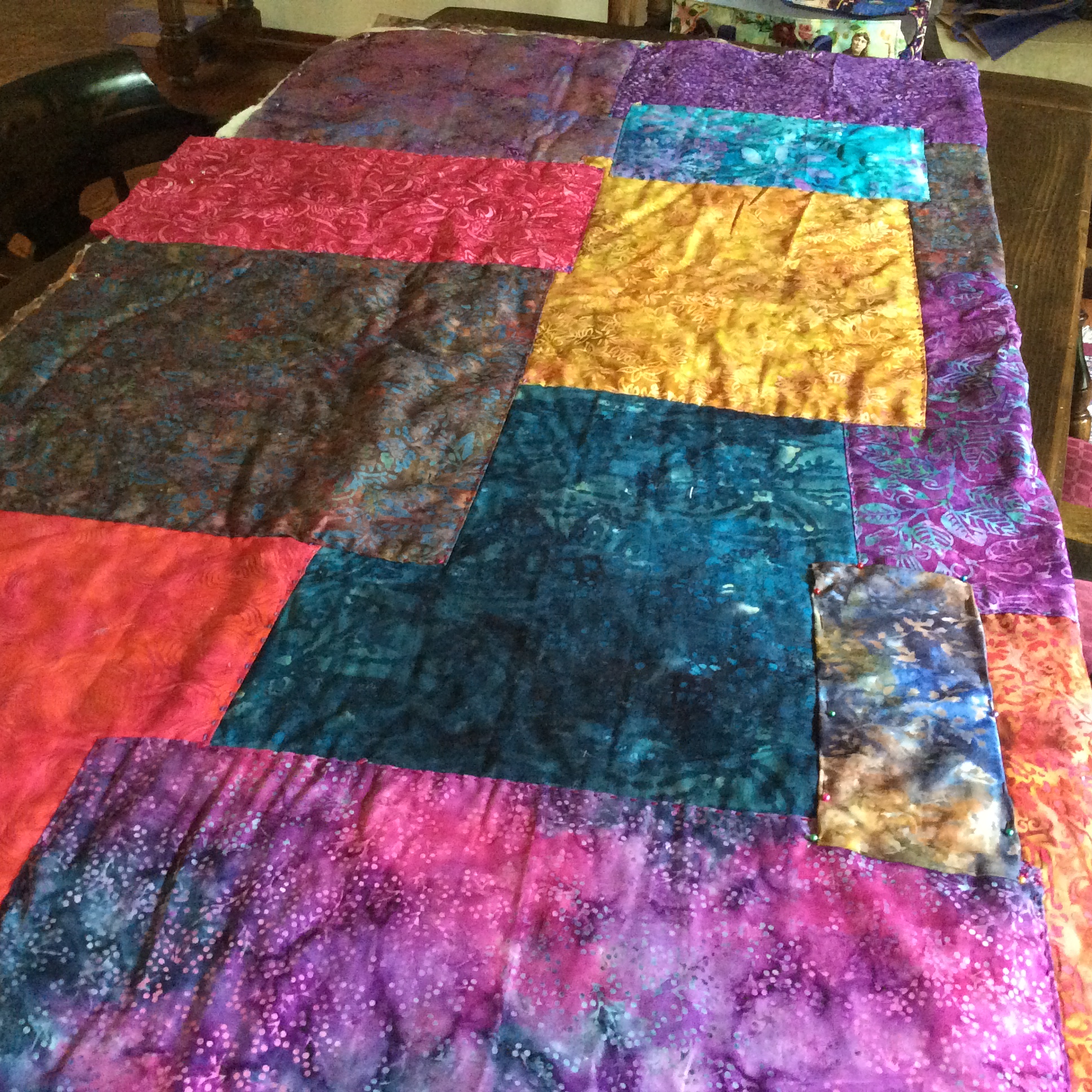
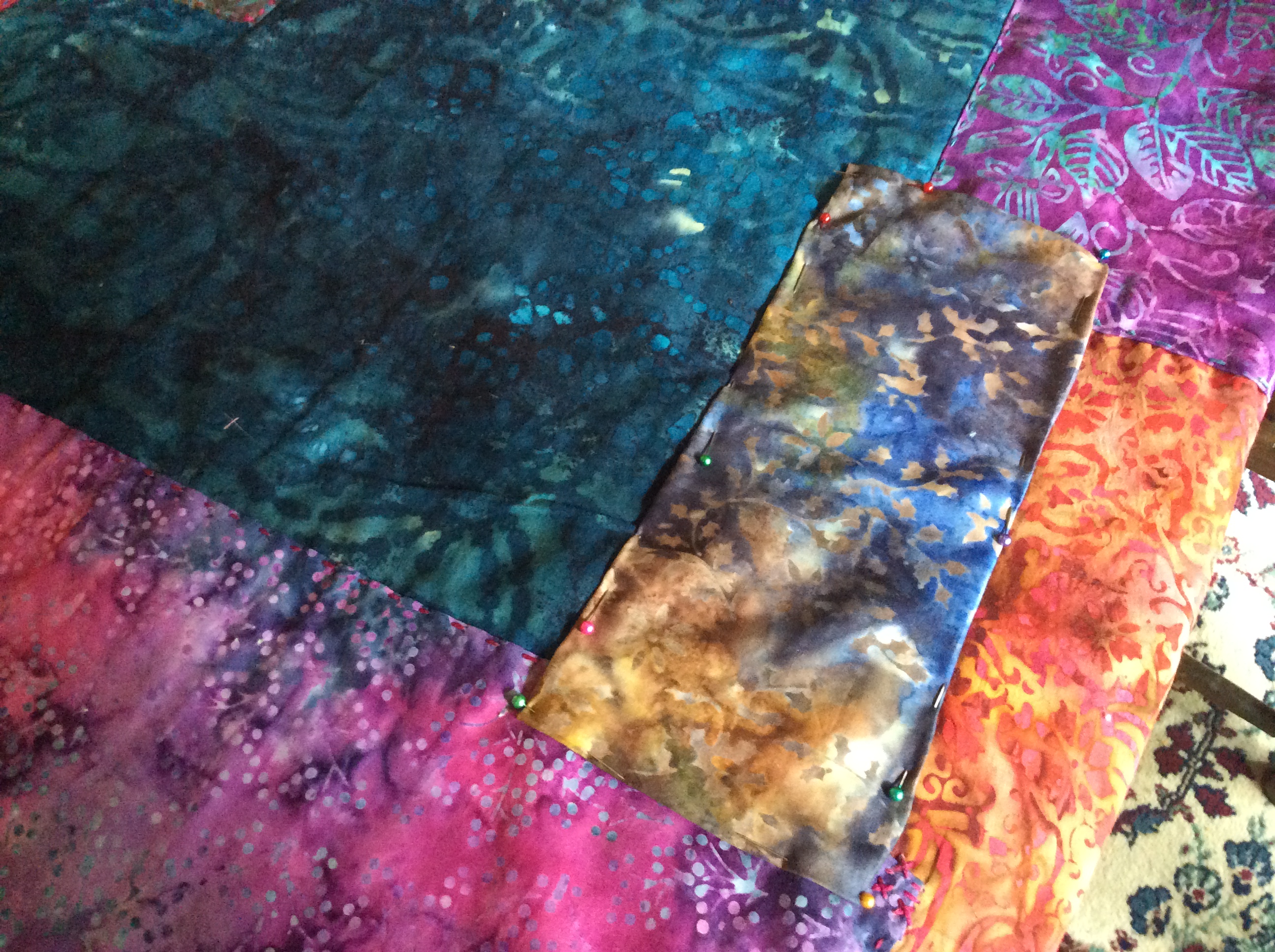
IMG_0385 IMG_0386 IMG_0388


This is another of what I refer to as a “boro-style” quilt. “Boro” means “rag” in Japanese, and traditionally they are stitched together to make quilted blankets. They’re very simple and often breath-takingly beautiful. This particular one is not making use of indigo-dyed, upcycled fabric scraps, it’s made from store-bought commercial batik fabrics. (I’m uncomfortably aware of the cultural appropriation taking place here, and its dissonance when contrasted with white, western privilege, so it’s transparently “boro-style” in this case.)  The process itself is pretty straight-forward: I choose the fabric for the backing, do any measuring and stitching, and then trim the batting and secure it to the back with basting spray, which creates a blank slate. Once the batting is secured to the back of the quilt, it’s possible to begin laying out patches of fabric and stitching them directly to the back of the quilt until it’s all covered.

Usually, the covered quilt, too, feels like a blank slate, and more quilting is needed if the patches are as large as these. For this quilt, I decided to use some old hand-made doilies collected from antique shops, estate sales, etc, and stitch them directly onto the quilt. 

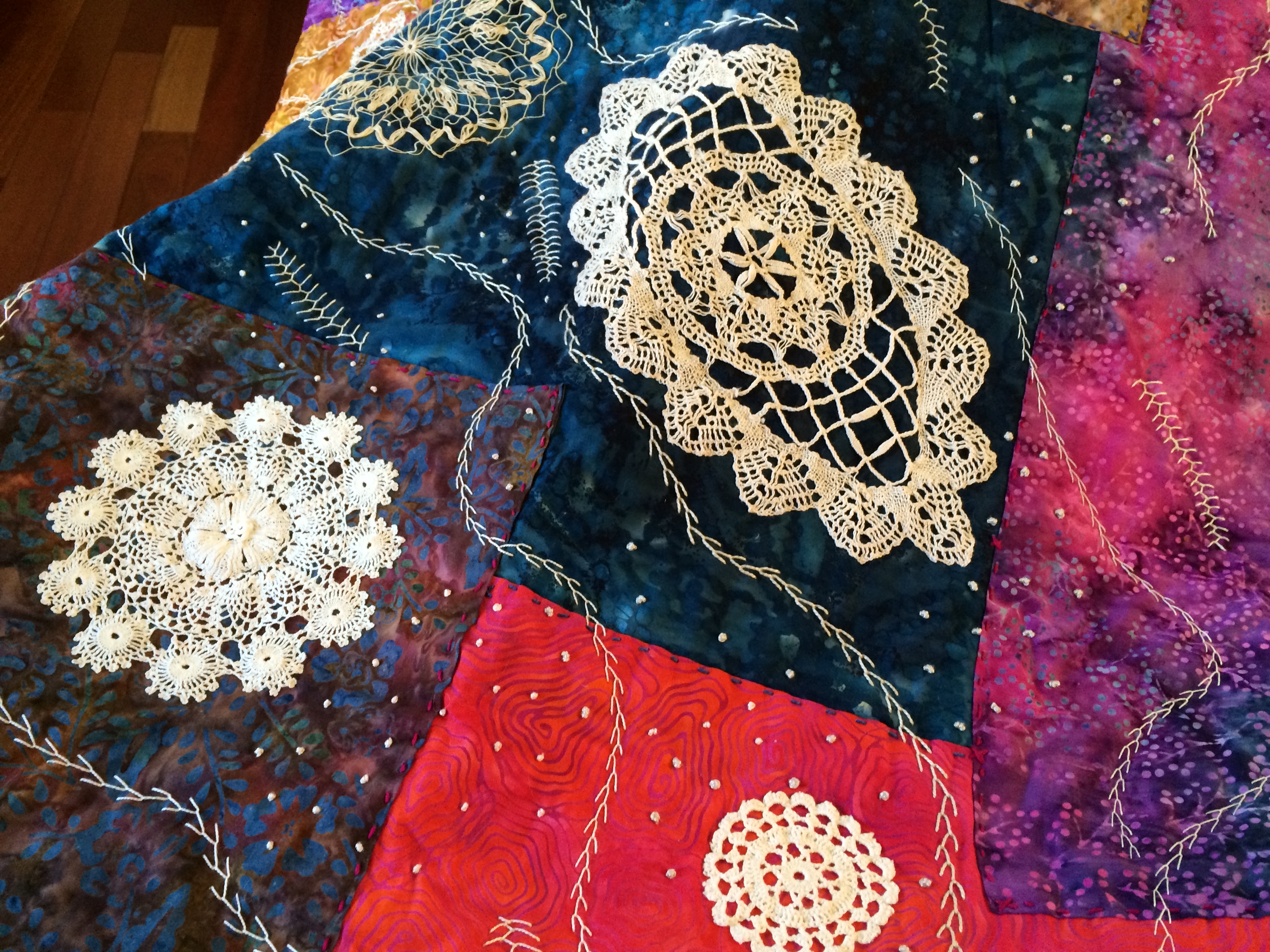
IMG_5045 IMG_5033 IMG_5049IMG_5036

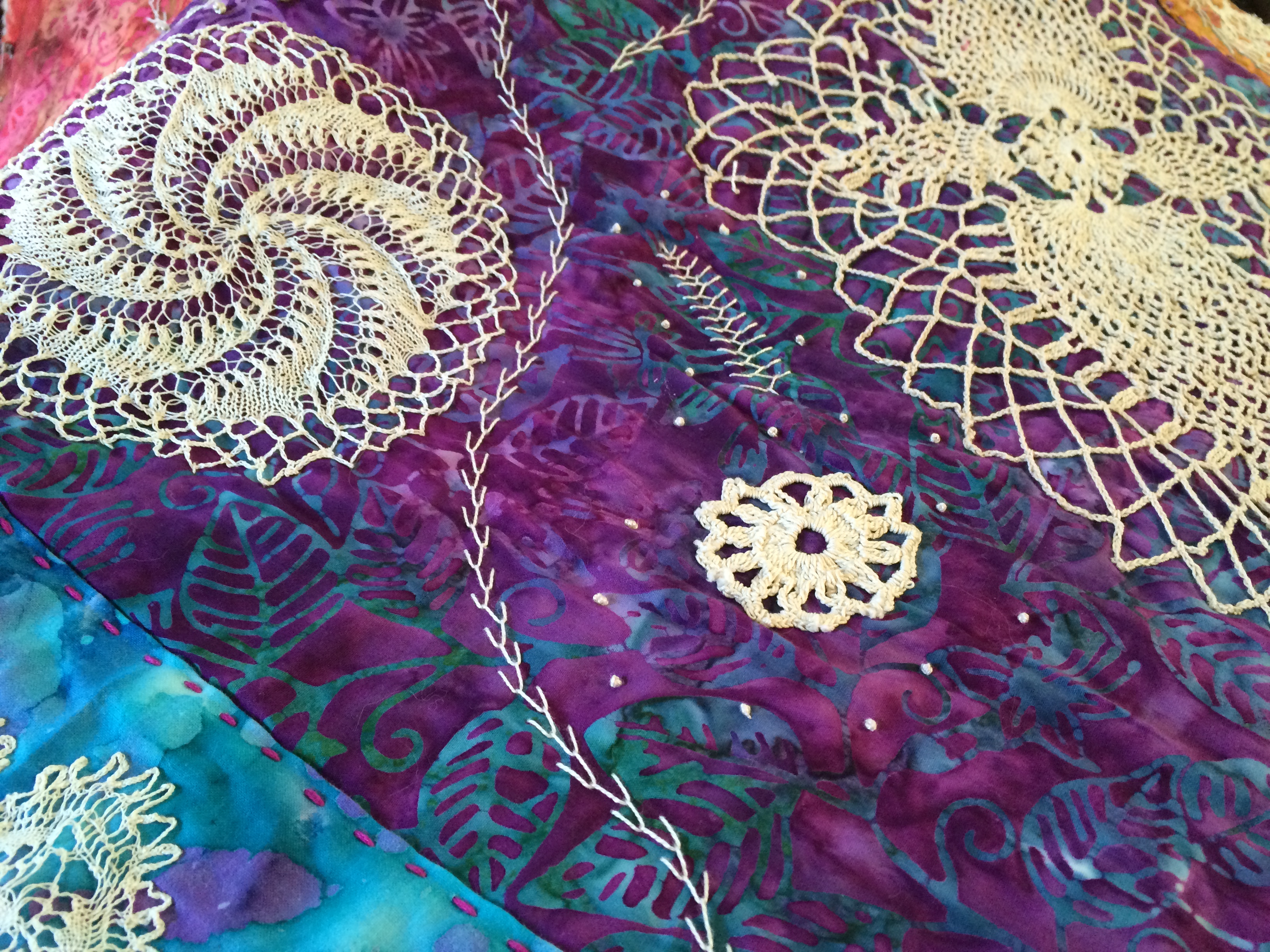
The stitches used are feather, cretan, and french knots. I like using embroidery floss and perle cotton for stitching, and I tend to use long, sharp darning needles for the job, although it depends on the weight of the thread. With many layers to stitch through, a heavier, longer needle is often really useful. It cheers me no end to work on this one. Batik fabrics are so pleasingly saturated with color!

None of these projects required stitching on a sewing machine, though some of the others this winter have. This is enough for now, however. More to come another time.


Off the Deep End

The last post was well-received on The Facebook, where many friends offered high praise, support, and comments like, “Wow — that’s so cool it makes me envy you.” Well — it seems likely that if they are the well adjusted, competent individuals I have credited them with being, they may not feel especially envious or terribly generous with praise after this update. . . *gulp*

In my last post, all was peachy keen, if a bit slow-going, and I was preparing to put the skylights in and finish the roof, all whilst listening to the dulcet tones of forest birds, embraced by nature, and charmed by the occasional owl while sitting in my loft at twilight. As my former acting teacher and colleague, Gary, would say, “What could be more fun or more wholesome?” 

That didn’t happen.

Instead, the weather forecast changed, and we were expecting cold temps and falling precipitation, which doesn’t make for a good roof-putting-on kind of weekend, really. (The owls agreed.)  Rather than being brought down by the change of plans and annoyance of yet further delays, however, I triumphantly decided to make another attempt at leveling and stabilizing the trailer. Up to this point, it’s been somewhat level, and somewhat stable. But not terribly. I had also noticed that it had shifted at some point (but clearly hadn’t taken the clue), and the jack that’s welded to the trailer was pushing up against the sheathing at the back, making it impossible to put siding there. It seemed that nothing could really be done “well” until it was fully stable and level, so I went out and bought jacks to stabilize and level the trailer, merrily took them home, and began the process.

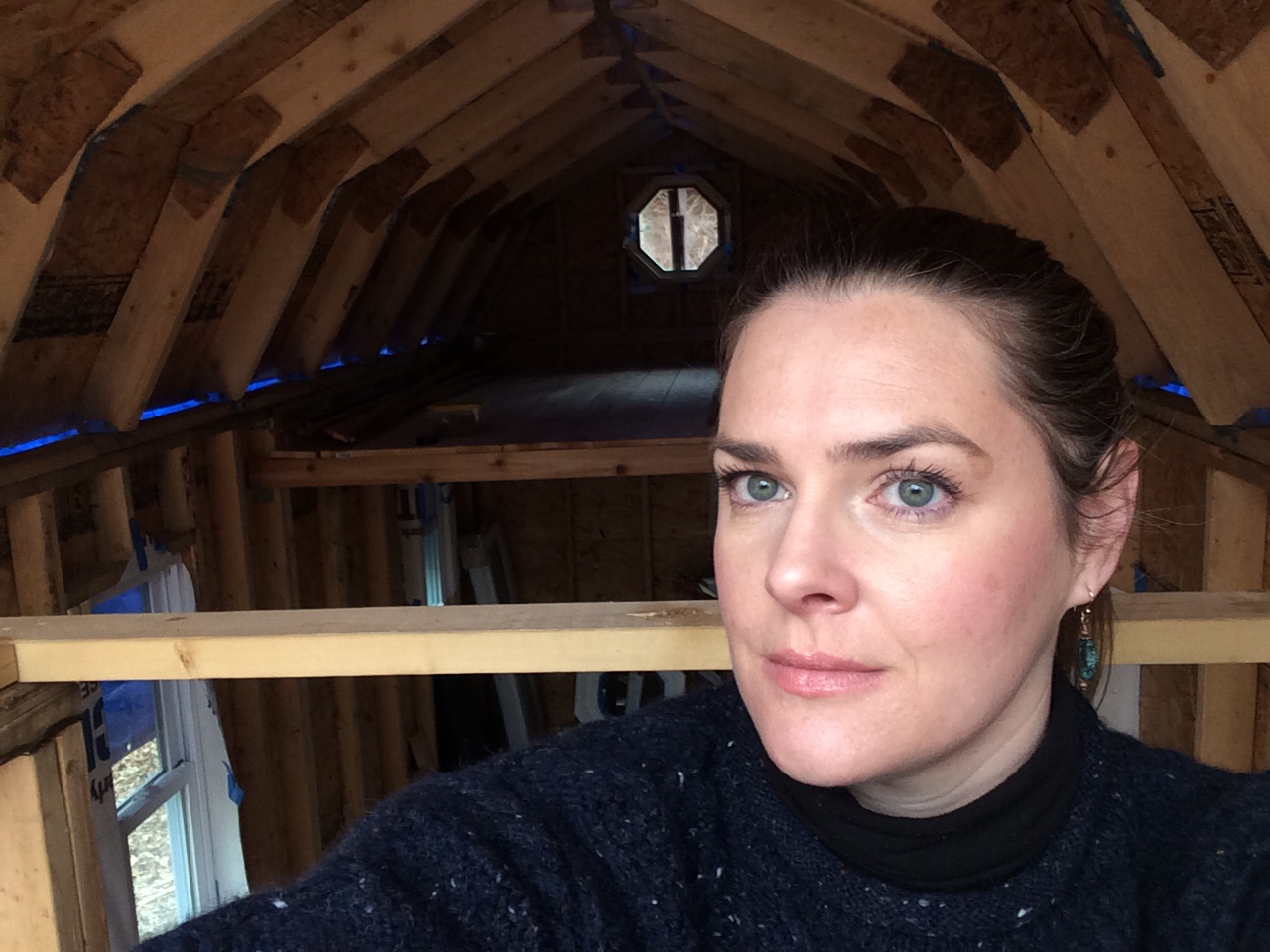
I was so merry, in fact, that I thought it would be a great time to take a selfie:

Triumphant selfie in front of the open gable.

Triumphant selfie in front of the open gable.

In short, it failed.

In fact, it was almost a complete disaster.

Just as Dad and I were making a final few adjustments before considering the whole thing something of a success, there was this . . . sound . . . like a groan . . . after which, the trailer suddenly gave way and heaved about 8 inches to the South-East, knocking me out of its way as it headed in the direction of the valley below.

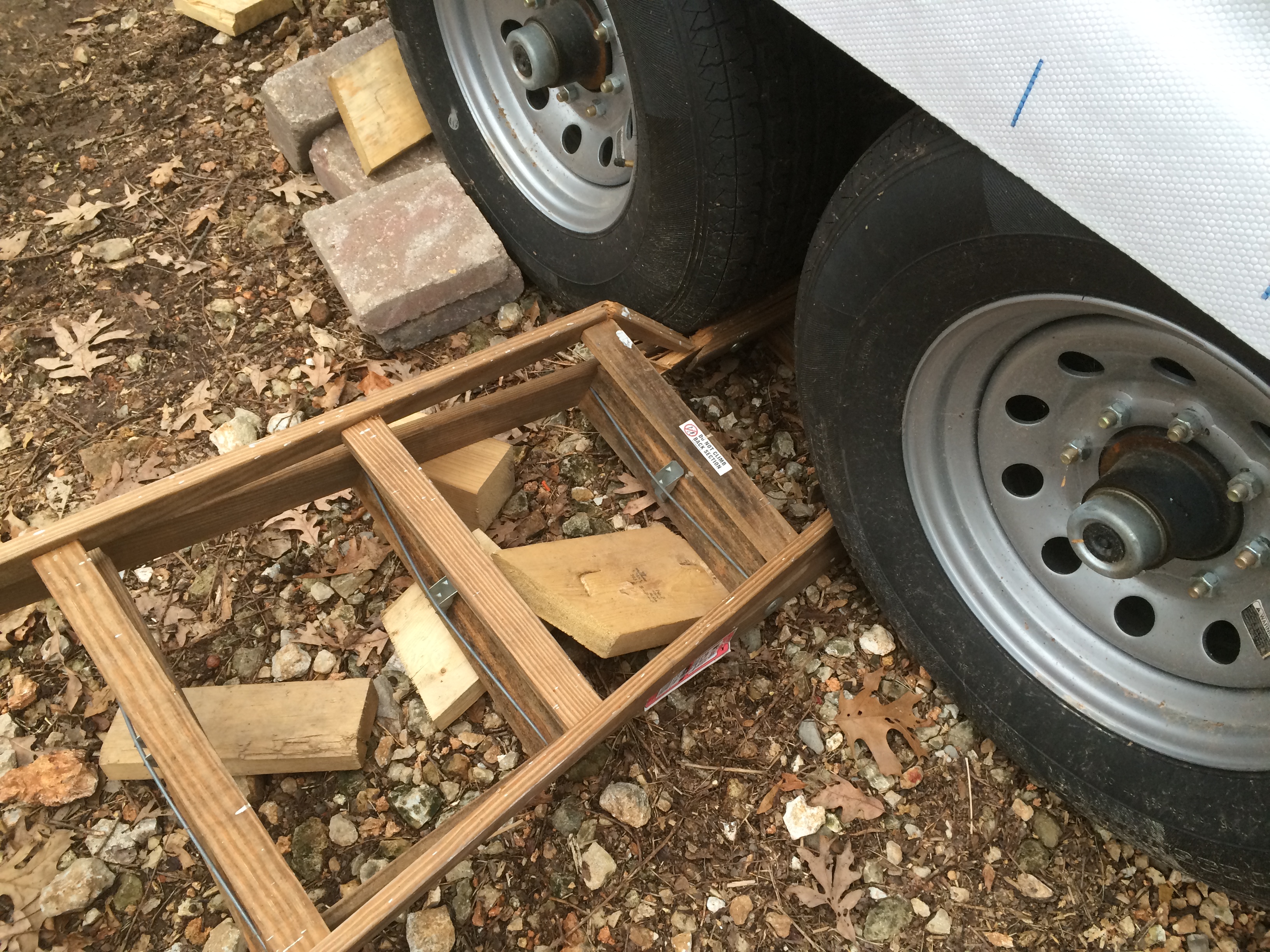
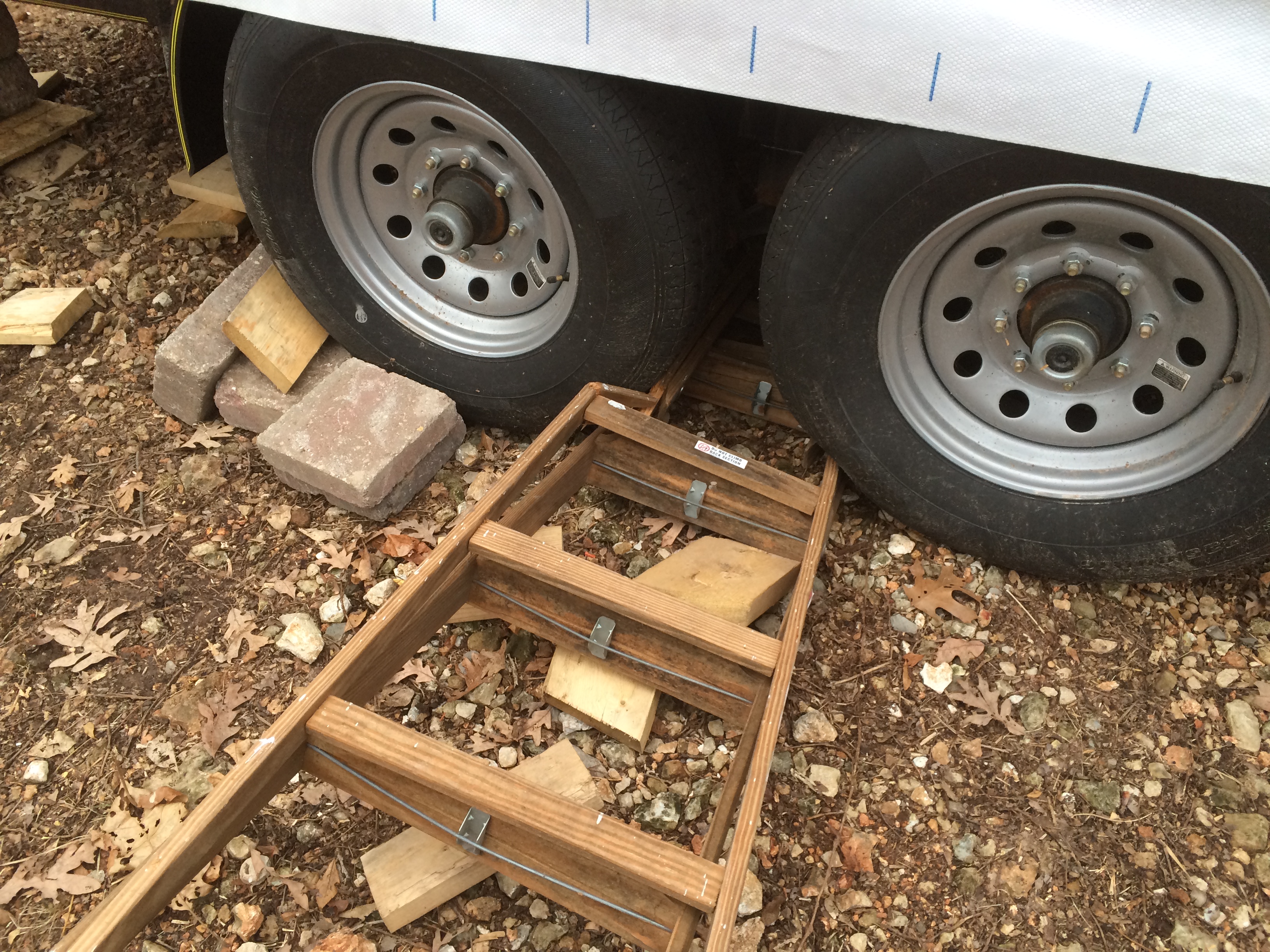
Fortunately, this ladder seems to have helped slow it down:

. . .worth taking a second picture of, right?

The ladder was crushed, but it helped stop the house from rolling into the valley. . .

IMG_4989

. . .worth taking a second picture of it, right?

It was pretty horrifying.

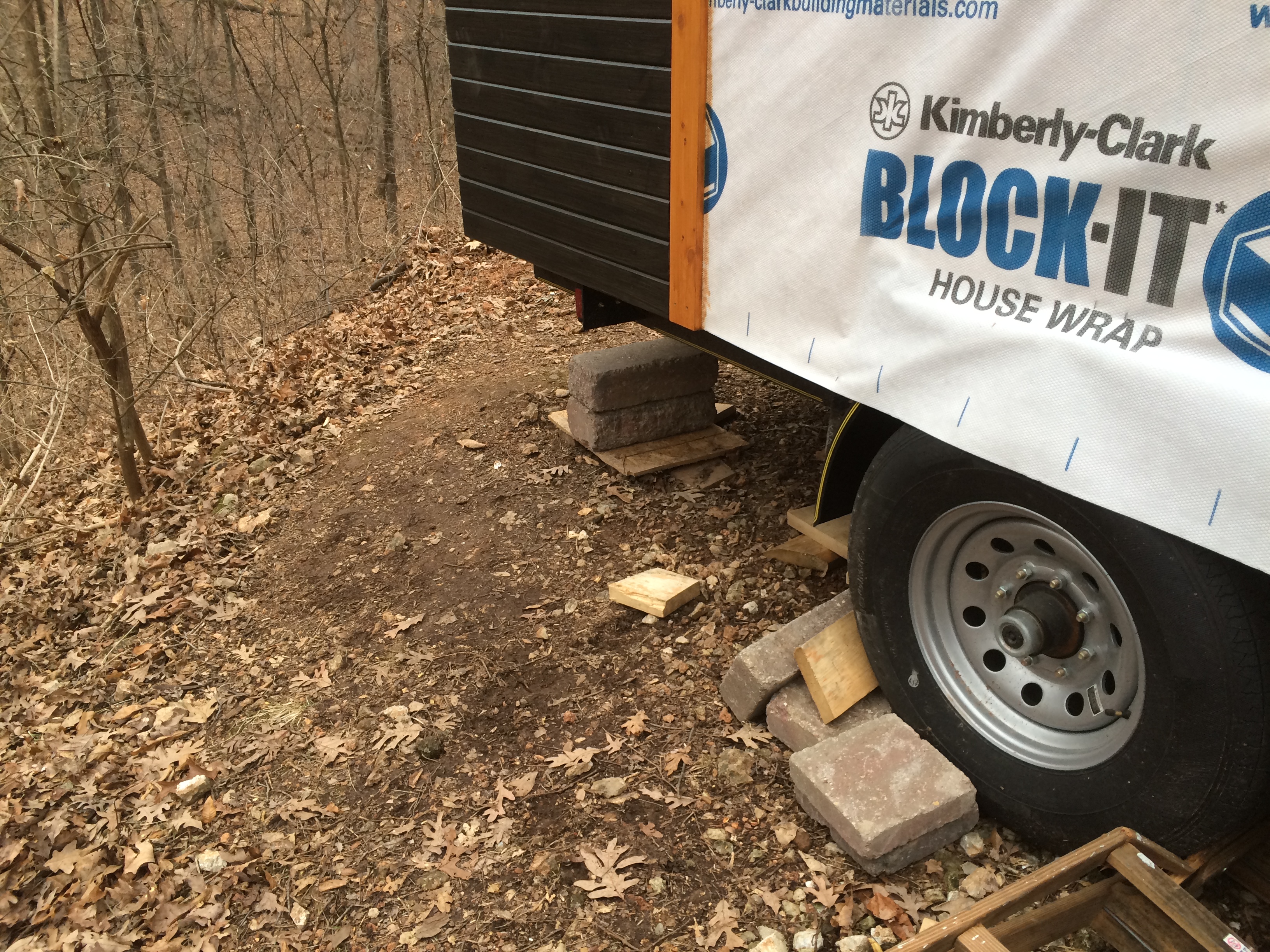
Once Dad established that I was okay (it was really more of a push out of the way) and we were sure it wasn’t going to slip further toward the valley, we started walking around scratching our heads for a bit, trying to decide what to do.  Here’s what we were looking at while we scratched:

IMG_4991


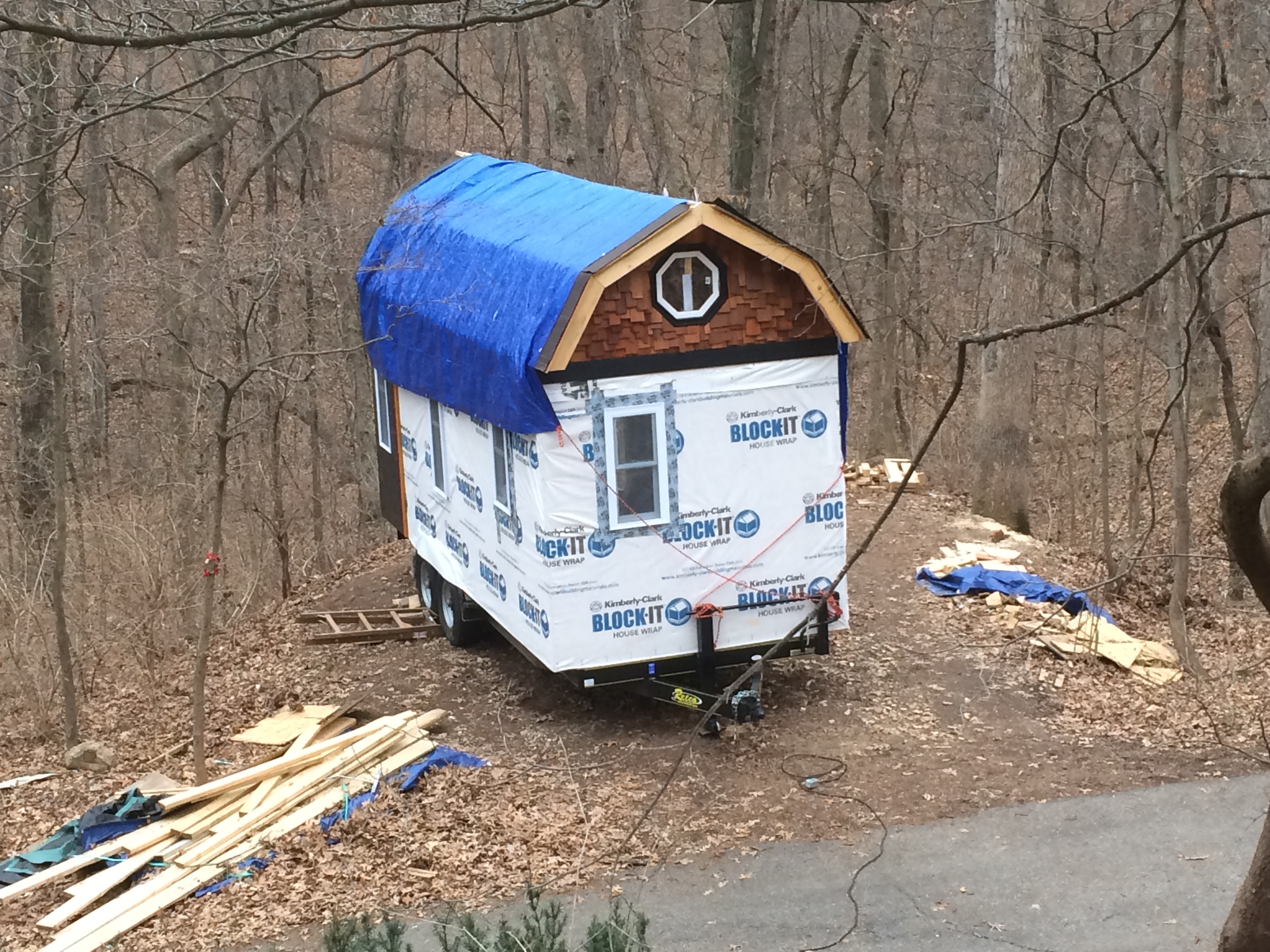
Here’s a longer-range view of the position of the trailer, which you can see is listing to the left (or South-East):

Uncomfortably close to the edge.

Uncomfortably close to the edge.

We considered many different options. Initially my dad was ready to get a winch to pull it back over to the right/South-West. I wasn’t too sure about it. I figured if he was serious, it would be wise to consult with my brother-in-law’s brother, Kevin. He owns big trucks, is a trained carpenter, has worked and/or lived on farms his entire life, and likely owns a winch. Turned out he was duck hunting that day, so we stacked blocks around the wheels, reassured ourselves that it was likely to stay put and be fine for a day or two, packed everything up, and went inside to warm up and settle our rattled nervous systems.

Although I was calm for the first few days afterward, the fact that I had nearly watched my house slide off the plateau and into the valley below eventually hit, and it made for a pretty tense week. No matter what your level of meditation practice or relative “Zen”, you’re still faced with the stark reality that the home you’ve spent the last 8 months of your life building was precariously close to being lost, and it’s really upsetting. As my father observed later on, “If that trailer had gotten any closer to the edge and had gone over into the valley, most of that work would probably have been lost, and I really don’t know how we’d go about getting it out of there.”

Here’s the thing: we didn’t have a way to engage the brakes (or ensure that the breaks are engaged) on the trailer, but it had been pretty reliably stable up to this point. There was no real reason to think it was in any danger where it was. When we initially got the dang thing up the hill in the first place (see my first blog post on the entire subject!), it was such a harrowing experience that by the end of it we felt lucky to have gotten it into a workable position at all. No amount of research, reading, consulting, planning, or ruminating will really adequately prepare you for the experience of doing something like this for the first time. We knew we would make plenty of mistakes, and we were prepared to do it anyway.

When I think of the imagery of “The Fool” (I love him) in the tarot, I see more and more often the ways I figuratively — and literally — resemble him:

"The Fool", Rider-Waite Tarot Deck

“The Fool”, Rider-Waite Tarot Deck

The intention, of course, would be to embody the archetype this way:

"The Fool", Rumi Tarot Deck

“The Fool”, Rumi Tarot Deck. “Be foolish, so that your heart may be at peace.”

Or even this way:

I honestly have no idea who to credit this one to.

I honestly have no idea who to credit this one to, but it’s SO COOL.

BUT — when all’s said and done, I think this is likely the most realistic depiction of what was going on:

I could do this even without the high heels, though.

I would be capable of this even in my bare feet some days. . .

All fools aside, though, after a solid 24 hours to think it through, dad had a new plan: call someone who moves and repositions mobile homes, and get them to come and move the tiny house. Seemed like a good plan, right?  Why not trust the experts? Probably much safer than winching the tiny house back up to a safer position, and far less likely to damage the axles in the process. After making several phone calls over a few days, we found someone willing to take it on: Jeffrey Day.

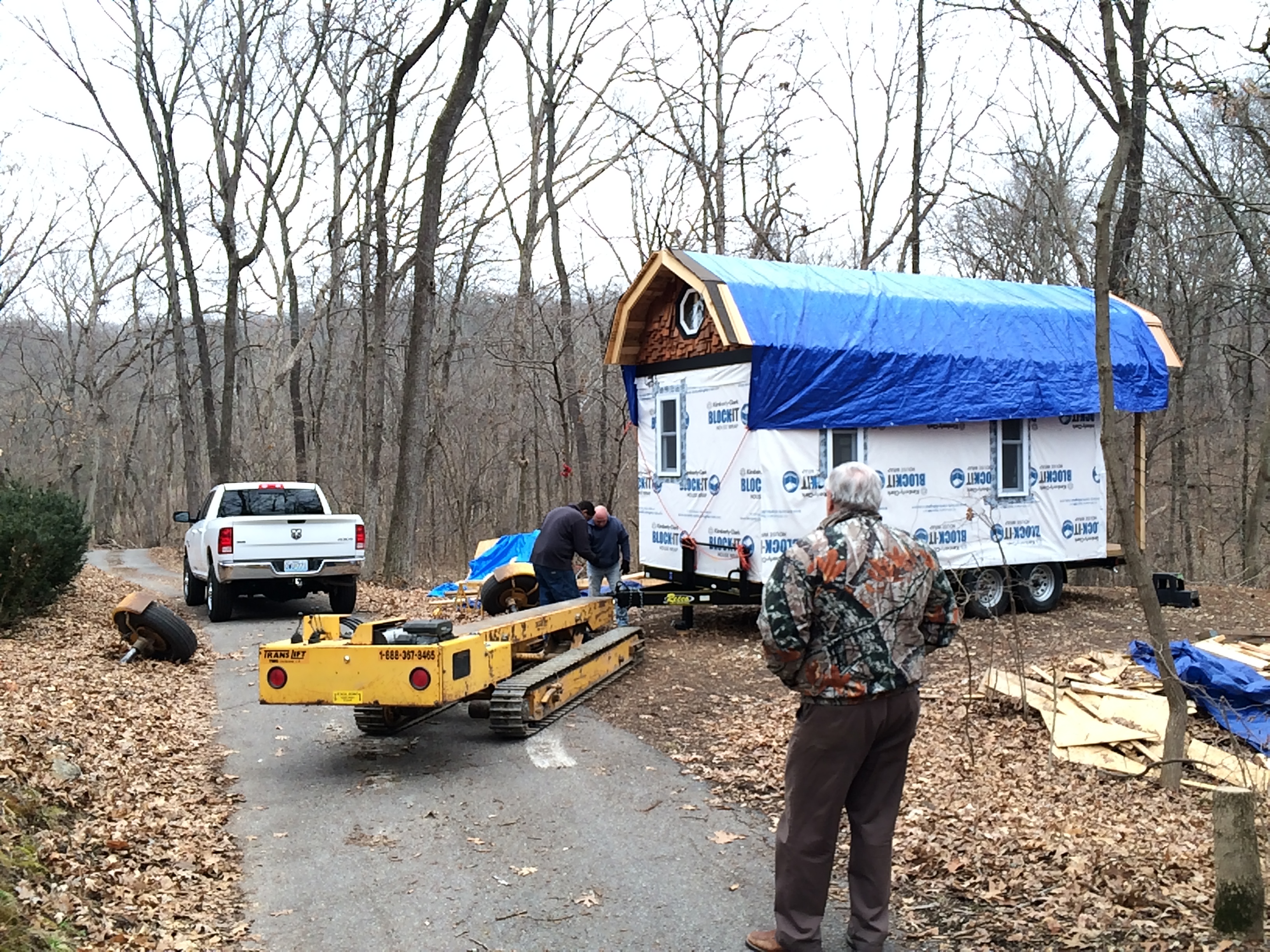
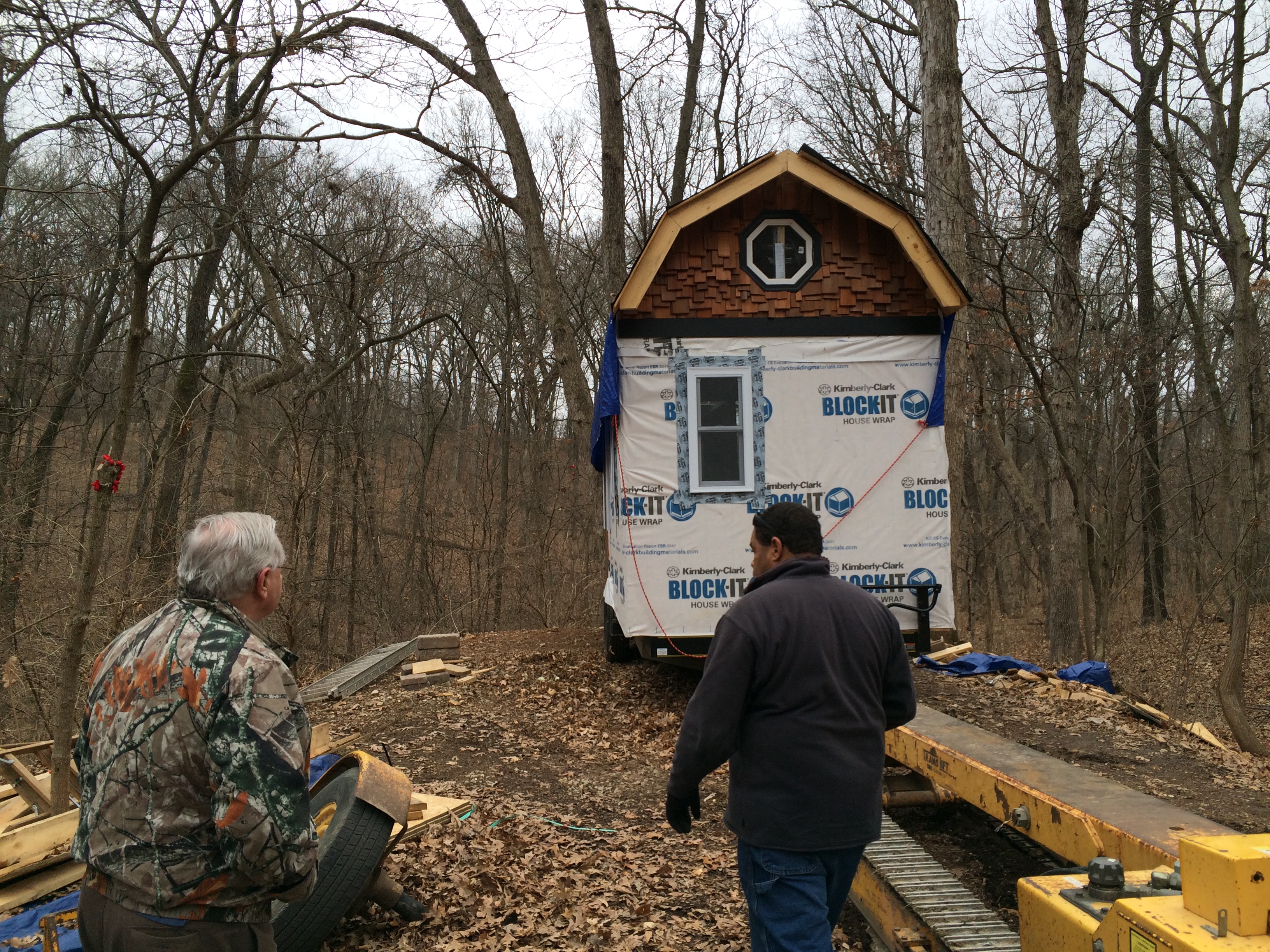
Jeffrey was unbelievably competent, and came armed with a piece of machinery that enabled him to reposition the tiny house as though it were a tinker toy. Check it out:

Jeffrey Day, his assistant, David, and the "Trans Lift".

Jeffrey Day, his assistant, David, and the “Trans Lift”. Dad is there in the foreground, observing.

I videoed the entire move, which took 2 minutes and 56 seconds, including moving the crushed ladder out of the way. (I hope to get it uploaded to YouTube in the near future. . .) Once it was re-positioned, mostly what they had to do was rock it back and forth to get the tires off the ground and stabilized at the right level, and put the TransLift back in its “on the road” mode. Then it was putting blocks under the corners of the trailer to ensure its level-ness and overall stability, which has been greatly improved, not to mention how much safer it will be to work on the left side of the house. So, while I’m confident that there will be plenty more mistakes made before it’s finished and ready to move into, the good news is that I will also be all the more likely to live to tell about it!

The trailer in its more stable position on the plateau overlooking the valley.

The trailer in its more stable position on the plateau overlooking the valley.

To give you some idea of the difference in position, as you look to the left in the above picture, where you see the aluminum ladder and stack of blocks is right about where it was sitting after it slipped.

And that’s pretty much it for the moment.

. . .never a dull moment, though, is there?